Plotting Points on a Graph Grid (Grade 12 NSC Matric Mathematical Literacy): Revision Notes
📚Revision Notes
Plotting Points on a Graph Grid
What are ordered pairs?
Ordered pairs help us locate specific points on a coordinate grid with precision. Each ordered pair contains exactly two numbers that work together to pinpoint a location. The first number tells us the horizontal position, while the second number indicates the vertical position.
The sequence of these numbers matters greatly. For example, if 5 apples cost R4, we write this as the ordered pair (5, 4). The first number (5) represents the horizontal movement, and the second number (4) represents the vertical movement.
Note
The order in ordered pairs is crucial! Changing the sequence from (5, 4) to (4, 5) would completely change the point's location on the grid. Always remember: horizontal first, then vertical.
Understanding the coordinate system
A coordinate grid consists of two perpendicular lines called axes. The horizontal line running left to right is called the horizontal axis or x-axis. The vertical line running up and down is called the vertical axis or y-axis. These axes intersect at a point called the origin, marked as (0, 0).
Coordinates are the individual numbers within an ordered pair. The first coordinate shows how far to move along the horizontal axis, whilst the second coordinate shows how far to move up the vertical axis.
Step-by-step plotting process
To plot any point on a coordinate grid, follow these systematic steps:
- Begin at the origin - Start at point (0, 0) where the axes meet
- Move horizontally first - Count the required number of spaces along the horizontal axis
- Move vertically second - From your horizontal position, move up the required number of spaces
- Mark the point - Draw a dot or cross where the grid lines intersect
This process ensures accuracy every time you plot points on a graph.
Example
Worked Example: Plotting the point (5, 4)
Let's plot the point representing "5 apples cost R4":
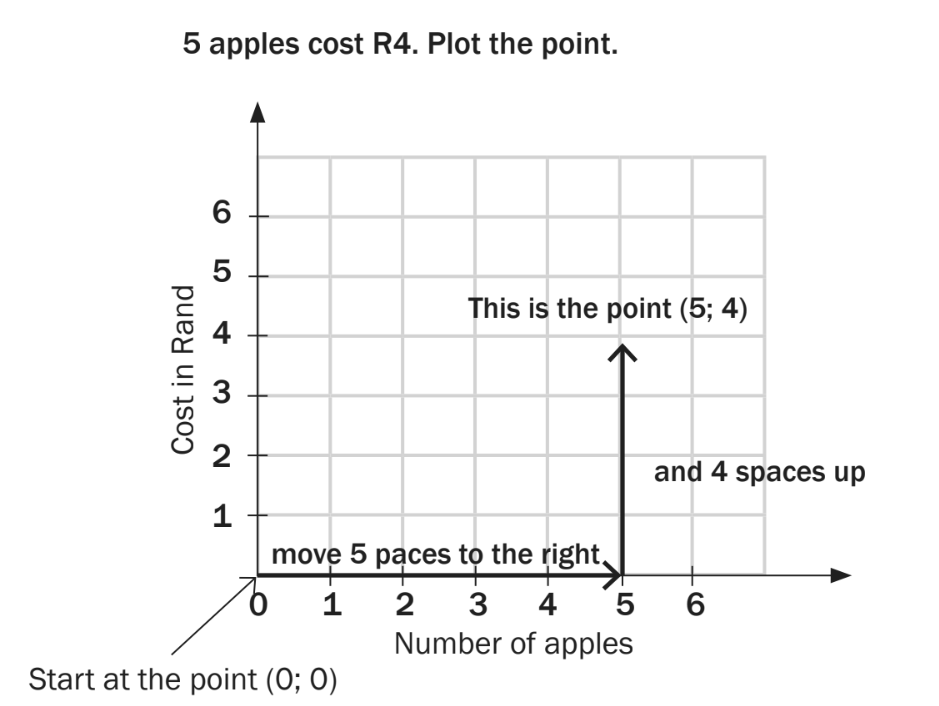
Step 1: Start at the origin (0, 0)
Step 2: Move 5 spaces to the right along the horizontal axis
Step 3: Then move 4 spaces up along the vertical axis
Step 4: Mark the point where these movements intersect
Result: You have successfully plotted the point (5, 4)
Variables in coordinate systems
Understanding which variable goes on which axis helps create meaningful graphs:
Independent variable - This variable stands alone and isn't affected by other factors in your study. Plot the independent variable on the horizontal axis. In our apple example, the number of apples is independent because we choose how many to buy.
Dependent variable - This variable changes based on the independent variable. Plot the dependent variable on the vertical axis. The cost depends on how many apples we buy, making it the dependent variable.
Important
Critical Concept: Always identify which variable is independent and which is dependent before creating your graph. This determines which axis each variable should be plotted on. Getting this wrong will make your graph misleading or incorrect.
Key definitions
- Ordered pair: Two numbers written in a specific sequence to show the location of a point on a grid
- Coordinate: Each individual number within an ordered pair
- Horizontal coordinate: The first number, showing position along the x-axis
- Vertical coordinate: The second number, showing position along the y-axis
- Plotting points: The process of marking positions on a grid using ordered pairs
Important
Common Mistakes to Avoid:
- Never move vertically first - always start with horizontal movement
- Don't confuse the order of coordinates in ordered pairs
- Remember to start every plotting exercise at the origin (0, 0)
- Ensure you're placing the correct variable on the appropriate axis
Summary
Key Points to Remember:
- Ordered pairs give exact positions on coordinate grids using two numbers in a specific order
- Always move horizontally first, then vertically when plotting points
- The independent variable goes on the horizontal axis, the dependent variable on the vertical axis
- Start at the origin (0, 0) for every plotting exercise
- The sequence of numbers in an ordered pair cannot be changed without altering the point's location