Games of Chance (Grade 12 NSC Matric Mathematical Literacy): Revision Notes
📚Revision Notes
Games of Chance
What are games of chance?
Games of chance are activities that use random events to help us understand probability better. These games work with unpredictable outcomes, making them useful for learning how to use probabilities to predict events.
When we play games of chance like tossing coins or throwing dice, we can make predictions based on what we know about the possible outcomes.
Key definitions you need to know
Note
Essential Vocabulary for Games of Chance:
- Frequency: The number of times that something happens
- Random: When something happens without being made to happen on purpose
- Trial: A test or single attempt. Throwing a dice and tossing a coin are examples of trials
- Fair: Treated equally, without having an advantage or disadvantage
- Theoretical probability: The calculated probability based on mathematical reasoning, not the actual result from experiments
Understanding coin tosses
When you toss a coin, there are only two possible outcomes:
- Heads (H)
- Tails (T)
Each outcome has an equal chance of occurring. We can predict that:
- The probability of getting heads = = 0.5 = 50%
- The probability of getting tails = = 0.5 = 50%
The more times you toss the coin, the closer your actual results will get to these theoretical probabilities.
Understanding dice throws
When you throw a standard six-sided die, there are 6 possible outcomes: 1, 2, 3, 4, 5, 6
Each number has an equal probability of of coming up.
If you want to find the probability of getting an even number (2, 4, or 6), you need to:
- Count the favourable outcomes: 2, 4, 6 (that's 3 outcomes)
- Count the total possible outcomes: 6
- Calculate: = 0.5 = 50%
This is much bigger than the chance of throwing just one specific number.
Theoretical probability vs experimental probability
Important
Understanding the Two Types of Probability:
Theoretical probability is what we calculate mathematically. For example, the theoretical probability of getting heads on a coin toss is .
Experimental probability (or relative frequency) is what actually happens when you do the experiment. For example, if you toss a coin 10 times and get heads 3 times, the relative frequency is .
As you increase the number of trials, your experimental results should get closer to the theoretical probability.
'Yes' and 'no' outcomes
When looking for a particular outcome, we can think about:
- 'Yes' outcome: Getting what we want (e.g., getting a 4 on a die has probability )
- 'No' outcome: Not getting what we want (e.g., not getting a 4 has probability )
Notice that the probabilities of 'yes' and 'no' outcomes always add up to 1.
Worked example 1
Example
Worked Example: Calculating Different Probabilities
Let's look at different probability scenarios:
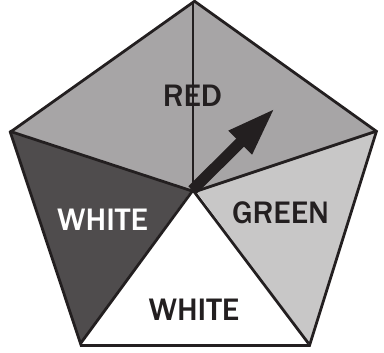
a) Getting any odd number when throwing a dice once
- Odd numbers on a die: 1, 3, 5 (3 numbers)
- Total possible outcomes: 6
- Probability =
b) Getting a 3 when throwing a dice with 8 faces
- Favourable outcomes: 1 (just the number 3)
- Total possible outcomes: 8
- Probability =
c) Spinner landing on red
- Red sections: 2 out of 5 total sections
- Probability =
d) Taking out a purple T-shirt from a pile with 1 blue, 3 green, and 2 purple T-shirts
- Purple T-shirts: 2
- Total T-shirts: 1 + 3 + 2 = 6
- Probability =
Fair and unfair games
What makes a game fair?
A fair game is one where there is an equal chance of winning or losing. This means the probability of winning equals the probability of losing.
What makes a game unfair?
Some games are designed to be unfair:
- Casino games are designed so players have a small chance of winning
- Games can be weighted towards one player (usually the house) so that person wins more often
- Changing the rules can make a game less fair
Important
Important Exam Tip:
Remember that there is no such thing as luck! The chances always remain the same for each individual trial, regardless of what happened before.
Worked example 2
Example
Worked Example: Roulette Betting Scenario
A gambler bets money on getting the number 20 on a roulette wheel in a casino. There are 36 numbers on the wheel.
a) What are her chances of losing the bet?
- To lose the bet means not getting a 20
- The number 20 is one number out of 36
- Numbers that are NOT 20: 35 out of 36
- Probability of losing =
b) She noticed that 20 has come up often in previous spins. Does this mean 20 is more likely to come up now?
No! The probability of not getting a 20 is always 97.2%. Each spin is random, and previous results have no effect on future events.
Summary
Key Points to Remember:
- Games of chance help us understand probability by using random events
- Theoretical probability is calculated, while experimental probability is what actually happens in trials
- Each trial in a fair game is independent - previous results don't affect future outcomes
- Fair games give equal chances to all players, while unfair games favour certain outcomes
- Always express probabilities as fractions, decimals, and percentages when asked in exams