Linear Functions (Grade 12 NSC Matric Mathematics): Revision Notes
📚Revision Notes
Linear Functions
Introduction to inverse functions
An inverse function reverses the effect of the original function. When you have a function that transforms input values into output values, its inverse function transforms those output values back to the original input values. For linear functions of the form , finding the inverse involves a systematic algebraic process.
The inverse of a function is written as . It's important to understand that the inverse function "undoes" what the original function does. If a function maps a value from its domain to its range, the inverse function maps that same value back from the range to the domain.
Note
The notation does not mean . The is not an exponent in this context - it specifically indicates the inverse function. This is a common source of confusion for students.
Finding inverse functions
General method for y = axe + q
To find the inverse of any linear function in the form , follow this systematic approach:
- Interchange x and y: Replace every with and every with in the original equation
- Make y the subject: Solve the new equation to express in terms of
- Express in function notation: Write the final answer using inverse function notation
The general result is that if , then the inverse function is:
This formula shows that if a linear function is invertible, its inverse will also be linear.
Important
For a function to have an inverse, it must be one-to-one (injective). All linear functions with are one-to-one, so they all have inverses. If , the function becomes constant and does not have an inverse.
Step-by-step process
Let's explore this method using detailed worked examples to ensure you understand each stage of the process.
Example
Worked Example 1: Finding the inverse of p(x) = -3x + 1
Step 1: Set up the equation
Start with:
Step 2: Interchange x and y
Replace with and with :
Step 3: Make y the subject
Solve for :
Step 4: Express in function notation
Therefore:
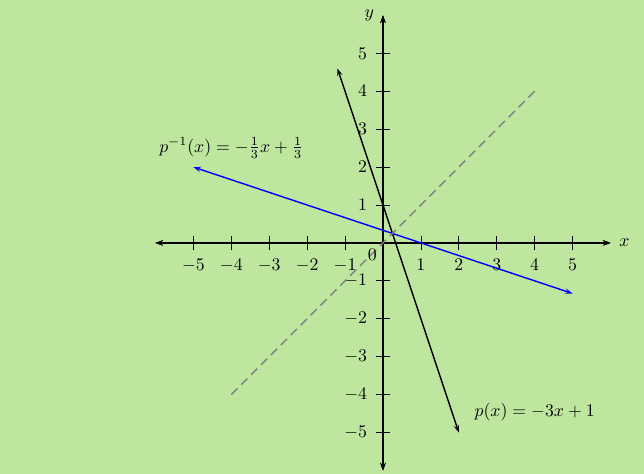
The graph above shows both the original function and its inverse . Notice how they are reflections of each other about the line .
Example
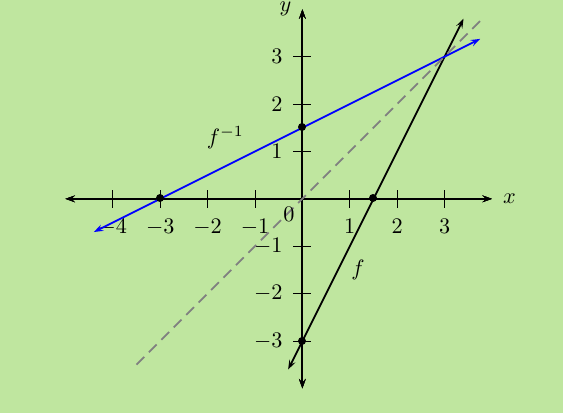
Worked Example 2: Finding the inverse of f(x) = 2x - 3
Step 1: Set up and interchange
Starting with:
Interchange and :
Step 2: Solve for y
Step 3: Function notation
Therefore:
Properties of inverse functions
Domain and range relationship
Understanding how domain and range behave with inverse functions is crucial for exam success.
For a linear function :
- Domain: (all real numbers)
- Range: (all real numbers)
When you find the inverse function:
- Domain of : (same as range of original function)
- Range of : (same as domain of original function)
Important
The domain and range swap positions when you move from a function to its inverse. This is a fundamental property that applies to all invertible functions, not just linear ones.
Intercepts relationship
The relationship between intercepts of a function and its inverse follows a specific pattern that's very useful in exams.
For a linear function (where ):
Finding intercepts of the original function:
- y-intercept: Set , so . Point:
- x-intercept: Set , so , which gives . Point:
Finding intercepts of the inverse function :
- y-intercept: Set , so . Point:
- x-intercept: Set , so , which gives . Point:
Note
Key insight: The intercepts are mirror images of each other. The x and y coordinates swap positions between the function and its inverse. This provides an excellent way to check your work!
Graphical relationship
The most important visual property of inverse functions is their reflexion relationship.
The graph of is the reflexion of the graph of about the line . This means:
- Every point on the graph of corresponds to the point on the graph of
- The line acts as a "mirror" between the two graphs
- Both graphs will intersect the line at the same points
This reflexion property is extremely useful for checking your work and understanding the relationship between functions and their inverses visually.
Note
If you're having trouble visualising this reflexion, try plotting a few points from the original function, then plot their "swapped" coordinates. You'll see how the inverse function emerges as the reflexion about .
Exam tips and common mistakes
Important
Common exam traps:
- Forgetting to interchange and at the beginning
- Making algebraic errors when solving for
- Not expressing the final answer in proper function notation
- Confusing domain and range relationships
- Writing when you mean
Problem-solving approach:
- Always start by clearly writing
- Systematically interchange variables
- Carefully solve for using proper algebraic techniques
- Double-check by substituting values
- Verify that
Note
Quick verification method: If , then should equal . Use this to check your inverse function. This is called the inverse function property and it's a reliable way to verify your answer.
Summary
Key Points to Remember:
- Finding inverses: Interchange and , make the subject, then use function notation
- Domain and range swap: The domain of becomes the range of , and vice versa
- Intercepts mirror: The intercepts of and have swapped and coordinates
- Graphical reflection: is the reflexion of about the line
- Linear inverses: If the original function is linear and invertible, the inverse is also linear
- Verification: Always check that and