Summary (Grade 12 NSC Matric Mathematics): Revision Notes
📚Revision Notes
Summary
Analytical geometry combines algebra and geometry to solve problems using coordinates and equations. This summary covers all the essential formulas and concepts you need for your NSC Mathematics exam.
Basic coordinate geometry formulas
These fundamental formulas form the building blocks of analytical geometry. You'll use them constantly throughout your exam.
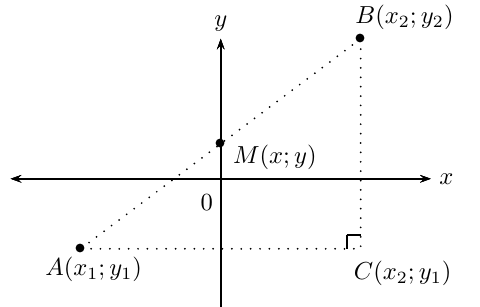
Theorem of Pythagoras
For any right-angled triangle with sides AC and BC, and hypotenuse AB:
This theorem helps you find distances between points and is the foundation for the distance formula.
Distance formula
To find the distance between two points A() and B():
Note
Remember: Always subtract the coordinates in the same order and square the differences before adding them under the square root.
Gradient (slope)
The gradient measures how steep a line is. For two points A() and B():
Think "rise over run" - the change in y-values divided by the change in x-values.
Midpoint formula
To find the midpoint M between two points A() and B():
Simply add the coordinates and divide by 2 for each axis.
Collinear points
Three or more points lie on the same straight line when:
All gradients between any two points must be equal.
Straight line equations
Different forms of line equations are useful for different situations. Choose the most appropriate form based on the information given.
Two-point form
When you know two points () and () on the line:
Gradient-point form
When you know the gradient m and one point ():
Gradient-intercept form
When you know the gradient m and y-intercept c:
This is often the most useful form for graphing and analysis.
Special cases
- Horizontal lines: (gradient = 0)
- Vertical lines: (gradient is undefined)
Note
Choosing the right equation form: Use the two-point form when you have two points, gradient-point form when you have one point and the gradient, and gradient-intercept form for general analysis and graphing.
Parallel and perpendicular lines
Understanding the relationship between lines is crucial for many analytical geometry problems.
Parallel lines
Lines are parallel when they have the same gradient and never intersect:
- Same gradients:
- Same angles with x-axis:
Perpendicular lines
Lines are perpendicular when they meet at right angles:
- Product of gradients:
- Angle relationship:
Important
Exam tip: If one line has gradient , a perpendicular line has gradient . This is one of the most commonly tested relationships!
Circle geometry essentials
Inclination of a straight line
The gradient of a line equals the tangent of its angle with the positive x-axis:
Circle equations
Circle with centre at origin (0; 0):
General circle with centre (a; b):
Where r is the radius of the circle.
Tangent properties
Note
Key tangent properties:
- A tangent touches a circle at exactly one point
- The radius is perpendicular to the tangent at the point of contact
This perpendicular property is often tested in exam questions involving tangents.
Worked example: Finding intersection points
Example
Worked Example: Finding Line-Circle Intersections
Question: Find where the line intersects the circle .
Solution:
Step 1: Substitute the line equation into the circle equation:
Step 2: Expand:
Step 3: Simplify:
Step 4: Factorise:
So or
Step 5: Find y-coordinates:
- When :
- When :
Step 6: Answer: The intersection points are and .
Summary
Key Points to Remember:
- Distance formula: - essential for finding lengths
- Parallel lines have equal gradients:
- Perpendicular lines: (product of gradients equals negative one)
- Midpoint: Add coordinates and divide by 2
- Circle at origin: ; General circle: