Ratio and Proportion (Grade 12 NSC Matric Mathematics): Revision Notes
📚Revision Notes
Ratio and Proportion
Understanding ratios
A ratio is a way of comparing two quantities that have the same units. When you see a ratio, you're looking at how one measurement relates to another measurement of the same type. Ratios are incredibly useful in mathematics because they help us understand relationships and make comparisons.
The key thing to remember about ratios is that they show relative size, not actual size. Think of a ratio as telling you "for every this much of one thing, there's that much of another thing."
Important
Critical Properties of Ratios:
When working with ratios, keep these important properties in mind:
- Ratios have no units - once you create a ratio, the units cancel out
- Ratios should be written in simplest form - always reduce to the lowest terms
- Ratios compare quantities of the same kind - you can't compare apples to metres!
Writing ratios
You can express the same ratio in several different ways. For example, if a rectangle has a length of 20 cm and width of 60 cm, you can write the ratio of length to width as:
- length to width = 20 to 60
- length : width = 20 : 60
- length/width = 20/60 = 1/3
All of these expressions tell us the same thing: for every 1 unit of length, there are 3 units of width.
Example
Worked Example: Simplifying Ratios
Question: A rectangle has length 50 cm and width 150 cm. Express the ratio of length to width in simplest form.
Solution: Step 1: Write the ratio as a fraction
Step 2: Find the highest common factor (HCF) of 50 and 150
HCF of 50 and 150 = 50
Step 3: Divide both numbers by the HCF
Step 4: Write the final answer
length : width = 1 : 3
This means for every 1 unit of length, there are 3 units of width.
Understanding proportions
Proportion describes the equality of ratios. When two or more ratios are equal to each other, we say they are in the same proportion. This concept is fundamental to solving many geometry problems.
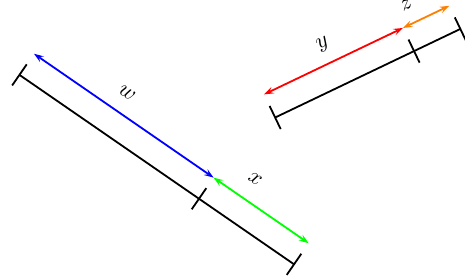
The diagram above shows parallel lines cut by transversals, creating proportional segments. This is a common setup in geometry problems.
When ratios are equal
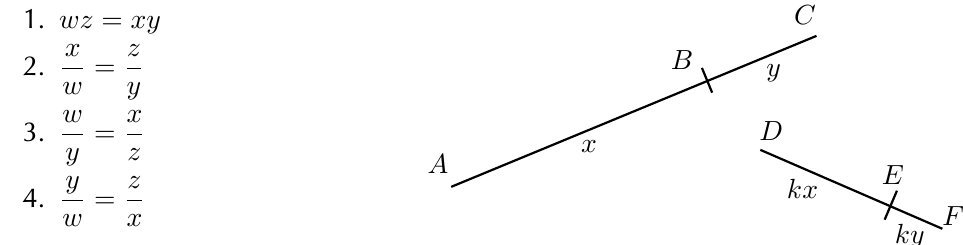
If , then we say that w and x are in the same proportion as y and z.
Note
Four Equivalent Forms of Proportion:
This relationship can be expressed in four equivalent ways:
- (cross multiplication)
- (reciprocal proportion)
- (alternative proportion)
- (another reciprocal form)
Different forms of proportional relationships
Understanding the various ways to express proportions is crucial for solving problems efficiently.
There are three equivalent forms:
- Basic proportion:
- Reciprocal proportion:
- Cross multiplication:
Cross multiplication method
Cross multiplication is one of the most powerful tools for solving proportion problems. When you have a proportion , you can cross multiply to get .
Example
Worked Example: Solving Proportions
Question: Solve for p:
Solution: Step 1: Cross multiply
Step 2: Solve for p
Step 3: Check your answer
and ✓
Example
Worked Example: Geometric Proportions
Question: In the diagram below, if AB = 12, BC = 18, DE = 54, and EF = 36, show that .
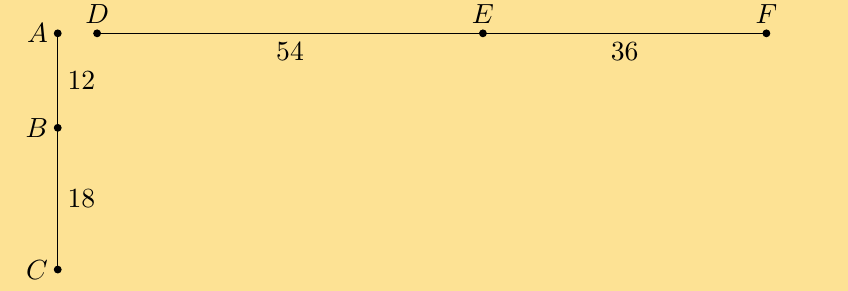
Solution: Step 1: Calculate
Step 2: Calculate \
Step 3: Compare the ratios
Since , we have shown that
This demonstrates that the segments are proportional.
Example
Worked Example: Real-World Proportions
Question: A mixture contains 2 parts of substance A for every 5 parts of substance B. If the total weight is 50 kg, how much of substance B is in the mixture?
Solution: Step 1: Understand the ratio
Substance A : Substance B = 2 : 5
Total parts = 2 + 5 = 7 parts
Step 2: Find the weight of one part
Weight of one part =
Step 3: Calculate substance B
Substance B =
Practical applications
Proportions appear everywhere in real life and geometry. They help us:
- Scale drawings and maps
- Calculate missing measurements in similar figures
- Solve mixture problems
- Work with rates and ratios
- Understand growth patterns
Note
Exam Tips:
- Always check if your ratios are in simplest form
- When cross multiplying, be careful with your arithmetic
- Look for parallel lines in geometry diagrams - they often create proportional segments
- Remember that ratios have no units, but the original quantities do
- Practice identifying which quantities should be compared in word problems
Summary
Key Points to Remember:
- Ratios compare quantities of the same type and have no units once formed
- Proportions are equal ratios - when two ratios are equivalent, they're proportional
- Cross multiplication is your main tool for solving proportion equations: if , then
- Always simplify ratios to their lowest terms for the clearest representation
- Check your work by substituting back into the original proportion to verify your solution