The Fundamental Counting Principle (Grade 12 NSC Matric Mathematics): Revision Notes
📚Revision Notes
The Fundamental Counting Principle
Introduction
When we need to count large numbers of possible outcomes, simple methods like listing all possibilities become impractical. The fundamental counting principle provides a systematic mathematical approach to determine the total number of possible outcomes when multiple events occur together.
This principle is essential in probability theory because it allows us to calculate the size of sample spaces without having to enumerate every single possibility.
Definition and basic formula
Important
The fundamental counting principle states that when you have multiple independent events occurring in sequence, you multiply the number of possible outcomes for each event to find the total number of possible outcomes.
Definition: If there are possible outcomes for event A and possible outcomes for event B, then there are possible outcomes when both events A and B occur together.
Formula for multiple events
For any number of independent events, the principle can be extended:
- Two events: Total outcomes =
- Multiple events: Total outcomes =
where represent the number of possible outcomes for each respective event.
Choices without repetition
When different events have different numbers of possible outcomes, we multiply these numbers together. This commonly occurs when making selections from different categories.
Example
Worked Example: Meal Combinations
Question: A restaurant offers a lunch special with four components. Calculate the total number of different meals possible.

Solution:
Step 1: Identify the number of events There are 4 meal components: sandwich, soup, dessert, and drink.
Step 2: Count the choices for each component
- Sandwiches: 4 options
- Soups: 3 options
- Desserts: 2 options
- Drinks: 5 options
Step 3: Apply the fundamental counting principle
Total possible meals =
Therefore, there are 120 different possible meal combinations.
Example
Worked Example: Dice and Coin Combination
Question: What is the total number of possible outcomes when rolling a die and tossing a coin?
Solution:
Step 1: Identify the events
- Event A: Rolling a die (outcomes: 1, 2, 3, 4, 5, 6)
- Event B: Tossing a coin (outcomes: heads, tails)
Step 2: Count the outcomes
- Die: 6 possible outcomes
- Coin: 2 possible outcomes
Step 3: Apply the principle
Total outcomes = possible combinations
The sample space contains: (1,H), (1,T), (2,H), (2,T), (3,H), (3,T), (4,H), (4,T), (5,H), (5,T), (6,H), (6,T)
Choices with repetition
When the same set of choices is available for multiple events, we use the formula , where is the number of choices and is the number of times the choice is made.
Important
Formula for Repetition: When you have objects to choose from and you choose times (with repetition allowed), the total number of possibilities is:
Example
Worked Example: Coin Flips
Question: If a coin is flipped three times, how many different sequences of outcomes are possible?
Solution:
Step 1: Identify the repeated event
Each coin flip has 2 possible outcomes: heads (H) or tails (T).
Step 2: Count the number of repetitions
The coin is flipped 3 times.
Step 3: Apply the formula
Total outcomes =
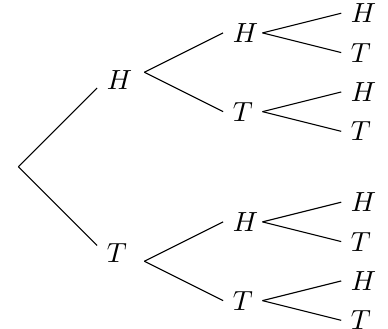
The tree diagram confirms there are 8 possible sequences: HHH, HHT, HTH, HTT, THH, THT, TTH, TTT.
Example
Worked Example: Letter Arrangements
Question: Using the letters A, B, C, and D, how many three-letter patterns can be formed if repetition is allowed?
Solution:
Step 1: Identify the available choices
There are 4 letters: A, B, C, D.
Step 2: Count the positions
We need to fill 3 positions in the pattern.
Step 3: Apply the formula
Since repetition is allowed, each position can be filled with any of the 4 letters.
Total patterns =
Examples include: AAA, ABC, BAD, DCA, etc.
Example
Worked Example: Sports Results
Question: A school plays 6 football matches. Each match can result in a win, draw, or loss. How many different sequences of results are possible?
Solution:
Step 1: Identify the outcomes per event
Each match has 3 possible outcomes: win, draw, or loss.
Step 2: Count the number of events
There are 6 matches.
Step 3: Apply the formula
Total sequences =
Tree diagrams vs counting principle
Tree diagrams are useful visual tools for small numbers of outcomes, but they become impractical as the number of events increases.
Note
When to use tree diagrams:
- Few events (typically 3 or fewer)
- Need to see all possible outcomes clearly
- Working with conditional probability
When to use the counting principle:
- Large numbers of outcomes
- Quick calculation needed
- Multiple independent events
- Exam situations requiring efficient solutions
Example: For 6 coin flips, a tree diagram would have endpoints, making it extremely complex to draw. The counting principle gives the answer immediately: .
Important
Critical Exam Points:
- Order matters: The fundamental counting principle assumes that the order of events is significant.
- Independence: The events must be independent - the outcome of one event doesn't affect the outcomes available for other events.
- Systematic approach: Always identify the number of events first, then count outcomes for each event, then multiply.
- Check your work: Ensure you've correctly identified whether repetition is allowed or not.
Summary
Key Points to Remember:
- The fundamental counting principle states: multiply the number of possible outcomes for each independent event to find the total outcomes
- For different choices: multiply the number of options for each event
- For repeated choices: use the power formula where = number of choices and = number of repetitions
- Tree diagrams become impractical with many events - use the counting principle for efficiency
- Always check whether repetition is allowed before choosing your approach