Adaptations (HSC SSCE Biology): Revision Notes
📚Revision Notes
Adaptations
What are adaptations?
Adaptations are inherited features that help living things survive in their environment. These characteristics develop through a process of evolutionary change driven by natural selection. Australian plants and animals have evolved remarkable adaptations that allow them to thrive in some of the harshest conditions on Earth, from the freezing Snowy Mountains to the scorching central deserts.
An adaptation is a characteristic that an organism has inherited from its parents, which makes it better suited to survive in the environment where it lives. It's important to understand that organisms don't intentionally develop adaptations. Living things cannot choose to change themselves to match their surroundings, nor can they deliberately produce offspring with helpful new features.
Important
Critical Concept: Organisms do not intentionally develop adaptations. Living things cannot choose to change themselves to suit their environment, nor can they deliberately produce offspring with new helpful features. Adaptations arise through random chance, not conscious choice.
How do adaptations arise?
Adaptations develop through random changes that occur during reproduction. When cells divide and replicate to create new organisms, small variations can arise by chance. These random differences might turn out to be beneficial, making the organism better suited to its environment. If this happens, the organism has a better chance of surviving and reproducing, which means it can pass the helpful variation on to its own offspring through gametes (reproductive cells).
Note
The Process of Adaptation Over many generations, beneficial adaptations become more common in a population through natural selection. An organism's chances of survival are often improved by multiple adaptations working together rather than just one single feature.
Types of adaptations
Scientists classify adaptations into three main categories based on what aspect of the organism they affect:
Structural adaptations
Structural adaptations relate to how an organism is physically built. These are the features you can observe in an organism's body structure, such as:
- Body shape and size
- Specialized body parts (like claws, wings, or fins)
- Colour and patterns
- Internal organs and their arrangement
Physiological adaptations
Physiological adaptations involve how an organism's body functions internally. These adaptations affect the chemical and physical processes that keep the organism alive, such as:
- How cells release and use energy
- Temperature regulation systems
- Digestive processes
- Reproduction methods
Behavioural adaptations
Behavioural adaptations describe how an organism acts or behaves. These are the actions and patterns of behaviour that help survival, such as:
- Hunting or feeding strategies
- Migration patterns
- Social interactions
- Daily activity cycles
How adaptation types work together
The three types of adaptations are closely connected and often work together. It can be difficult to separate them because they depend on each other.
Note
Understanding Interconnection Consider a dog's ability to run (behavioural adaptation): this requires both legs to move with (structural adaptation) and cells that release energy (physiological adaptation). Without all three working together, the behaviour wouldn't be possible. This demonstrates how structural, physiological, and behavioural adaptations are interdependent.
Example: The bilby
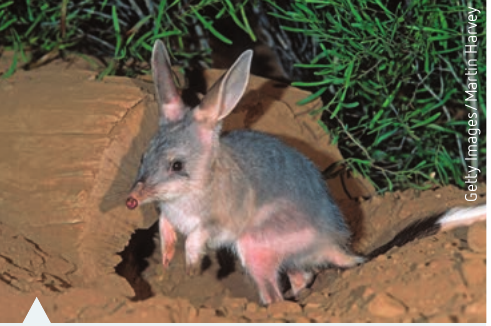
The bilby provides an excellent example of how multiple adaptations work together to help an animal survive in challenging conditions.
Example
Worked Example: The Bilby's Multi-Faceted Adaptations
The bilby is superbly adapted to survive in harsh desert environments through a combination of structural, physiological, and behavioural adaptations:
Behavioural adaptation:
- The bilby is nocturnal, meaning it is only active at night. This behaviour helps it avoid exposure to the intense heat of the desert day.
Structural adaptations:
- Very large ears that serve two purposes: they provide excellent hearing to detect predators and prey, and they help the bilby lose excess body heat. The blood vessels in the ears are positioned very close to the surface, making heat loss more efficient.
- Small eyes which reflect its nocturnal lifestyle (vision is less important at night).
- Small but powerful front digging claws that allow the bilby to dig burrows for shelter and to find food underground.
- Long nose that enhances its sense of smell, helping it locate food in the dark.
These adaptations demonstrate how structural features, internal body functions, and behaviour patterns all work together to help the bilby thrive in one of Australia's most challenging environments.
Australian environmental challenges
Australian environments present unique challenges for living things. The conditions can be harsh and varied, ranging from extremely cold mountain regions to hot, dry deserts. Over thousands of years, Australian organisms have developed adaptations to cope with these demanding conditions.
Note
The Three Main Abiotic Factors
The three main abiotic factors (non-living environmental factors) that affect survival in Australian environments are:
- Water - many areas experience drought or have very limited water availability
- Temperature - extreme heat in summer and cold in some regions during winter
- Sunlight - intense UV radiation and high light levels, particularly in open areas
Native Australian plants and animals have evolved specific adaptations to survive conditions such as water scarcity, high temperatures, and intense sunlight exposure.
Remember!
Summary
Key Points to Remember:
- Adaptations are inherited characteristics that help organisms survive in their environment - they are passed from parents to offspring through gametes.
- Adaptations arise through random variation during reproduction - organisms cannot intentionally develop adaptations to suit their needs.
- The three types of adaptations are structural (body structure), physiological (body function), and behavioural (actions and behaviour).
- These three types of adaptations often work together to improve an organism's chances of survival.
- In Australia, organisms have adapted to cope with three main environmental challenges: water availability, temperature extremes, and intense sunlight.