Structural Adaptations (HSC SSCE Biology): Revision Notes
📚Revision Notes
Structural Adaptations
What are structural adaptations?
A structural adaptation refers to the physical features of an organism, both internal and external, that help it survive in its natural environment. These adaptations relate to how the organism is built or structured, and they play a crucial role in ensuring survival and reproduction.
Note
Structural adaptations can be found throughout an organism's body, from external features like body coverings and limbs to internal organs and systems. These features have evolved over countless generations to help organisms thrive in their specific environments.
Structural adaptations can be found throughout an organism's body. For example, the webbed feet of a platypus enable it to swim efficiently through water. In plants, the thin, pointed leaves of spinifex grass help reduce water loss in arid environments. Inside a koala's digestive system, a specialized organ called the caecum allows it to break down the tough cellulose in eucalyptus leaves, maximizing nutrient absorption from its limited diet.
Structural adaptations of plants
Water balance in desert plants
Plants living in hot, dry environments face significant challenges. They must maintain a delicate balance between carrying out photosynthesis (which requires open stomata) and conserving water. The main pathway for water loss in plants is transpiration, which is the evaporation of water from the stomata (tiny pores) in leaves.
Important
The Photosynthesis-Water Conservation Dilemma
Desert plants face a critical challenge: photosynthesis requires open stomata to take in carbon dioxide, but open stomata also allow water to escape through transpiration. This creates a constant balance between the need for energy production and the risk of dehydration.
Transpiration serves two important functions in plants:
- It creates a pulling force that draws water and dissolved minerals from the soil up through the roots and stem to all parts of the plant
- It provides evaporative cooling, which is essential for regulating the plant's temperature
Plants adapted to water-limited environments must carefully balance their need for photosynthesis with the risk of dehydration through excessive water loss.
Xerophyte adaptations
Xerophytes are plants that live in hot, dry habitats with high temperatures and intense sunlight. Australian plants have evolved numerous structural adaptations to maximize water absorption and storage while minimizing water loss.
Succulents: water storage specialists
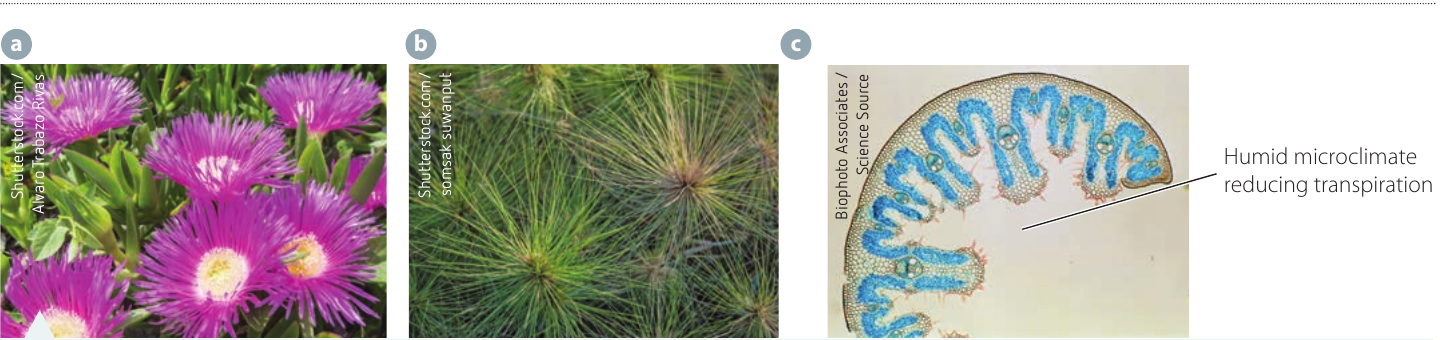
Some plants, known as succulents, have developed fleshy stems or leaves that can store large amounts of water. Pigface (Carpobrotus glaucescens) is an excellent example of this adaptation. These plants can swell up and retain moisture when water is available, then slowly use this stored water during extended dry periods.
Example
Desert Survival: The Parakeelya Plant
In Australia, the desert plant Calandrinia (parakeelya) demonstrates the dual function of succulents. Aboriginal people have traditionally used this plant as both:
- A source of food (edible leaves)
- A source of moisture in the harsh desert environment
This shows how water storage adaptations can make a plant valuable for survival in arid regions.
Protective cuticles
Eucalypts and banksias have evolved coarse, leathery leaves covered with a thick waxy coating called a cuticle. This protective layer serves multiple purposes:
- Shields the leaf from excessive sunlight exposure
- Provides insulation against temperature extremes
- Has reflective properties that reduce heat absorption
- Reduces evaporation through the leaf surface
- Makes all epidermal cells waterproof, preventing water loss from surface cells
Note
The waxy cuticle acts like a waterproof barrier, similar to how wax paper repels water. This adaptation is so effective that it can reduce water loss by up to 90% compared to leaves without a cuticle.
Modified leaf shapes
Leaf shape plays a crucial role in water retention. Cypress pines have developed tiny cylindrical leaves with a very small surface-area-to-volume ratio, which significantly reduces water loss through transpiration. All spinifex species possess tough, pointed, and narrow leaves that minimize the surface area exposed to the dry atmosphere.
Example
Ingenious Adaptation: Leaf Rolling in Porcupine Grasses
Porcupine grasses (Miscanthus sinensis) have developed an ingenious mechanism: they roll their leaves during the hottest part of the day. This positioning creates several advantages:
Step 1: The leaf curls inward, positioning the stomata on the inside of the rolled leaf
Step 2: This protects the stomata from the dry external atmosphere
Step 3: A humid microclimate forms inside the roll, trapping moisture from transpiration
Result: Water loss is dramatically reduced during the most dangerous part of the day
Sclerophyllous leaves
Sclerophyllous (hard) leaves represent another strategy for minimizing water loss. These leaves may feature:
- Waxy or hairy surfaces
- Sunken stomata or stomatal pits
- Greatly reduced leaf size
Sunken stomata

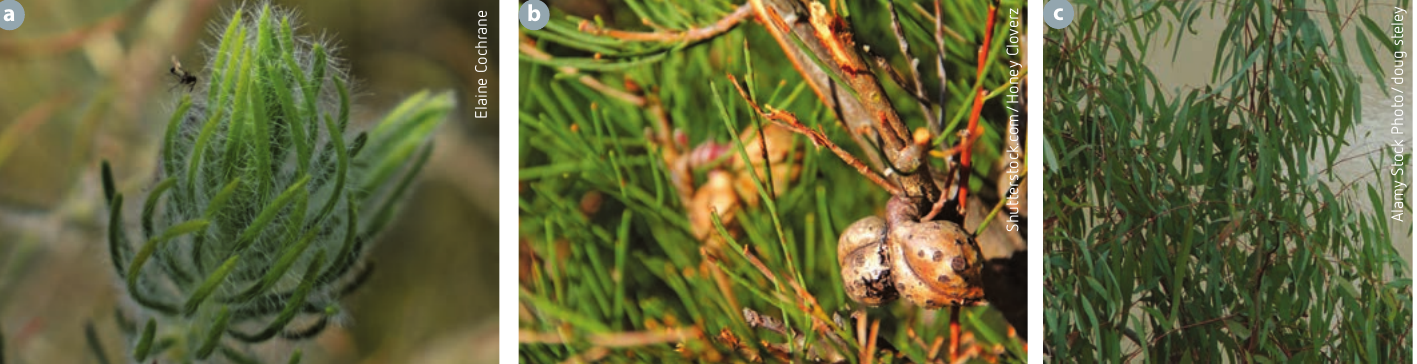
Sunken stomata or stomatal pits are found in plants like Hakea and in the cladodes (flattened stems) of she-oaks. In this adaptation, the actual stomata are positioned lower than the main surface of the leaf. This creates a small pit where moist air becomes trapped, reducing the difference in osmotic pressure between the inside of the leaf and the air immediately outside the stoma.
Note
How Stomatal Pits Work
Hairs growing in the stomatal pit trap water vapour from transpiration, creating a humid microclimate that further reduces water loss. Think of it like a sheltered pocket of air that stays moist, making it harder for water to evaporate from the stoma compared to a stoma exposed directly to the dry air.
Epidermal hairs
Fine hairs on the leaf surface trap a moist layer of air close to the leaf. This reduces the concentration difference between the water inside the leaf tissue and the water vapour in the trapped air layer, slowing down transpiration.
Note
The coastal banksia (Banksia integrifolia) has hairs on the undersurface of its leaves, while Melaleuca urceolaris leaves are completely covered in hairs. These hairs create a protective blanket of humid air that shields the leaf surface from the drying effects of wind and low humidity.
Woody fruits
While most people associate fruits with moist, fleshy structures like oranges or apples, many Australian plants produce woody fruits rather than fleshy ones. This is an adaptation to water-restricted climates. Hakea species, for example, produce hard, woody fruits that require far less water to develop than fleshy fruits would.
Note
Woody fruits represent a water-efficient reproductive strategy. While they may not be as attractive to animals for seed dispersal, they allow the plant to reproduce successfully without investing precious water resources in developing juicy, fleshy fruits.
Vertical leaf orientation
Desert acacias (wattles) have developed vertically flattened leaflets that hang towards the ground. This orientation reduces the amount of sunlight absorbed by the leaf surface, consequently reducing both heat absorption and water loss through transpiration.
Root system adaptations
Many desert plants have developed deep root systems that can access water supplies far underground. Some species also possess shallow root systems near the surface, which enable rapid uptake of moisture when rain does fall, before it evaporates or soaks too deeply into the soil.
Note
Dual Root Strategy
This combination of deep and shallow roots is called a dimorphic root system. The deep roots provide a reliable water source during extended dry periods, while the shallow roots capitalize on brief rain events. This dual strategy maximizes water acquisition opportunities in unpredictable desert environments.
Investigation of plant adaptations
Understanding structural adaptations in plants requires careful observation and analysis. When examining plant specimens, it's important to:
- Observe multiple features including stems, leaves, fruits, and flowers
- Use magnification tools like stereomicroscopes to view fine details
- Record adaptations systematically
- Research the plant's natural environment to understand how each adaptation aids survival
Safety considerations
Important
Essential Safety Precautions When Handling Plant Specimens
Some plants produce irritants or poisons that can affect the eyes, skin, and mucous membranes. Many Australian plants have thorns and spikes that can pierce skin. Always follow these safety guidelines:
- Wear disposable gloves and safety goggles
- Wash hands thoroughly after handling specimens
- Handle plant material carefully
- Use forceps when available to avoid direct contact
- Never touch your face while handling plant specimens
Structural adaptations of animals
Australian animals have evolved diverse structural adaptations to survive in challenging environments. The main survival challenges for animals include obtaining sufficient water and food, regulating body temperature, finding suitable habitat space, reproducing successfully, and avoiding predators.
The thorny devil: a desert specialist
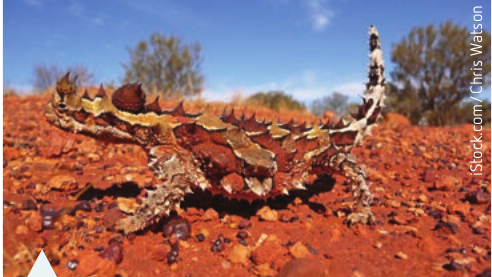
The thorny devil (Moloch horridus) is a small lizard, approximately cm long, that inhabits the Western and Central Australian deserts. It survives on a diet consisting primarily of black ants and termites. This remarkable reptile displays several impressive structural adaptations:
Defense mechanisms
The thorny devil's body is covered with large, prickly spikes that serve multiple purposes. These spikes make the lizard appear ferocious and difficult to swallow, effectively deterring many predators. Additionally, the lizard has a 'false head' made of bony material on top of its real head. When threatened, the thorny devil tucks its real head between its front legs, making its body appear larger while presenting the false head to potential attackers.
Water collection system
Example
Remarkable Adaptation: The Thorny Devil's Water Collection System
One of the most remarkable adaptations of the thorny devil is its sophisticated water collection system. Here's how it works:
Structure: The lizard's body is covered with a complex arrangement of layered scales. Each scale is attached by a hinge joint that allows water from rain or dew to be collected and funneled along channels between the scales.
Process:
- Water contacts the scales and enters the microscopic channels
- Capillary action draws the water along these channels across the lizard's body
- The water flows to the back of the lizard's mouth
- The lizard uses its tongue to draw the water in for drinking
Result: The thorny devil can drink through its skin, allowing it to collect moisture from dew, fog, or rain that touches any part of its body. This adaptation is crucial for survival in environments where standing water is extremely rare.
Camouflage
The thorny devil's gold and brown coloration provides excellent camouflage against the red desert soils, making it difficult for predators to spot the lizard when it remains still.
The common wombat: a burrowing marsupial
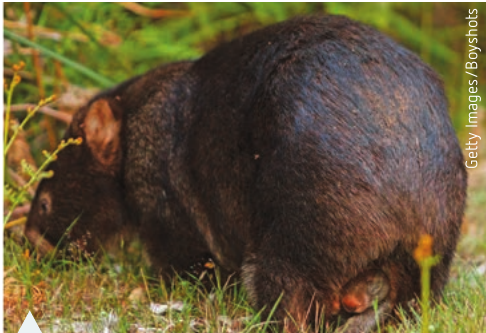
The common wombat (Vombatus ursinus) is a nocturnal animal that lives in extensive underground burrow systems. These burrows can reach up to m in depth and extend m in length.
Digging adaptations
Because wombats are prolific diggers, they have evolved large muscular shoulders and long, strong claws on their front feet. These physical features enable them to excavate extensive burrow systems in various soil types.
Rear-facing pouch
As a marsupial, the wombat gives birth to underdeveloped young (called joeys) that complete their development in the mother's pouch for approximately five months. Unlike many other marsupials, the wombat's pouch opens towards the rear of the body rather than forwards.
Example
Adaptive Design: Why Wombat Pouches Face Backward
This rear-facing pouch is a crucial structural adaptation related to the wombat's digging behavior:
The Problem: When a female wombat digs, dirt is thrown backwards. A forward-facing pouch (like a kangaroo's) would fill with dirt, sticks, and roots.
The Solution: The rear-facing orientation protects the joey from these hazards.
The Result: The vulnerable joey remains clean and safe inside the pouch during digging activities, significantly increasing its chances of survival until it's ready to leave the pouch.
This adaptation demonstrates how structural features can be perfectly linked to behavioral patterns and reproductive success.
Specialized teeth
Wombats are herbivorous, feeding exclusively on plant material such as grasses and leaves. This constant gnawing of tough, fibrous vegetation would normally wear down teeth to the point where the animal could no longer eat, leading to starvation. Wombats have evolved a remarkable dental adaptation to overcome this challenge.
A wombat has rootless teeth that grow continuously throughout its life, replacing tooth material that wears away. The dental arrangement includes:
- A pair of large, deep-rooted incisors for snapping off grass
- No canine teeth
- A large gap (diastema) between the incisors and premolars
- Premolars with large surface areas for grinding plant material
Note
This continuously growing dental structure is similar to that of rodents like rats and beavers. The constant growth ensures the wombat can continue to process its fibrous diet throughout its entire lifespan, which can be up to 15 years in the wild and over 20 years in captivity.
Remember!
Summary
Key Points to Remember:
-
Structural adaptations are physical features, both internal and external, that help organisms survive in their natural environments
-
Desert plants face the challenge of balancing photosynthesis with water conservation and temperature regulation through transpiration
-
Xerophytes use multiple strategies to conserve water: thick cuticles, modified leaf shapes, sunken stomata, epidermal hairs, and specialized root systems
-
Succulents store water in fleshy stems or leaves for use during dry periods
-
Australian animals show diverse structural adaptations for water acquisition, temperature control, predator avoidance, and reproduction
-
The thorny devil demonstrates adaptations including defensive spikes, a sophisticated water collection system, and camouflage coloration
-
The common wombat shows adaptations for burrowing (muscular shoulders, strong claws), protection of young (rear-facing pouch), and processing tough plant material (continuously growing teeth)