Cell Requirements (HSC SSCE Biology): Revision Notes
📚Revision Notes
Cell Requirements
Introduction to cellular needs
All living organisms require both energy and matter to survive and function. Cells must acquire nutrients in two main forms: organic substances and inorganic nutrients.
Note
Understanding the difference: Organic substances are always produced by living organisms and contain carbon-hydrogen bonds, while inorganic nutrients come from the nonliving environment and lack these characteristic carbon-hydrogen chains.
Organic substances are produced by living organisms and contain carbon and hydrogen atoms. These include molecules such as glucose, amino acids, fatty acids, glycerol, nucleotides and vitamins. In contrast, inorganic nutrients come from the nonliving environment and do not contain carbon and hydrogen in long chains. Examples include gases (oxygen and carbon dioxide), minerals (such as phosphates and sodium ions) and water.
How cells use nutrients
The substances that cells require serve two primary purposes:
- As building blocks – nutrients form the structural components from which cells and living tissues are constructed
- As energy stores – nutrients provide stored energy that cells can access when needed
Organic nutrients primarily supply stored energy for living organisms, but they also contribute to cellular structure. Inorganic nutrients function mainly as essential structural components of cells and tissues.
Inorganic nutrients
Inorganic nutrients play vital roles in cellular function despite not being produced by living organisms. The table below summarises the main inorganic nutrients found in cells.
Water
Water forms approximately of the protoplasm (cytoplasm and nucleus). This abundant molecule serves multiple critical functions:
- Acts as the transport medium within cells and throughout organisms
- Functions as an important solvent for many molecules inside cells
- Provides the medium for all chemical reactions in cells, and may participate directly in these reactions
Important
Water is the most abundant molecule in cells, making up roughly 90% of the protoplasm. Without water, cellular chemical reactions cannot occur, making it absolutely essential for life.
Mineral salts
Various mineral salts dissolve as ions in the cytoplasm and vacuoles of plant cells. These include chlorides, nitrates, phosphates and carbonates of elements such as sodium, magnesium, calcium, potassium and ammonium.
Mineral salts perform several important functions:
- Assist in all chemical reactions occurring within cells
- Provide raw materials for synthesising macromolecules and body tissues (for example, calcium is essential for bones and teeth, whilst iron is crucial for blood cells)
- Help maintain water balance in cells
- Enable proper functioning of cell membranes, nerve cells and muscle cells (particularly sodium ions and chloride ions )
Gases
Two key gases dissolve in the protoplasm and are used or produced in chloroplasts and mitochondria:
Carbon dioxide :
- Used during photosynthesis in plant cells
- Released as a product of aerobic cellular respiration in both plants and animals
Oxygen :
- Used by all living organisms during aerobic cellular respiration to release energy for cell function
- Released as a product of photosynthesis
Note
Notice the complementary relationship: Carbon dioxide is consumed during photosynthesis and produced during respiration, while oxygen is produced during photosynthesis and consumed during respiration. This creates a natural cycle between plants and animals.
Organic compounds (Biomacromolecules)
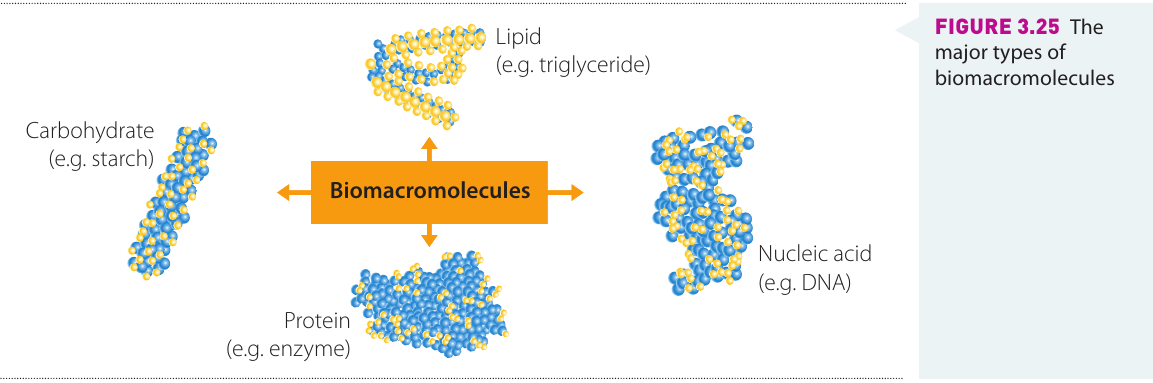
Every living cell requires large organic molecules, called biomacromolecules, as part of their structure and to maintain biochemical processes for effective functioning. Four major categories exist based on their chemical composition and structure: carbohydrates, lipids, proteins and nucleic acids.
Note
Organisms that perform photosynthesis (such as plants) can absorb inorganic nutrients from soil and air and convert these into organic nutrients. In contrast, organisms unable to photosynthesise must consume food to obtain organic nutrients for their cells.
Carbohydrates
Carbohydrates are a group of organic molecules composed of carbon (C), hydrogen (H) and oxygen (O) atoms in a ratio of . This gives the general formula for carbohydrates as .
Important
Key Formula for Carbohydrates:
The general formula shows the characteristic 1:2:1 ratio of carbon to hydrogen to oxygen atoms that defines all carbohydrates. The subscript represents the number of repeating units.
Scientists classify carbohydrates based on how many monomers (basic units) link together:
- Monosaccharides – simple sugars consisting of a single monomer
- Disaccharides – complex sugars consisting of two monomers
- Polysaccharides – complex molecules consisting of more than five and up to hundreds of monomers joined together
The product of photosynthesis, glucose, is a monosaccharide. The table below shows the classification and uses of different carbohydrates.
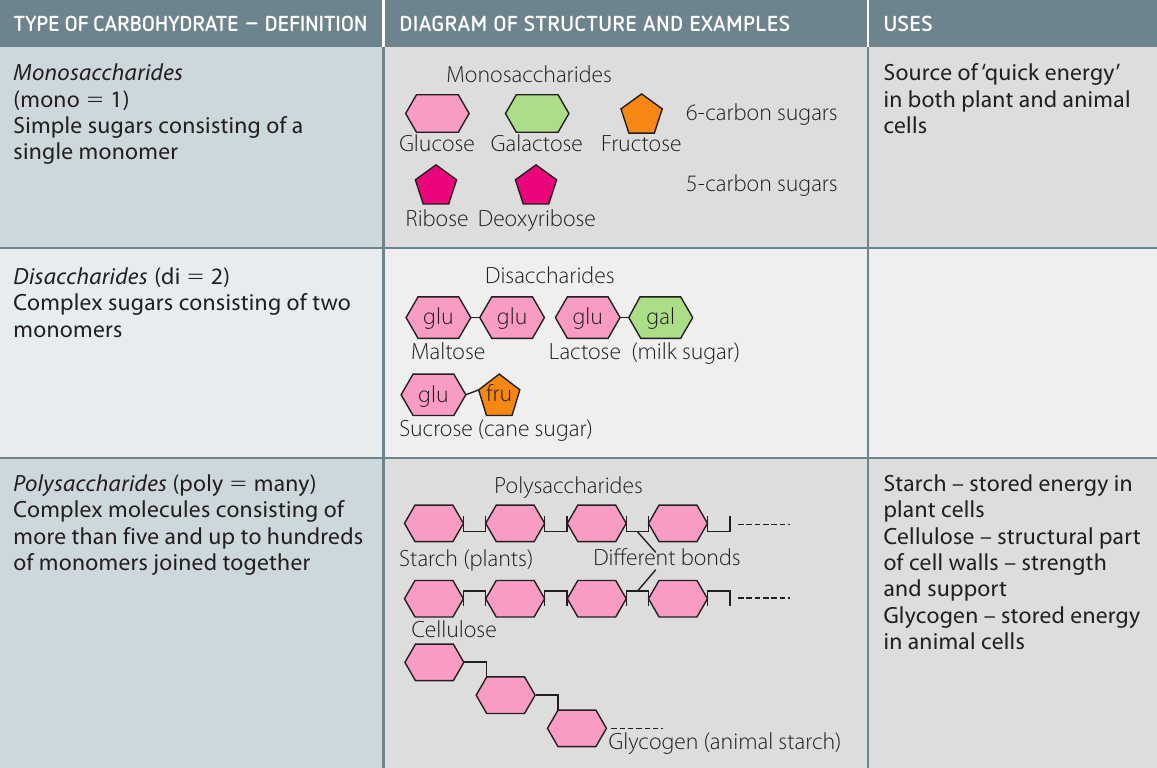
Monosaccharides include glucose, galactose and fructose (all -carbon sugars), as well as ribose and deoxyribose (-carbon sugars). These simple sugars provide a source of quick energy in both plant and animal cells.
Disaccharides form when two monosaccharides join together. Common examples include maltose (formed from two glucose molecules), lactose or milk sugar (glucose plus galactose), and sucrose or cane sugar (glucose plus fructose).
Polysaccharides are large molecules formed when many monomers link together. Important examples include:
- Starch – stores energy in plant cells
- Cellulose – provides structural support in plant cell walls, giving strength and rigidity
- Glycogen (animal starch) – stores energy in animal cells
Lipids
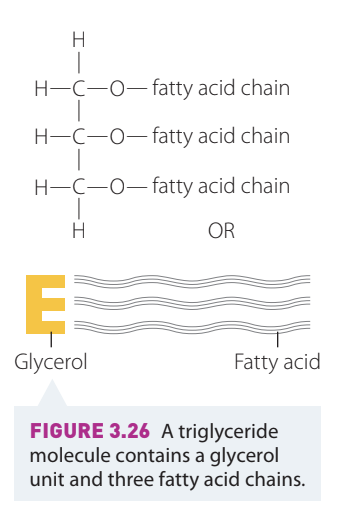
Lipids contain many carbon (C) and hydrogen (H) atoms with only a few oxygen (O) atoms. The fats and oils found in cells typically consist of triglyceride molecules. In these molecules, atoms arrange as a glycerol unit to which three fatty acid chains attach.
Lipids have an oily, greasy or waxy consistency and are relatively insoluble in water.
In cells, lipids perform three important functions:
- Energy storage – lipids store approximately twice the amount of energy as carbohydrates
- Membrane structure – lipids form a structural component of cell membranes
- Hormone production – lipids are essential structural parts of hormones, which act as chemical messengers produced by cells (for example, steroids)
Note
Lipids are the most efficient form of energy storage in living organisms. Because they store roughly twice as much energy per gram as carbohydrates, they are ideal for long-term energy reserves in both plants (as oils) and animals (as fats).
Proteins
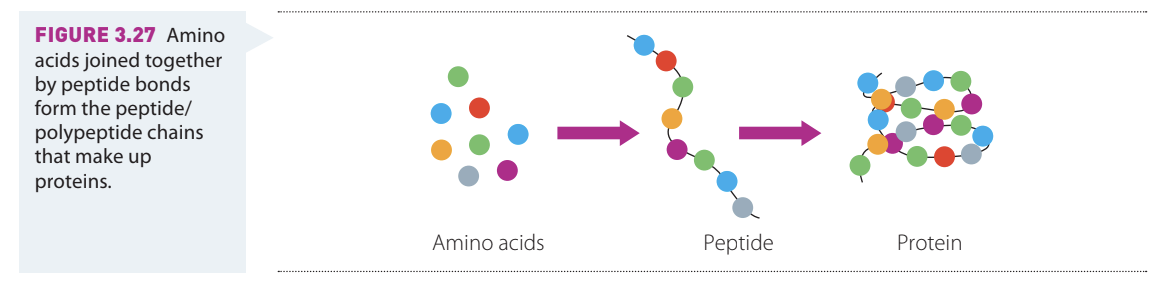
Proteins are composed of the elements carbon, hydrogen, oxygen, nitrogen, and sometimes sulphur. These elements combine to form amino acids, which are the building blocks of proteins.
Approximately different amino acids exist. Cells can join these amino acids in chains of up to amino acids to form a peptide or polypeptide chain. Proteins consist of one or more of these polypeptide chains twisted together into a particular three-dimensional shape. The DNA in the cell nucleus controls the sequence and arrangement of amino acids, which determines the type of protein formed.
Important
Essential Amino Acids:
Plant cells can synthesise their own amino acids. Animal cells produce most required amino acids, but nine amino acids are called 'essential' because animal cells cannot synthesise them. These essential amino acids must be obtained as nutrients from the external environment, such as from food.
Proteins perform multiple functions in cells:
- Form structural components in cells and tissues
- Act as important structural components of cell membranes
- Serve functional roles, such as enzymes (which control all metabolic or chemical reactions in cells) and hormones (which control the functioning of other cells)
- Combine with other macromolecules to form important structural parts of all membranes within cells
Nucleic acids
Nucleic acids are very large biomacromolecules containing the elements carbon, hydrogen, oxygen, nitrogen and phosphorus. Two types of nucleic acids exist: DNA (deoxyribonucleic acid) and RNA (ribonucleic acid).
DNA consists of two strands that form a double helix. It stores the information controlling cell activities and is the main chemical component of the nucleus. Small amounts of DNA also occur in mitochondria and chloroplasts.
RNA occurs in small amounts in the nucleus and in larger amounts in the cytoplasm, where it assists in protein manufacture.
Important
Structure of Nucleotides:
The building blocks of DNA and RNA are called nucleotides. Each nucleotide consists of three components:
- A sugar molecule
- A sub-unit called a base
- A phosphate group
This three-part structure is essential for nucleotides to link together and form the long chains of DNA and RNA.
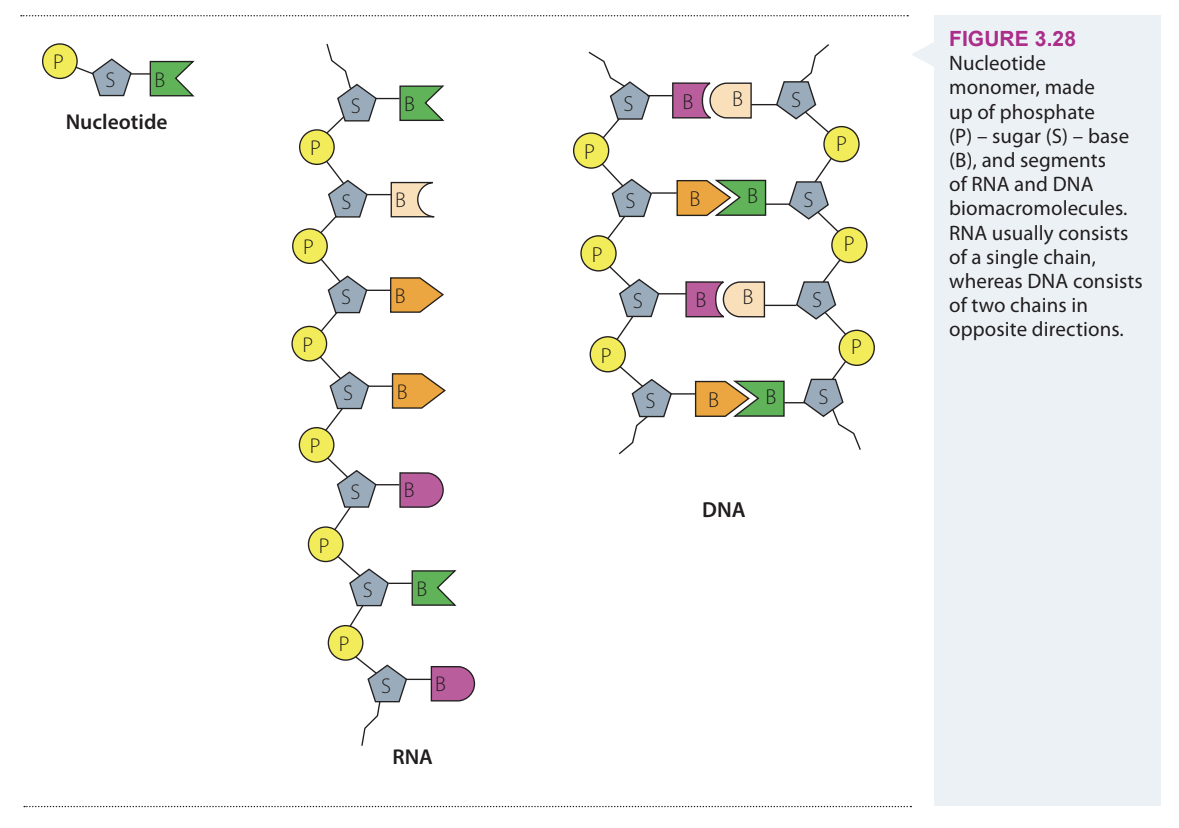
DNA nucleotides contain:
- Four bases: adenine, guanine, cytosine and thymine
- The sugar deoxyribose
- Cells require DNA nucleotides to make DNA during cell replication
RNA nucleotides contain:
- Four bases: adenine, guanine, cytosine and uracil
- The sugar ribose
- Cells require RNA nucleotides to make ribosomes and RNA so that cells can produce proteins
Note
Key Difference: The main structural differences between DNA and RNA nucleotides are the type of sugar (deoxyribose vs ribose) and one of the bases (thymine in DNA vs uracil in RNA). These differences reflect their distinct roles in the cell.
Remember!
Summary
Key Points to Remember:
-
Cells require both organic substances (produced by living organisms, containing carbon and hydrogen) and inorganic nutrients (from the nonliving environment) to survive and function.
-
Nutrients serve two primary purposes: as building blocks for cellular structures and as energy stores for cellular activities.
-
The four major types of biomacromolecules are carbohydrates, lipids, proteins and nucleic acids. Each type has a distinct chemical composition and performs specific functions within cells.
-
Carbohydrates are classified as monosaccharides (simple sugars), disaccharides (two monomers) or polysaccharides (many monomers), and function in energy provision, energy storage and structural support.
-
DNA stores genetic information and controls cell activities, whilst RNA assists in protein manufacture. Both are made from nucleotides, which consist of a sugar, a base and a phosphate group.