Using Technology to Investigate the Past (HSC SSCE Biology): Revision Notes
📚Revision Notes
Using Technology to Investigate the Past
Advances in chemistry and physics have led to the development of powerful technologies that can detect the signatures of life. These signatures provide scientists with valuable clues about how environments have changed over time.
Note
These technological advances have revolutionized our understanding of Earth's history, allowing scientists to look billions of years into the past with remarkable accuracy. The combination of multiple dating techniques and gas analysis provides a comprehensive picture of how our planet and its ecosystems have evolved.
Radiometric dating (geochronology)
What is radiometric dating?
Radiometric dating is a method that scientists use to determine the age in years of fossils, rocks, and minerals. This technique works best with igneous and metamorphic rocks because they contain radioactive isotopes that can be measured.
Many elements in the periodic table exist in unstable forms called isotopes. These unstable parent isotopes break down through radioactive decay, releasing energy and particles to become more stable daughter atoms. The daughter product is chemically different from the original parent atom.
Important
The decay process happens at a constant, predictable rate. This predictability is the foundation of radiometric dating - it means scientists can accurately calculate ages regardless of external conditions like temperature, pressure, or chemical environment.
Scientists calculate the age of a rock using the age equation, which compares the amount of the original isotope remaining with the amount of decay product that has accumulated.
Parent and daughter isotopes
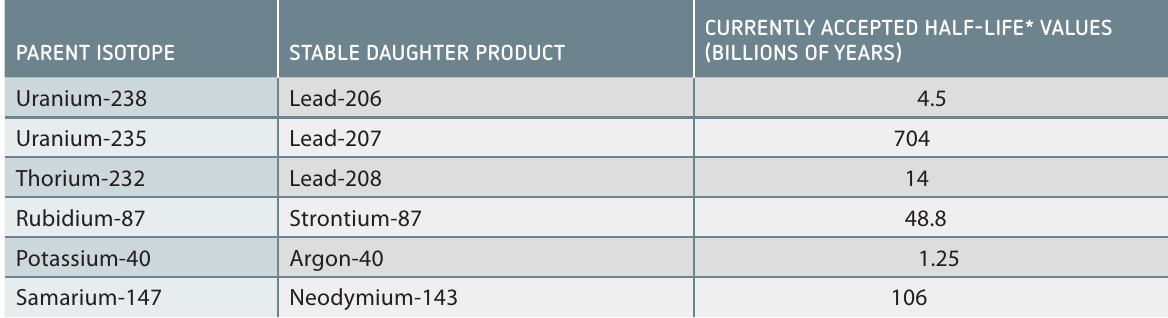
When a radioactive parent isotope decays, it transforms into a stable daughter product. Different parent isotopes decay at different rates, making some more useful than others for dating different types of rocks.
Note
Notice how different parent-daughter pairs have vastly different half-lives - from thousands of years to billions of years. This range allows scientists to date materials of almost any age, from relatively recent organic materials to the oldest rocks on Earth.
Understanding half-life
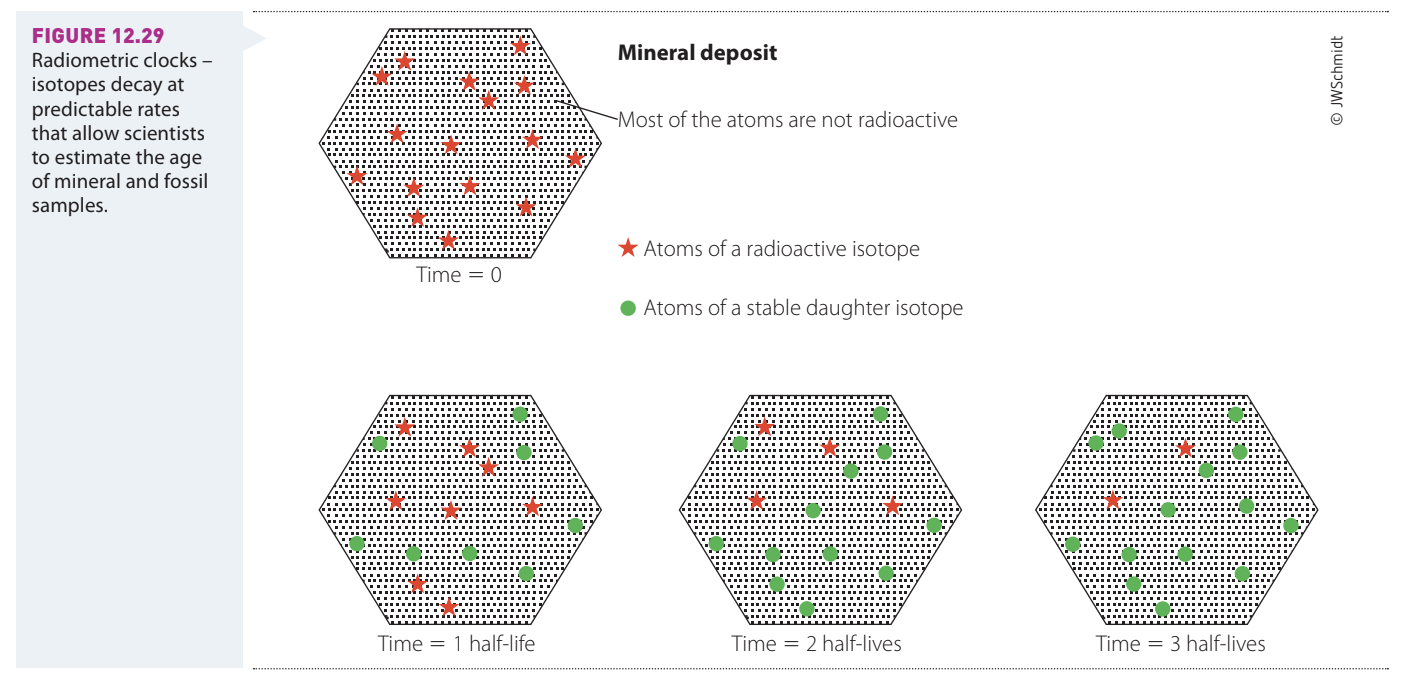
The half-life () of a radioisotope is the time it takes for half of a radioactive sample to decay from the parent isotope to the daughter product. This is a crucial concept in radiometric dating.
Example
Understanding Decay Over Time:
The diagram above demonstrates the predictable pattern of radioactive decay:
- Time = 0: The mineral contains 100% radioactive parent isotopes (red stars)
- After one half-life (): 50% parent isotopes remain, 50% have decayed to daughter isotopes (green circles)
- After two half-lives (): Only 25% of original parent isotopes remain (¼ of the sample)
- After three half-lives (): Only 12.5% of original parent isotopes remain (⅛ of the sample)
This exponential decay pattern is mathematically predictable and forms the basis for calculating absolute ages.
This predictable pattern allows scientists to estimate the age of mineral and fossil samples with remarkable precision.
Technologies to measure radioactivity in rocks
SHRIMP technology
One of the most significant advances in radiometric dating was the development of SHRIMP (Sensitive High Resolution Ion Microprobe) in the 1980s. This was an Australian development by the Research School of Earth Sciences at the Australian National University in Canberra.
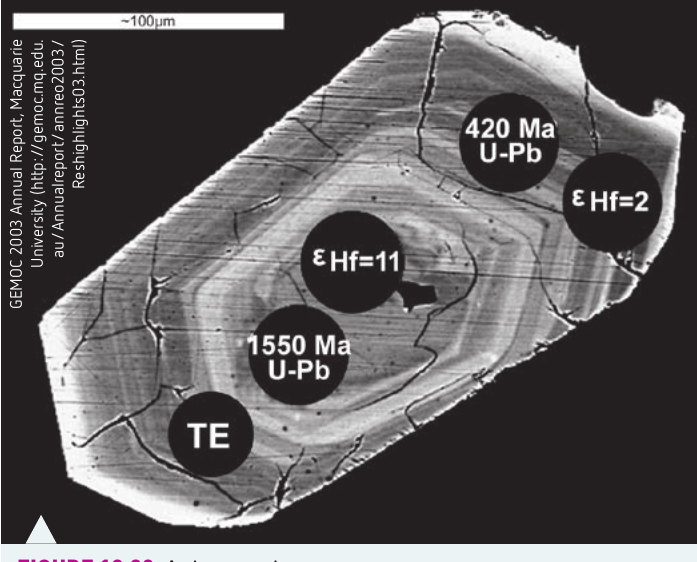
SHRIMP dates very tough mineral grains called zircon. These crystals are extremely resistant to weathering and can survive for billions of years. Using this technique, scientists have identified the oldest rocks on Earth: 4.4 billion-year-old zircon grains from north-west Western Australia.
Note
The image above shows a zircon grain analyzed using SHRIMP technology. The different regions of the grain show different ages (420 Ma and 1550 Ma), revealing the crystal's complex history. This demonstrates that a single grain can contain multiple growth periods, each preserving a record of different geological events.
Fission track dating
In fission track dating, scientists examine the marks left by decaying uranium atoms as they release particles and energy. These tracks appear on the surface of mineral grains and can be viewed using electron microscopes. By analyzing the density of these tracks, scientists can estimate the age of the mineral.
Note
The more tracks present in a mineral sample, the older the sample is likely to be. This method is particularly useful for dating volcanic ash layers and can date materials from about 100,000 years to several billion years old.
Luminescence dating
All rocks contain some level of natural radiation. Luminescence dating measures the amount of radiation trapped in mineral crystals. Scientists can release this trapped radiation using:
- Thermoluminescence: applying heat to the crystal
- Optically stimulated luminescence: using laser light
The longer a crystal has been buried, the brighter the luminescence it produces when heated or exposed to light.
Dating fossils
The challenge with fossils
Fossils can contain radioisotopes like carbon-14 (), which can be used for dating. However, carbon-14 has a relatively short half-life of 5,730 years.
Important
This means organisms fossilized more than 50,000 years ago cannot be dated accurately using carbon-14 alone. For older fossils, scientists must use alternative dating methods and combine multiple techniques.
Combining relative and absolute dating
To find the age of older fossils, scientists combine two approaches:
- Relative dating: using the principle of superposition to determine which rock layers are older or younger
- Absolute dating: using radiometric dating on igneous and metamorphic rocks
Since fossils typically accumulate in sedimentary rock layers, scientists date the igneous and metamorphic formations above and below the fossil-containing sedimentary layers. This provides an age range for the fossils.
Important
Exam tip: Remember that sedimentary rocks themselves cannot be reliably dated using radiometric methods because they contain mixed samples from different sources. That's why the surrounding igneous and metamorphic rocks are used instead - they formed at a specific point in time and contain undisturbed radioactive isotopes.
Gas analysis
Analyzing ice cores
Scientists analyze large amounts of data from ice cores to look for patterns in past atmospheric conditions. Ice cores trap tiny bubbles of ancient air, which can be analyzed to reconstruct the concentrations of gases like carbon dioxide and oxygen over time.
Note
Ice cores from Antarctica and Greenland provide climate records spanning hundreds of thousands of years. Each layer of ice represents a specific year, creating an annual archive of atmospheric composition and temperature.
Carbon dioxide analysis
Carbon dioxide () levels in the atmosphere have long been recognized as a key factor in atmospheric temperature. Carbon dioxide is a normal component of Earth's atmosphere, along with nitrogen, oxygen, argon, and other trace gases.
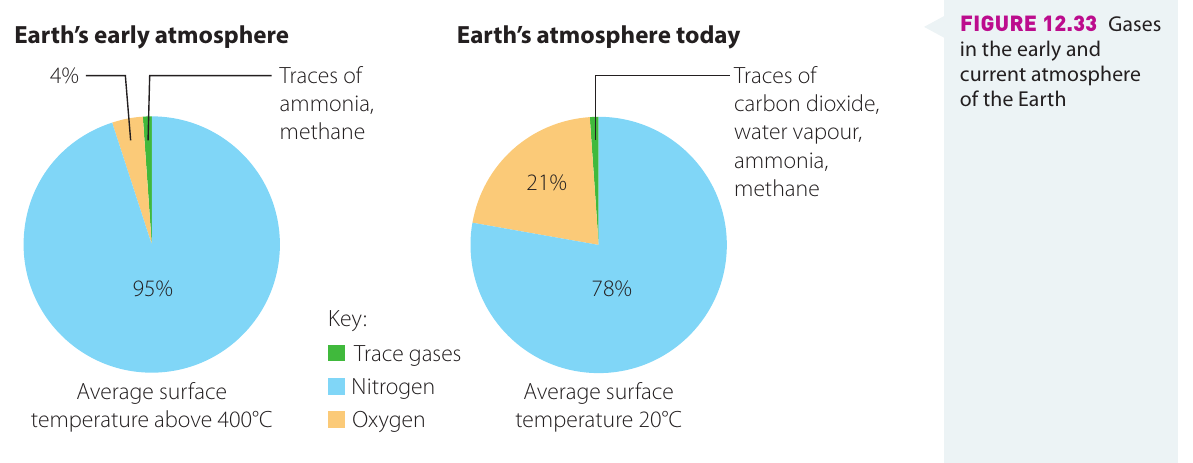
The comparison above shows dramatic changes in Earth's atmospheric composition:
- Early atmosphere: 95% nitrogen, 4% trace gases (ammonia, methane), average temperature above 400°C
- Current atmosphere: 78% nitrogen, 21% oxygen, trace amounts of , water vapour, ammonia, and methane, average temperature 20°C
The greenhouse effect
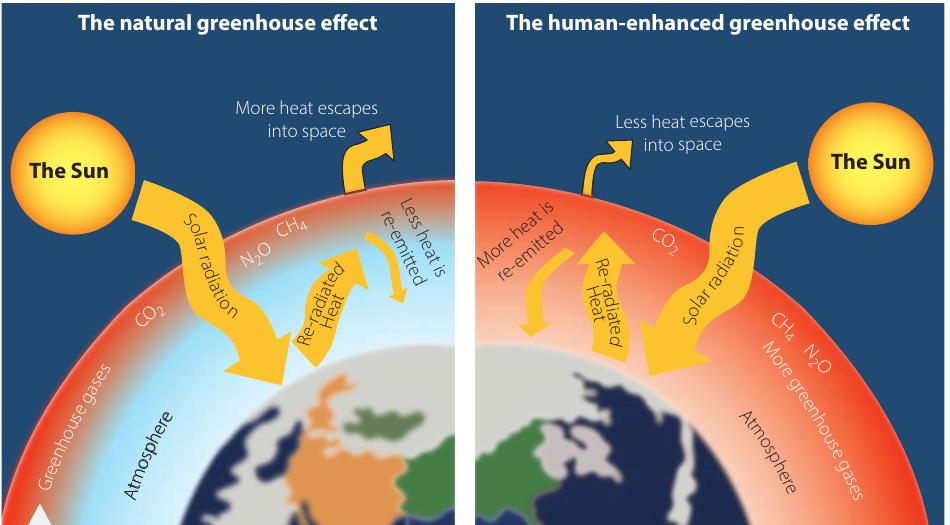
Carbon dioxide is one of several greenhouse gases that trap solar radiation and keep Earth warm enough to sustain life. This natural process is called the greenhouse effect.
However, a large increase in greenhouse gases can increase the temperature of Earth's atmosphere and oceans. This process is known as the enhanced greenhouse effect or global warming.
Important
The natural greenhouse effect is essential for life on Earth - without it, our planet would be too cold to support most life forms. However, the enhanced greenhouse effect caused by increased atmospheric from human activities is causing rapid climate change that threatens ecosystems worldwide.
Scientists use ancient carbon dioxide levels to infer past climates. Changes in atmospheric temperature would have directly affected which plants and animals could survive in different environments.
Oxygen isotope analysis
Oxygen has three naturally occurring isotopes: , , and . These atoms are incorporated into water molecules as .
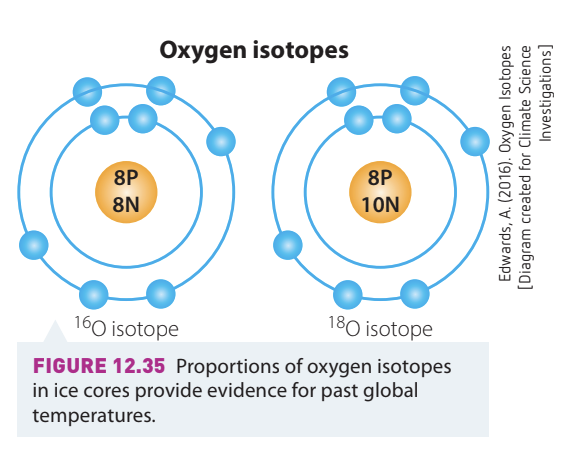
The ratio of provides a record of ancient water temperatures. Scientists analyze these ratios in ice core samples to reconstruct water temperatures for ancient Earth. This information helps reveal how global temperatures have changed over geological time.
Note
Learning aid: Think of oxygen isotopes as thermometers frozen in ice - the heavier isotope () behaves differently at different temperatures, creating a permanent record of past climate conditions. During warmer periods, more is incorporated into ice; during colder periods, less is incorporated.
Importance for understanding past ecosystems
These technologies allow scientists to:
- Determine the absolute age of rocks and fossils with remarkable accuracy
- Reconstruct past atmospheric compositions and temperatures
- Understand how climate change has affected ecosystems over millions of years
- Make informed predictions about current and future climate trends
- Manage current environmental challenges like global warming
Note
By combining radiometric dating, ice core analysis, and isotope studies, scientists can create a comprehensive timeline of Earth's environmental history. This information is crucial for understanding current climate change and predicting future trends.
Remember!
Summary
Key Concepts to Master:
-
Radiometric dating uses the predictable decay rates (half-lives) of radioactive isotopes to determine the absolute age of rocks and minerals
-
Half-life is the time it takes for half of a radioactive sample to decay from parent isotope to daughter product - this constant rate is the foundation of all radiometric dating
-
SHRIMP technology dates zircon grains and can identify rocks up to 4.4 billion years old - these are the oldest materials ever found on Earth
-
Dating fossils requires combining relative dating (stratigraphy) with absolute dating (radiometric methods) because fossils are usually found in sedimentary rocks that cannot be directly dated
-
Gas analysis from ice cores reveals past atmospheric compositions, particularly and oxygen isotope ratios, which indicate past temperatures and climate conditions
-
The enhanced greenhouse effect (global warming) results from increased greenhouse gases trapping more solar radiation in Earth's atmosphere - this is different from the natural greenhouse effect which is essential for life