How Genes and the Environment Affect Phenotypic Expression (HSC SSCE Biology): Revision Notes
📚Revision Notes
How Genes and the Environment Affect Phenotypic Expression
Introduction
Have you ever wondered whether abilities like playing sport or traits like shyness are inherited or shaped by our environment? This question lies at the heart of the nature versus nurture debate in biology. Understanding how genes and environment interact to produce the characteristics we observe in organisms is fundamental to modern genetics.
The phenotype of an organism includes all its observable characteristics - not just physical appearance, but also behaviour and physiology. The phenotype encompasses the sum of all gene products expressed in an organism. In contrast, the genotype refers to the genetic information (DNA sequences) that an organism possesses.
Note
An important tool for understanding gene-environment interactions comes from twin studies. Identical twins share identical genotypes, so any differences between them must reflect environmental influences. Studies of twins separated at birth have been particularly valuable, as they allow researchers to explore the effects of nature (genes) and nurture (environment) independently.

Recent research has revealed a fascinating field called epigenetics, which explores how the environment can chemically modify DNA and affect gene expression without changing the actual DNA sequence. This discovery has transformed our understanding of how genes and environment interact.
Understanding genotype and phenotype
Before exploring how genes and environment interact, it's important to clarify these key terms:
Important
Genotype is the set of genes in an organism's DNA that is responsible for a particular trait. It represents the genetic blueprint and can be determined through biological testing.
Phenotype is the physical expression or observable characteristics of that trait. It can be determined simply by observation and includes structure, behaviour, and physiology.
While every cell in an organism contains the same genotype (genetic blueprint), different cells become specialised into different tissue types. This specialisation occurs through the controlled expression of specific genes within cells.
Gene expression and phenotype
Gene expression refers to the process by which genetic information is converted into functional protein products. These proteins determine the physical and chemical features of each cell type and the overall phenotype of the organism.
Not all genes are active (expressed) in all cells at all times. Cells "switch on" or "switch off" particular genes depending on:
- The cell type
- The developmental stage
- Environmental signals
Stem cells and transcription factors
Stem cells are unspecialised cells capable of dividing and becoming specialised tissue. There are two main types:
- Embryonic stem cells - These are pluripotent, meaning they can give rise to any type of tissue within an organism (pluri = many; potent = potential).
- Adult stem cells - These are not pluripotent and can only give rise to cells of one specific tissue type.
Note
When stem cells differentiate, special proteins called transcription factors control which genes are transcribed. These transcription factors therefore determine the developmental pathway of a cell and what type of tissue it will become.
An interesting aspect of gene regulation is that genes must produce the proteins that regulate their own expression. This makes accurate protein synthesis according to DNA instructions critically important for proper cell functioning and producing a healthy phenotype.
Environmental effects on gene expression and phenotype
While genes provide the instructions for building an organism, the environment can significantly influence how these instructions are expressed. Some variations in organisms are genetically determined (nature), whereas others are influenced by the environment (nurture). Many variations result from an interaction between the two.
Note
The term 'environment' here includes all environmental influences - not just the home environment, but temperature, pH, nutrition, toxins, and other external factors.
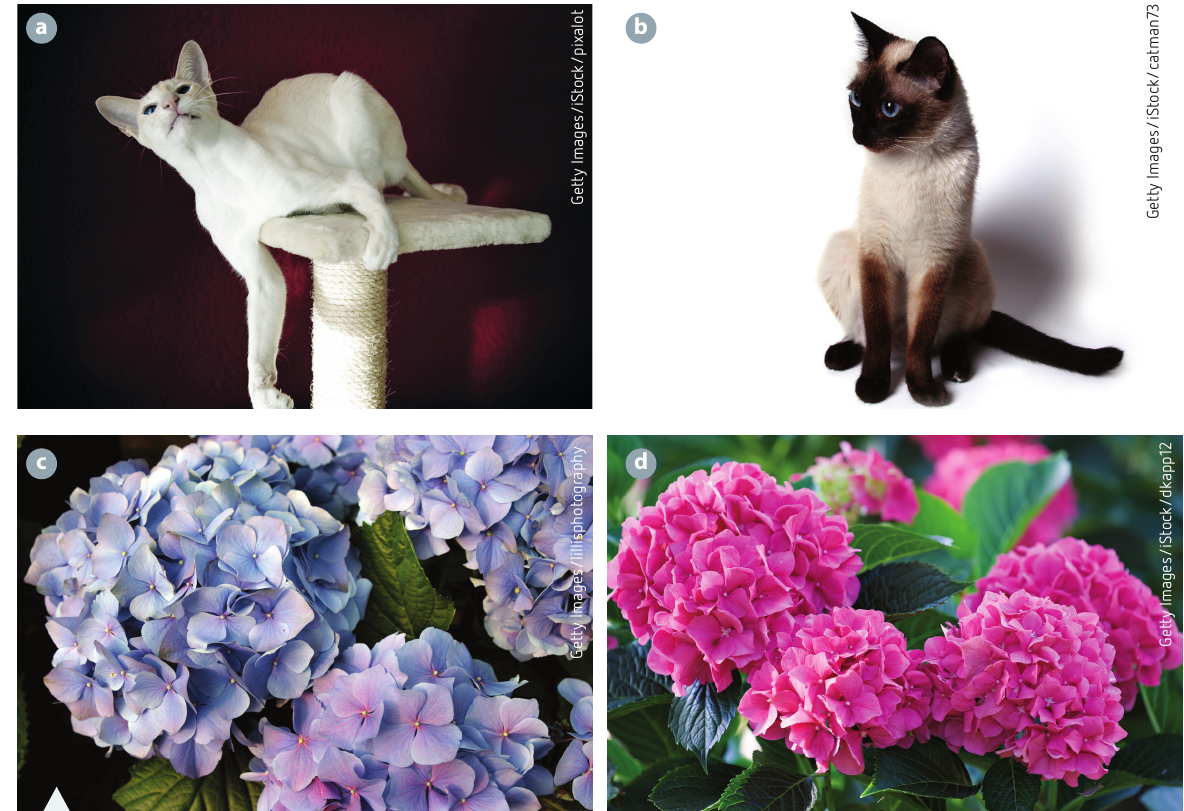
Temperature effects: Siamese cats
The coat colour of Siamese cats provides an excellent example of environmental influence on gene expression.
Example
Worked Example: Temperature and Coat Colour in Siamese Cats
Cats with the allele have uniform pigmentation across their entire body. However, cats that are homozygous recessive for the mutant allele show dark pigmentation at their body's extremities - the tips of their ears, tail, legs, and face.
These darkly pigmented areas are also the regions with poorer blood circulation, which means they are colder. The allele can only produce pigment at low temperatures. In warmer parts of the cat's body, where body temperature is higher, no dark pigment is produced. As cats age, circulation may become poorer and these areas can darken further as a greater proportion of each extremity becomes colder.
Conclusion: Phenotypic expression of colour is influenced by the temperature of the environment.
pH effects: Hydrangea flowers
Example
Worked Example: pH and Flower Colour in Hydrangeas
The colour of hydrangea flowers is influenced by the acidity or alkalinity of the soil:
- Acidic soil produces blue flowers
- Alkaline soil produces pink flowers
Conclusion: The same plant with the same genotype will produce different coloured flowers depending on soil pH, demonstrating environmental influence on phenotype.
Enzyme function
Changes in temperature or pH can alter the shape of an enzyme's active site, affecting how well it binds to its substrate. This changes the enzyme's functioning and consequently affects the organism's phenotype.
Human growth and nutrition
Human height and infant birth weight have a genetic basis, but environmental factors significantly influence their expression:
- Lack of nutrients can restrict growth
- Presence of toxins (such as those in cigarette smoke) can limit development
Phenylketonuria (PKU)
Example
Worked Example: Environmental Intervention in PKU
PKU is a rare genetic disease in which the amino acid phenylalanine accumulates in the body. Symptoms become increasingly severe over time and include:
- Behavioural and emotional problems
- Developmental delays such as stunted growth
- Seizures
- Brain damage
However, early intervention with a diet low in proteins containing phenylalanine can affect gene expression, slowing disease onset and keeping symptoms under control.
Conclusion: Environmental factors (diet) can modify the expression of genetic diseases.
Regulation of genes for phenotypic expression
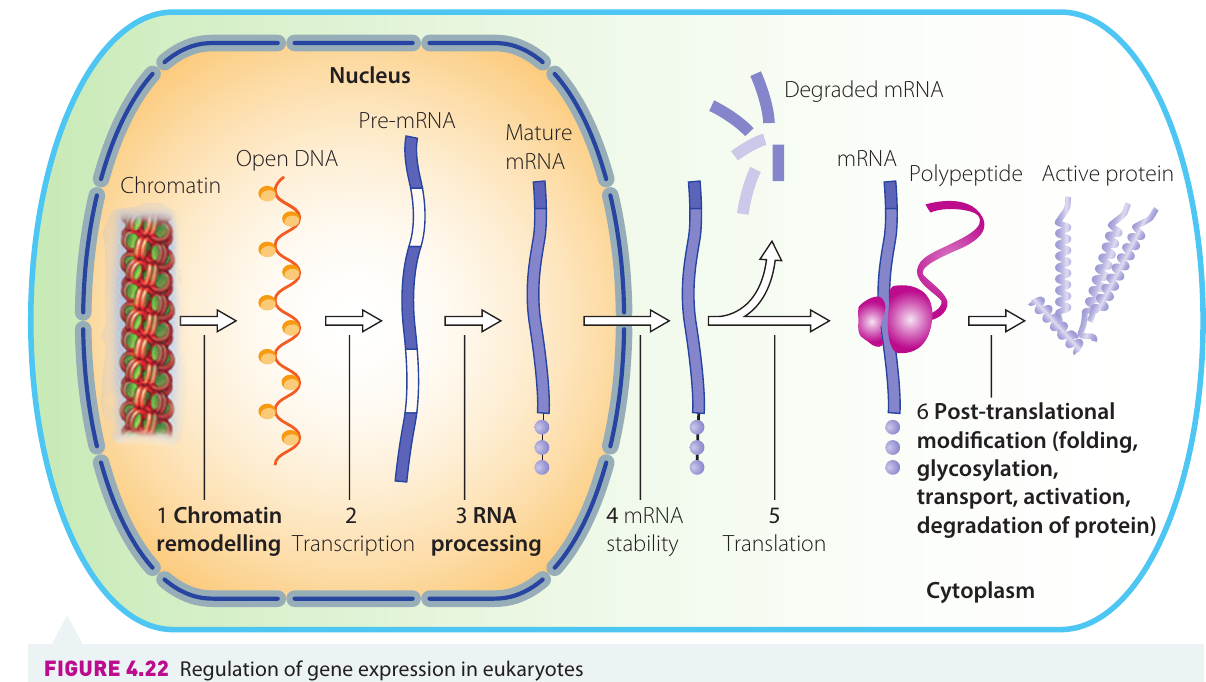
Gene expression can be understood as the switching on and off of genes as needed. Research has shown that gene expression may be regulated at various stages from DNA to functional protein. Interestingly, gene expression can also be affected by changes in the cellular environment.
Gene regulation by modifying DNA for transcription
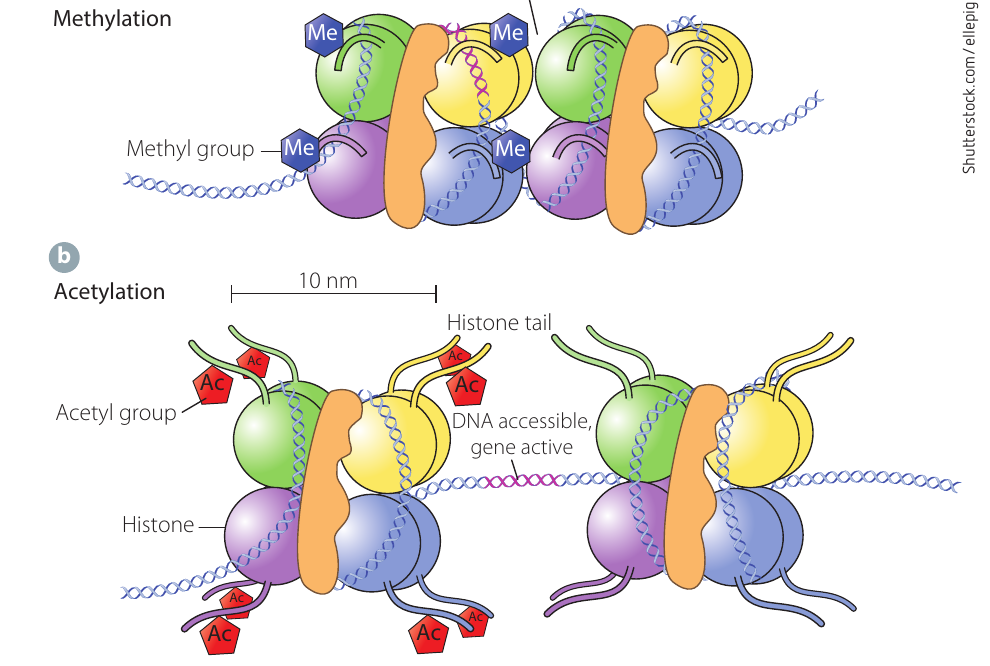
The initiation of transcription is influenced by how densely DNA is bound to histone proteins. Epigenetics explores how chemical modifications to either histones or DNA structure (without changing the base sequence) affect DNA binding density and gene expression.
Regions of DNA that are tightly bound are inaccessible to RNA polymerase (the enzyme that initiates transcription). Two important types of chemical modifications are:
Methylation
Methylation involves adding a methyl group () to DNA or histones.
Effects of DNA methylation:
- Generally represses transcription
- Increases the density of binding between DNA and histones
- Acts as a 'muffler' in silencing gene expression
- Loss of methylation activates genes
Acetylation
Acetylation involves adding an acetyl group to DNA or histones.
Effects of acetylation:
- Makes DNA accessible to RNA polymerase
- Promotes transcription
- Has the reverse effect to methylation
Note
Remember the difference:
- Methylation = Muffles (silences genes by increasing DNA-histone binding)
- Acetylation = Activates (promotes transcription by loosening DNA-histone binding)
Epigenetics and disease
Important
Cancer was the first human disease linked to epigenetics. In 1983, researchers compared DNA from cancerous colorectal tissue with normal tissue from the same patients. They discovered that DNA in cancerous cells had less methylation than DNA in normal tissue.
Normally, DNA that is not being transcribed is methylated, which turns off genes. A decrease in DNA methylation can cause abnormally high gene activity, which is typical of cancer cells that divide uncontrollably. Conversely, too much methylation can be harmful by preventing the action of protective tumour suppressor genes.
This discovery has led to extensive research into links between epigenetics and various diseases.
Gene regulation during transcription
Elongation of RNA and termination of transcription are additional points where gene expression can be regulated. Protein factors influence whether mRNA elongation continues or stops. If the production or binding of transcription factors is affected, gene expression will be affected. These regulatory proteins are themselves produced by genes, meaning some genes encode their own functioning.
Post-transcription gene regulation - modifying and processing RNA
Processing of mRNA before it leaves the nucleus is one of the most common forms of gene regulation in eukaryotes. This may involve:
- Alternative splicing - removing different introns to produce different proteins from the same gene
- Regulating mRNA stability - The longer an mRNA molecule lasts, the more protein will be translated. If mRNA degrades quickly, less protein will be made.
- MicroRNA (miRNA) silencing - Small non-coding RNA molecules called miRNA can silence mRNA after transcription by:
- Cutting RNA into two pieces
- Making RNA unstable by shortening its poly(A) tail
- Interfering with translation on ribosomes
Post-translation gene regulation - modifying proteins
After translation, the protein product may require additional modifications:
- Some proteins are inactive until a chemical group is added
- Other proteins are active until a chemical group is removed
Note
These post-translation modifications provide another level of control over phenotypic expression.
Summary of gene regulation stages
Gene expression in eukaryotes can be regulated at six main stages:
- Chromatin remodelling - modifying how tightly DNA is packaged
- Transcription - controlling which genes are transcribed
- RNA processing - modifying mRNA before it leaves the nucleus
- mRNA stability - controlling how long mRNA molecules last
- Translation - controlling protein synthesis at ribosomes
- Post-translational modification - modifying proteins after synthesis (folding, glycosylation, transport, activation, or degradation)
This multi-level regulation allows cells to precisely control which proteins are made, when they are made, and in what quantities.
Remember!
Summary
Key Points to Remember:
-
Genotype refers to an organism's genetic makeup, while phenotype refers to observable characteristics including structure, behaviour, and physiology.
-
Gene expression is the process of converting genetic information into functional protein products, which determines cell type and organism phenotype.
-
Both genes and environment influence phenotype. Many traits result from an interaction between genetic factors (nature) and environmental factors (nurture).
-
Epigenetics involves chemical modifications to DNA (such as methylation and acetylation) that affect gene expression without changing the DNA sequence itself. These changes may be influenced by environmental factors.
-
Gene expression is regulated at multiple stages: DNA packaging, transcription, RNA processing, translation, and post-translation protein modification. This multi-level regulation allows precise control of which genes are expressed in different cells and conditions.