Genotypes and Inheritance Patterns (HSC SSCE Biology): Revision Notes
📚Revision Notes
Genotypes and Inheritance Patterns
Introduction to Mendelian inheritance
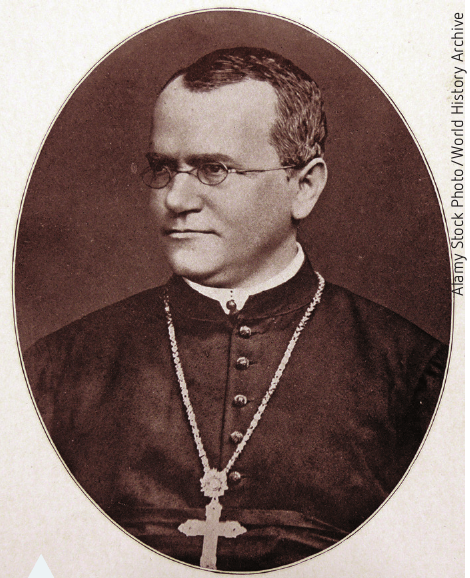
Inheritance patterns have fascinated scientists for over 170 years. Gregor Mendel, often called the father of genetics, proposed a mathematical model to predict the ratios of offspring from any two specific parents. His work laid the foundation for all modern inheritance patterns.
Note
Mendel's laws became particularly important when combined with Darwin's theory of evolution by natural selection. This combination led to the development of modern synthesis, which merged Mendelian genetics with evolutionary theory to create our current understanding of evolution (also called neo-Darwinism).
Modern genetics terminology
Before exploring inheritance patterns, it's essential to understand key genetic terms that form the foundation of modern genetics.
Genes and alleles
A gene is a segment of DNA on a chromosome that determines a particular characteristic. For example, in pea plants, one gene determines stem length, whilst another determines seed colour.
Alleles are different versions of the same gene. They:
- Occur in pairs in diploid individuals
- Occupy identical positions (called loci, singular: locus) on pairs of homologous chromosomes
- Separate during gamete formation through meiosis
- Appear individually in each haploid gamete
- Pair up again during fertilisation when the diploid condition is restored
Genotype and phenotype
The genotype is the combination of alleles present in an organism's cells. In simple terms, it's the genetic makeup.
The phenotype is the physical appearance and observable characteristics resulting from gene expression. At a molecular level, phenotype represents the sum of all gene products (proteins and RNA) that are produced. These determine not only physical appearance but also behaviour and functioning.
Important
Phenotype results from both genotype and environmental factors. For instance, a person's final height depends on their genetic potential and their nutrition during growth. Poor nutrition may prevent someone from reaching their genetically-determined height.
Homozygous and heterozygous genotypes
Mendel originally used the terms "pure-breeding" and "hybrid." In modern genetics, these are known as:
- Homozygous: having two identical alleles (e.g., or ). The term comes from homo (the same) and zygote (fertilised egg).
- Heterozygous: having two different alleles (e.g., )
Diploid and haploid cells
- Diploid individuals have two alleles of each gene (one from each parent)
- Haploid cells (gametes) have only one allele of each gene
Autosomal recessive inheritance
Mendel's model of inheritance applies under specific conditions, creating what we now call autosomal recessive inheritance. This pattern occurs when certain key conditions are met.
Important
Seven key conditions for autosomal recessive inheritance:
- Each characteristic is controlled by a pair of inherited factors (alleles), one from each parent
- Alleles pass from generation to generation according to predictable ratios
- Alleles in an individual may be the same (homozygous) or different (heterozygous)
- In heterozygous individuals, the dominant allele is expressed whilst the recessive allele is masked
- A recessive trait only appears when both alleles are recessive
- During gamete formation, allele pairs segregate so each gamete receives only one allele
- When studying multiple traits, allele pairs separate independently of each other
Notation for alleles
Note
Scientists use letters to represent alleles:
- Capital letter for the dominant allele (e.g., for tall)
- Lower case letter for the recessive allele (e.g., for short)
The capital and lower case versions of the same letter always represent dominant and recessive alleles of the same genetic trait.
Mendel's laws
Mendel's first law: dominance and segregation
This fundamental law states that:
- Characteristics are determined by factors (alleles) occurring in pairs
- Only one member of an allele pair can be present in any gamete (segregation)
- Offspring inherit one factor from each parent
- When two heterozygous individuals breed, they produce offspring in a ratio of approximately 3:1 (dominant:recessive phenotype)
Mendel's second law: independent assortment
This law explains how variation arises during meiosis:
- When individuals with two or more pairs of contrasting characteristics are crossed, different pairs of factors separate independently
- For example, crossing tall plants with yellow pods and short plants with green pods produces some tall green offspring and some short yellow offspring
- This law assumes genes are located on different chromosomes
Mendel's monohybrid cross
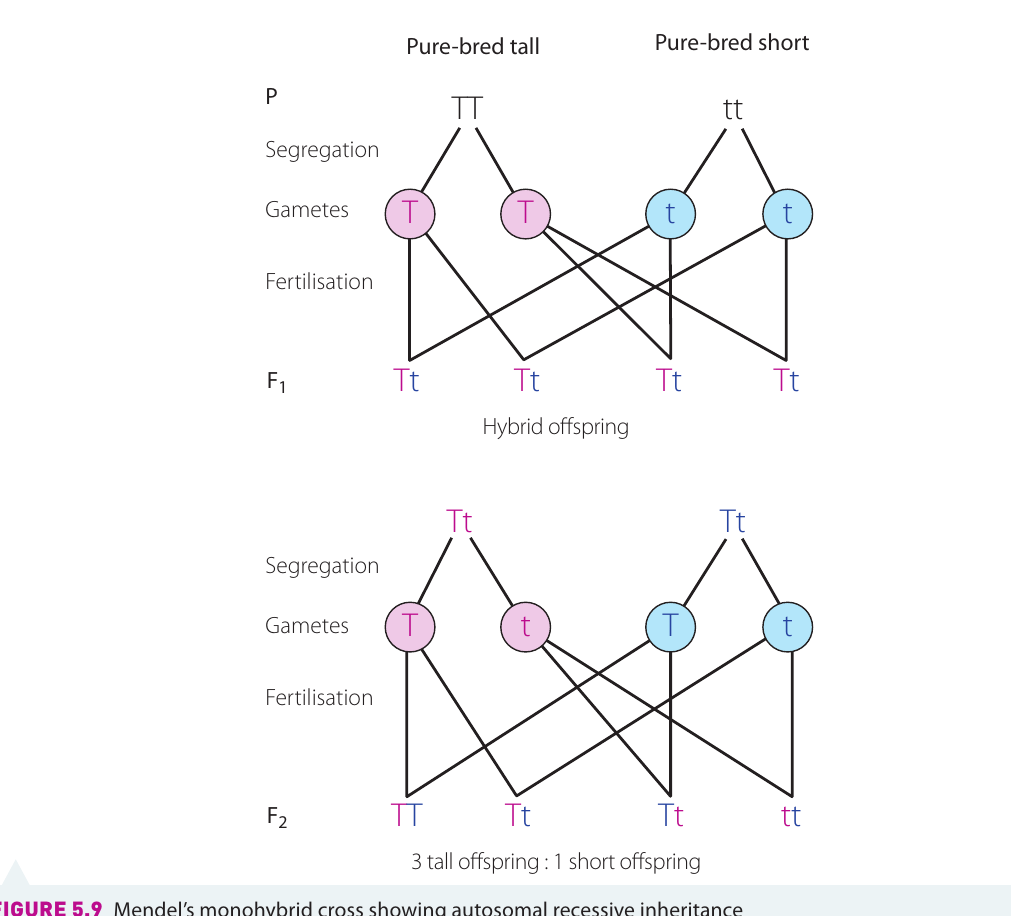
Mendel's classic experiment involved crossing pure-breeding (homozygous) parents with contrasting traits. This elegant experiment demonstrated the fundamental principles of inheritance.
Example
Worked Example: Classic Monohybrid Cross
P generation (parents): Pure-bred tall () Pure-bred short ()
F₁ generation (first filial): All offspring were tall () - heterozygous hybrids
F₂ generation (second filial): When F₁ hybrids were crossed, offspring appeared in a ratio of 3 tall : 1 short
Genotypic ratio:
Phenotypic ratio: tall : short
This can be expressed as probabilities:
- 75% probability of tall offspring
- 25% probability of short offspring
Note
These ratios are based on probability and require large sample sizes. Mendel obtained ratios close to, but not exactly, 3:1 in his experiments.
Solving genetics problems with Punnett squares
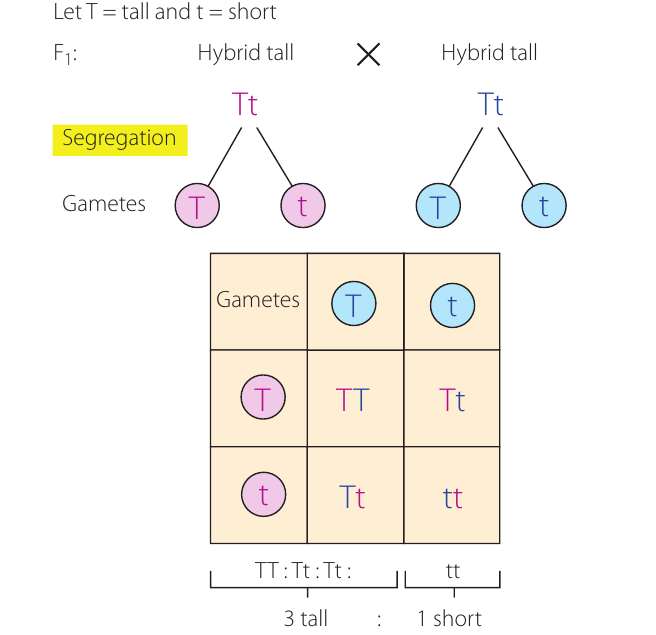
A Punnett square is a problem-solving tool that helps predict the outcomes of genetic crosses. It shows how alleles segregate during gamete formation and the possible combinations during fertilisation.
Note
How to construct a Punnett square:
- Write the parent genotypes to be crossed
- Show how gametes segregate during meiosis
- Draw a 3 × 3 grid
- Write one set of gametes across the top
- Write the other set of gametes down the side
- Fill in each box with the resulting genotype combinations
- Calculate genotypic and phenotypic ratios
Example
Worked Example: Using a Punnett Square
Crossing two heterozygous tall pea plants ():
Gametes from each parent: and
Punnett square results:
- (tall) - 1 offspring
- (tall) - 2 offspring
- (short) - 1 offspring
Genotypic ratio: 1TT : 2Tt : 1tt
Phenotypic ratio: 3 tall : 1 short
Test crosses
Sometimes an organism's genotype cannot be determined from its phenotype alone. For example, a tall pea plant could be either or .
A test cross determines whether an organism showing a dominant trait is homozygous dominant or heterozygous. The method involves crossing the organism in question with an organism that is homozygous recessive.
Example
Worked Example: Drosophila Wing Length Test Cross
Long wings () are dominant to short/vestigial wings ().
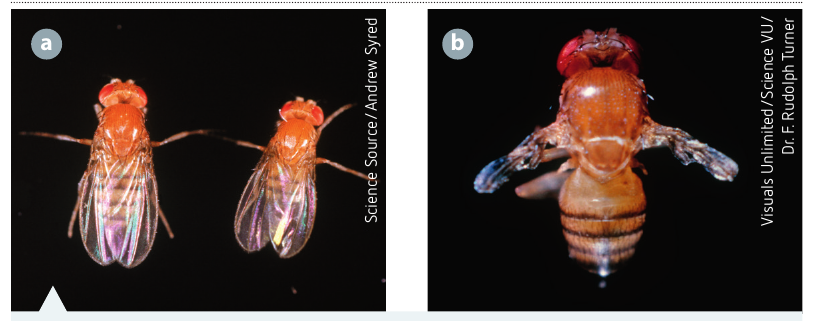
If the long-winged parent is homozygous ():
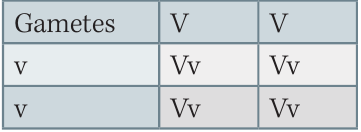
All offspring will have long wings () - 100% long-winged
If the long-winged parent is heterozygous ():
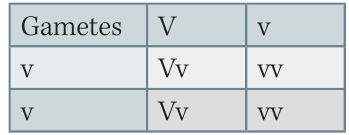
Offspring ratio will be 1:1 (50% long-winged : 50% short-winged )
Pedigree analysis
A pedigree chart (family tree) traces the inheritance of a particular trait through multiple generations. These charts use standardised symbols to record phenotypes and help determine genotypes.
Standard pedigree symbols
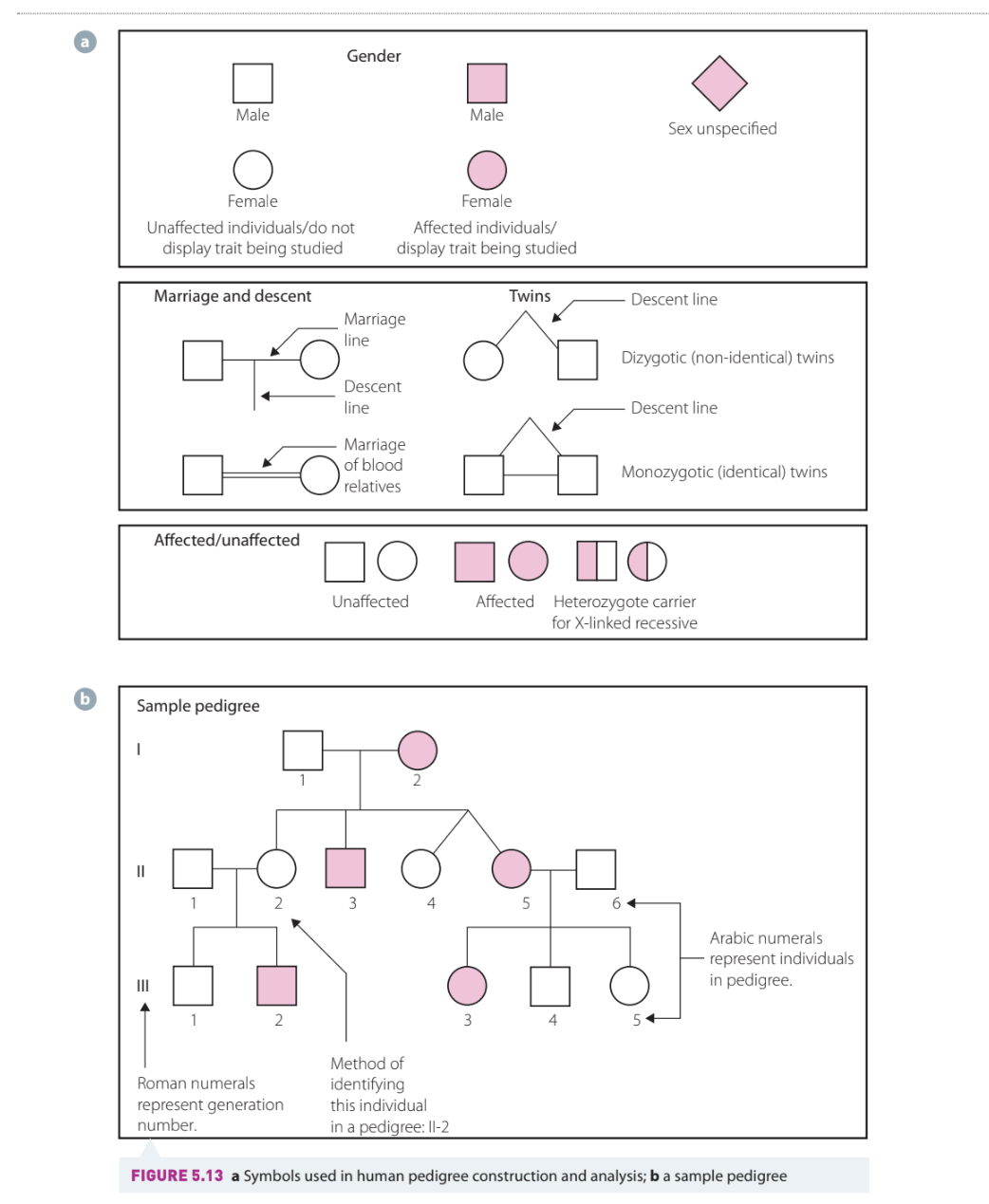
- Squares = males
- Circles = females
- Shaded symbols = individuals expressing the trait being studied
- Horizontal lines = marriages/matings
- Vertical lines = offspring relationships
- Roman numerals = generation numbers (I, II, III)
- Arabic numerals = individual numbers within each generation
Constructing a pedigree chart
Note
Steps for constructing a pedigree:
- Gather phenotypic information about family members over several generations
- Use correct symbols to represent males and females
- Shade symbols for individuals expressing the trait
- Connect family members with appropriate lines
- Number generations with Roman numerals
- Number individuals within each generation with Arabic numerals
Uses of pedigree charts
Pedigree analysis helps to:
- Record how many family members have a trait
- Identify the gender of affected individuals
- Determine relationships between family members
- Identify inheritance patterns (dominant, recessive, etc.)
- Assign genotypes where possible
- Predict probability of future offspring inheriting the trait
Analysing pedigree charts
To determine genotypes from a pedigree:
- Record known genotypes from phenotypes (use underscore _ for unknown alleles)
- Analyse crosses using logic
- Look for patterns (e.g., do unaffected parents have affected children?)
- Make deductions based on Mendelian ratios
- Fill in missing genotypes
Important
Key insight: Recessive traits may "skip" a generation because they can be masked in heterozygous individuals. Studying three generations often reveals hidden recessive alleles.
Autosomal inheritance patterns
| Type | Features | Examples |
|---|---|---|
| Autosomal recessive | - Affected individuals must have two recessive alleles - Affects males and females equally - Often skips generations | - Albinism - Cystic fibrosis - Sickle cell anaemia |
| Autosomal dominant | - Only one dominant allele needed - Affects males and females equally - Does not skip generations | - Huntington's disease - Polydactyly |
Probability in genetics
Genetic ratios are based on probability and become more accurate with larger sample sizes.
For a typical monohybrid cross ():
- Probability of tall offspring = or 75%
- Probability of short offspring = or 25%
Note
When Mendel studied hundreds of pea plants, his ratios approached (but didn't exactly match) 3:1. For example:
- Height: 787 tall : 277 short = 2.84:1
- Seed colour: 6022 yellow : 2001 green = 3.01:1
This demonstrates the importance of large sample sizes in genetic studies.
Remember!
Summary
Key Points to Remember:
- Genotype is the genetic makeup; phenotype is the observable characteristics
- Dominant alleles are expressed in the phenotype; recessive alleles are masked in heterozygous individuals
- Homozygous means two identical alleles ( or ); heterozygous means two different alleles ()
- Mendel's monohybrid cross produces a 3:1 phenotypic ratio and 1:2:1 genotypic ratio in the F₂ generation
- Punnett squares help predict offspring ratios from genetic crosses
- Test crosses determine whether an organism is homozygous dominant or heterozygous
- Pedigree charts trace traits through generations and help identify inheritance patterns
- Genetic ratios are based on probability and require large sample sizes for accuracy