Genetics and Disease: Large-Scale Data (HSC SSCE Biology): Revision Notes
📚Revision Notes
Genetics and Disease: Large-Scale Data
Introduction to genetics and disease
Modern genetics allows us to study how genetic variations cause disease in human populations. With advances in DNA sequencing technology, scientists can now analyse genetic data from thousands of individuals to identify disease-causing mutations and understand inheritance patterns across different populations.
Monogenic diseases
What are monogenic diseases?
A monogenic disease is a condition caused by a mutation in a single gene that affects all cells in the body. These diseases follow predictable inheritance patterns and can be passed from parents to offspring.
Note
Scientists estimate there are more than different monogenic diseases affecting humans. While each individual disease is relatively rare, together they affect millions of people worldwide.
The global prevalence of monogenic diseases at birth is approximately 10 in every 1,000 births.
Example: alkaptonuria
Example
Worked Example: Understanding Alkaptonuria as a Genetic Disease
Alkaptonuria, also called black urine disease, provides an early example of understanding genetic disease. In this condition, the body cannot properly metabolise two amino acids (phenylalanine and tyrosine) found in protein. The first noticeable symptom is unusually dark urine that turns black when exposed to air.
Historical breakthrough: In the early 20th century, scientist Archibald Garrod demonstrated that alkaptonuria is inherited as a recessive trait by studying family histories of affected patients.
Modern genetic understanding: Later research using DNA sequencing identified the specific cause: a mutation in the HGD gene on chromosome 3. This gene codes for the enzyme homogentisate 1,2-dioxygenase, which is needed to break down those amino acids.
Single nucleotide polymorphisms (SNPs)
Understanding SNPs
The most common type of genetic variation in human DNA consists of single base pair differences called single nucleotide polymorphisms, abbreviated as SNPs (pronounced "snips"). These are locations where one DNA base differs between individuals.
Note
For example, most people might have the sequence AAGCCTA at a particular location, whilst others have AAGCTTA (with a T instead of C). This single letter change is a SNP.
SNPs in genetic testing
SNPs are extremely useful for genetic testing because:
- They are easy to detect using modern technology
- Specific SNPs are associated with particular diseases
- Testing can be performed quickly and accurately
- They can identify disease risk before symptoms appear
Many genetic screening programs look for SNPs known to cause or increase the risk of genetic diseases. This allows early diagnosis and treatment planning.
Large-scale genetic screening programmes
Newborn screening in New South Wales
New South Wales runs a comprehensive newborn screening programme that provides free genetic testing for all newborns. This programme screens for SNPs associated with numerous congenital (present at birth) conditions.
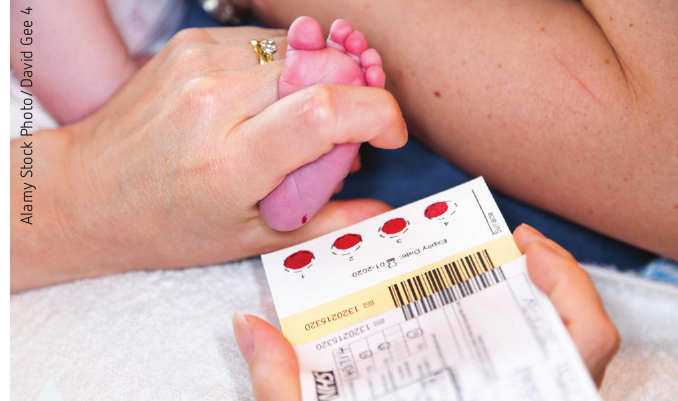
The screening tests for conditions including:
- Phenylketonuria
- Congenital hypothyroidism
- Cystic fibrosis
- Galactosaemia
- Fatty acid oxidation disorders
- Urea cycle disorders
- Many other genetic conditions
Benefits of large-scale screening
Large-scale genetic screening programmes provide multiple benefits:
Note
For individuals:
- Early detection before symptoms develop
- Improved treatment options when intervention begins early
- Better health outcomes through prompt medical care
For population genetics research:
- Data collection about how common specific genetic conditions are
- Information about genetic variation in the population
- Understanding of which populations are most affected
- Evidence to improve public health strategies
Gene mutation databases
As genetic sequencing becomes faster and cheaper, researchers have created specialized databases to store and organize mutation data.
Human Gene Mutation Database (HGMD)
The HGMD stores comprehensive information about germline mutations - genetic changes in reproductive cells that can be inherited and passed to offspring. This database focuses specifically on mutations that cause inherited diseases in humans.
COSMIC database
COSMIC (Catalogue of Somatic Mutations in Cancer) stores information about somatic mutations - genetic changes that occur in body cells during a person's lifetime. These mutations are not inherited but can cause cancer to develop.
MITOMAP database
MITOMAP focuses specifically on mutations in mitochondrial DNA. Because mitochondria have their own small genome separate from nuclear DNA, they require a dedicated database for tracking mutations that affect mitochondrial function.
Note
These databases are essential tools for:
- Diagnosing genetic diseases
- Researching disease mechanisms
- Identifying treatment targets
- Understanding population genetics
Case study: BRCA1 and BRCA2 genes
Understanding breast cancer genes
The BRCA1 and BRCA2 genes represent an important case study in genetics and disease. These genes are tumour suppressor genes that normally protect against cancer development.
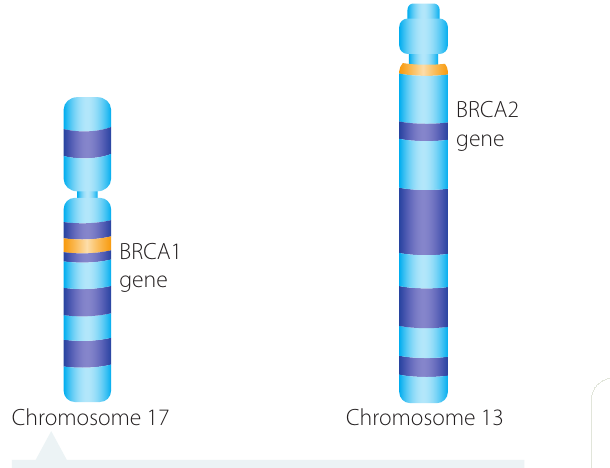
- BRCA1 is located on chromosome 17
- BRCA2 is located on chromosome 13
Normal function of BRCA genes
In healthy individuals, BRCA1 and BRCA2 genes code for proteins that repair damaged DNA and regulate cell division. These proteins are essential for:
- Fixing errors in DNA replication
- Preventing cells from dividing uncontrollably
- Maintaining genetic stability
- Stopping tumour formation
Mutations and cancer risk
Important
When deleterious mutations (harmful changes) occur in BRCA1 or BRCA2 genes, the repair proteins don't function properly. This means:
- DNA damage accumulates in cells
- Genes controlling cell division aren't repaired
- Cells may begin dividing uncontrollably
- Cancer, particularly breast and ovarian cancer, becomes more likely
One woman in 600 carries BRCA1 or BRCA2 mutations. Women with these mutations have up to 85% increased risk of developing "basal-like" breast cancer - a particularly aggressive form that is difficult to control and treat.
Prevalence in different populations
Large-scale population studies have examined how common BRCA mutations are in different ethnic groups. A major study analysed 46,276 women from various ancestries.
| Ethnicity | Number of subjects | BRCA1 (%) | BRCA2 (%) | Total (%) |
|---|---|---|---|---|
| Western European | 36,235 | 6.9 | 5.2 | 12.1 |
| Central European | 4,066 | 8.3 | 5.3 | 13.5 |
| Latin American | 1,936 | 9.6 | 5.4 | 14.8 |
| African | 1,767 | 10.2 | 5.7 | 15.6 |
| Asian | 1,183 | 6.3 | 6.3 | 12.7 |
| Native American | 597 | 7.4 | 5.9 | 13.2 |
| Middle Eastern | 492 | 6.1 | 3.3 | 9.4 |
| Total | 46,276 | 7.2 | 5.3 | 12.5 |
Note
Key findings from this data:
- Overall, 12.5% of women in the study carried deleterious BRCA1 or BRCA2 mutations
- African women showed the highest prevalence of BRCA1 mutations (10.2%)
- Asian women showed the highest prevalence of BRCA2 mutations (6.3%)
- Middle Eastern women showed the lowest overall prevalence (9.4%)
- For most ethnic groups, BRCA1 mutations were more common than BRCA2 mutations, except in Asian populations where they were equal
Cancer risk over time
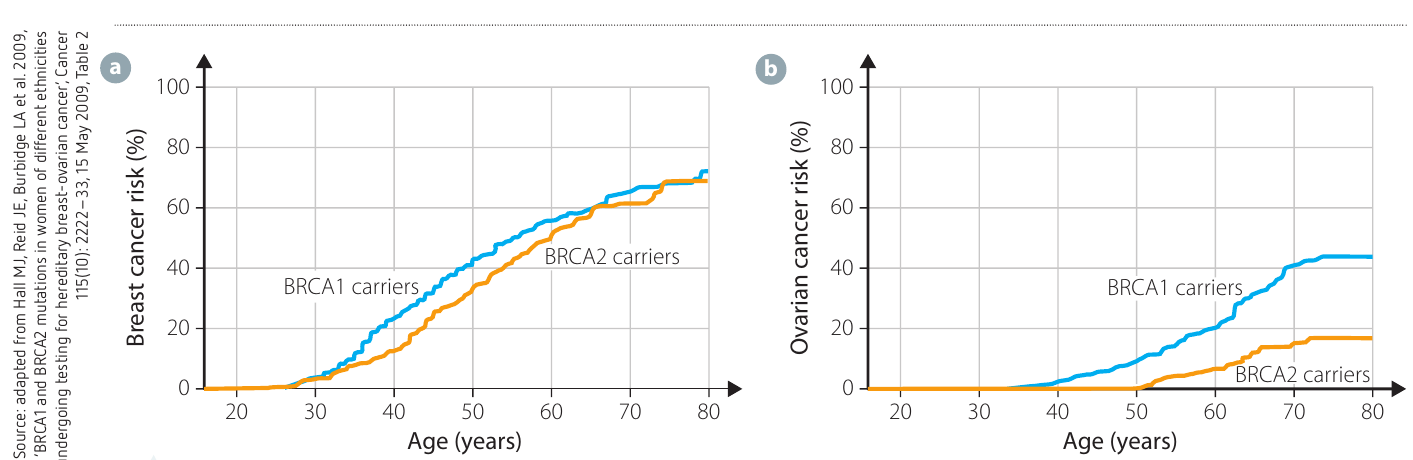
The presence of BRCA mutations significantly increases cancer risk, and this risk accumulates throughout a person's lifetime.
Important
Breast cancer risk:
- Both BRCA1 and BRCA2 carriers show similar patterns
- Risk increases steadily with age
- By age 80, approximately 70% of carriers will have developed breast cancer
- Risk begins to rise notably from around age 30
Ovarian cancer risk:
- BRCA1 carriers face much higher risk than BRCA2 carriers
- BRCA1 carriers reach approximately 40-45% cumulative risk by age 80
- BRCA2 carriers reach only 15-20% cumulative risk by age 80
- Risk increases more gradually than breast cancer risk
- Significant differences become apparent after age 40
Importance for healthcare
Understanding BRCA mutations and their associated risks has important implications:
For individuals:
- Genetic testing can identify carriers before symptoms appear
- High-risk individuals can undergo more frequent screening
- Preventative measures may be considered
- Family planning decisions can be informed
For population health:
- Different ethnic populations have different risk levels
- Screening programmes can be targeted to high-risk groups
- Research can focus on understanding why certain populations are more affected
- Treatment strategies can be developed based on mutation type
Remember!
Summary
Key Points to Remember:
-
Monogenic diseases are caused by mutations in a single gene and affect approximately 10 in every 1,000 births worldwide.
-
SNPs (single nucleotide polymorphisms) are single base pair differences in DNA that can be easily tested to identify genetic diseases and individual risk factors.
-
Large-scale genetic screening programmes, like NSW's newborn screening, enable early detection of genetic conditions, improving treatment outcomes whilst generating valuable population data.
-
Specialized databases (HGMD, COSMIC, MITOMAP) organize genetic mutation data to support research, diagnosis, and treatment of inherited diseases and cancer.
-
BRCA1 and BRCA2 genes are tumour suppressor genes located on chromosomes 17 and 13 respectively. Mutations significantly increase breast and ovarian cancer risk, with patterns varying across ethnic populations and increasing cumulatively with age.