Manipulation of Reproduction in Agriculture (HSC SSCE Biology): Revision Notes
📚Revision Notes
Manipulation of Reproduction in Agriculture
Introduction to reproductive manipulation in agriculture
Agriculture involves growing and breeding animals, plants and fungi to produce essential resources for human life. This includes food crops, livestock, forestry products, and fisheries. Agricultural products meet diverse human needs including nutrition, clothing, medicines, building materials, and economic livelihood.
Reproductive technology refers to any technological method used to assist and enhance the reproductive process in plants and animals. Humans have been manipulating reproduction in agricultural species for hundreds of years. As our scientific understanding of reproductive biology has advanced, the techniques have become increasingly sophisticated and effective.
Note
The manipulation of reproduction in agriculture is not a new concept. Farmers have been selectively breeding animals and plants for desirable traits for centuries. What has changed is our scientific understanding, which has enabled the development of much more precise and effective techniques.
The primary purpose of using reproductive technologies in agriculture is to improve both the quality and quantity of food production. This benefits farmers through increased yields and consumers through better products.
Scientific knowledge underlying reproductive technologies
Successful manipulation of reproduction requires detailed understanding of several biological processes:
- Seasonal breeding patterns - knowing when animals naturally reproduce
- Hormonal regulation - understanding how hormones control reproduction
- The oestrous cycle - the reproductive cycle in female mammals
- Ovulation control - managing when eggs are released
- Pregnancy and embryonic development - how offspring develop
Note
This scientific foundation has enabled the development of various reproductive technologies that can be applied in farming practice. Without understanding these fundamental processes, modern reproductive technologies would not be possible.
Categories of reproductive technologies
Reproductive technologies can be divided into two main categories based on the stage of reproduction they target.
Technologies manipulating fertilisation
These techniques intervene at the point where gametes (sex cells) meet:
- Artificial insemination (AI) - manually introducing sperm to fertilise an egg
- In vitro fertilisation (IVF) - fertilising eggs outside the body in laboratory conditions
- Artificial pollination - manually transferring pollen between plants
Note
Fertilisation technologies focus on controlling when and how gametes meet. These techniques are particularly useful for breeding from superior males without the need for natural mating, and for overcoming fertility problems in animals or plants.
Technologies involving embryos
These techniques work with embryos after fertilisation has occurred:
- Embryo splitting - dividing early embryos to create identical offspring
- Cloning - producing genetically identical individuals from embryonic stem cells
- Embryo sexing - identifying the sex of embryos before implantation
- Embryo selection - choosing embryos with desirable characteristics for implantation
Note
Embryo technologies allow farmers to maximize the number of offspring from superior animals and to select for specific traits before birth. This can significantly accelerate genetic improvement in livestock populations.
Hormonal regulation in reproduction
Understanding hormonal control systems is essential for many reproductive technologies. The cow oestrous cycle provides an excellent example of how complex hormonal interactions regulate reproduction in mammals.
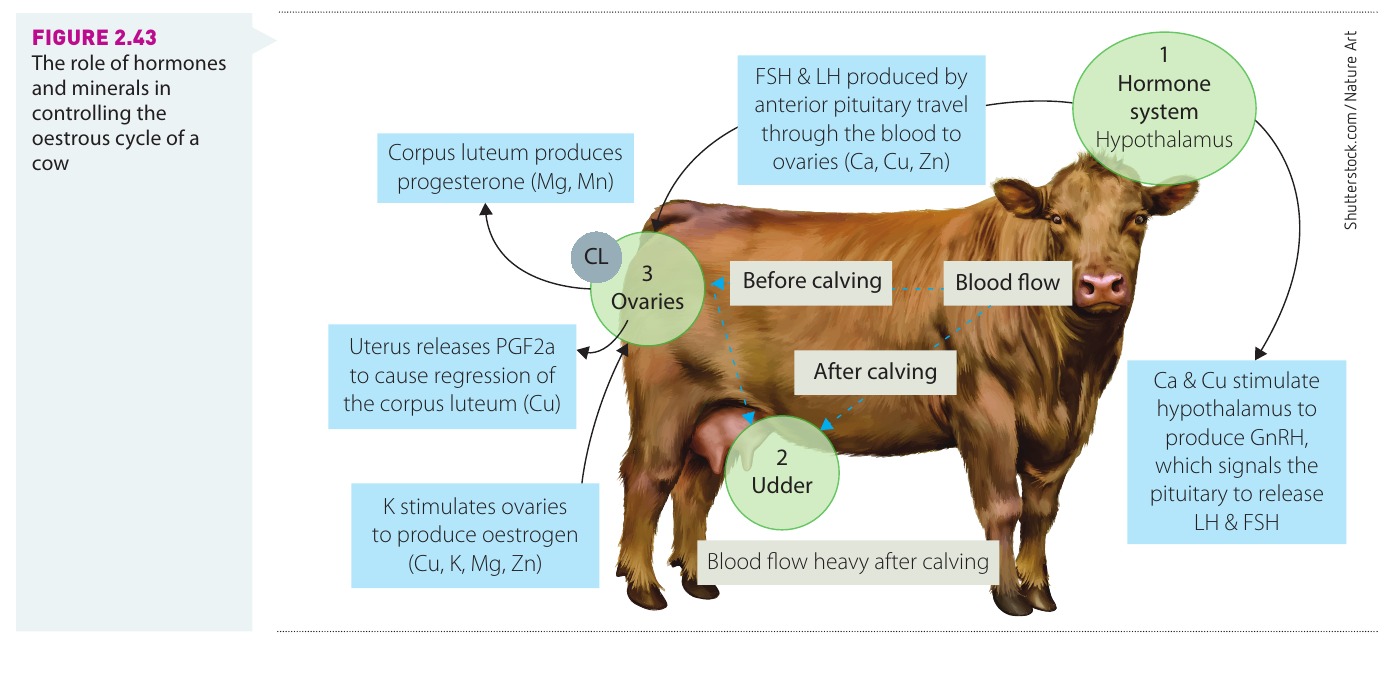
The cow oestrous cycle
The reproductive cycle in cows is controlled by an intricate feedback system involving multiple hormones and organs:
Example
Understanding the Hormonal Cascade in the Cow Oestrous Cycle
The cycle operates through a step-by-step hormonal cascade:
Step 1: Brain Initiation The hypothalamus (part of the brain) produces (gonadotropin-releasing hormone). This production is stimulated by the minerals calcium () and copper ().
Step 2: Pituitary Response The pituitary gland responds to by releasing two important hormones:
- (follicle-stimulating hormone)
- (luteinising hormone)
These hormones travel through the bloodstream to the ovaries. This process requires calcium (), copper (), and zinc ().
Step 3: Ovarian Activity The ovaries respond to and by producing oestrogen. The mineral potassium () helps stimulate this oestrogen production. Other minerals including copper (), potassium (), magnesium (), and zinc () also play supporting roles.
Step 4: Pregnancy Maintenance The corpus luteum (a temporary structure in the ovary) produces progesterone, which maintains pregnancy if fertilisation occurs. This process depends on magnesium () and manganese ().
Step 5: Cycle Reset The uterus releases (prostaglandin F2 alpha) which causes the corpus luteum to break down if pregnancy does not occur. Copper () is required for this process.
Important
The diagram also shows how blood flow patterns change before and after calving (giving birth), with particularly heavy blood flow to the udder after calving to support milk production. This demonstrates how the reproductive system integrates with other physiological systems.
The role of minerals
An important aspect of reproductive management is ensuring animals receive adequate mineral nutrition. As shown in the diagram, specific minerals activate or support the action of reproductive hormones:
- Calcium and copper - stimulate the hypothalamus
- Potassium - helps ovaries produce oestrogen
- Magnesium and manganese - support progesterone production
- Zinc - supports multiple stages of hormone production
Note
This knowledge allows farmers to optimize animal nutrition to improve reproductive success. Mineral deficiencies can lead to reproductive problems, so understanding these relationships is crucial for effective herd management.
Framework for evaluating reproductive techniques
When studying any reproductive technology used in agriculture, it is important to consider four key questions:
What scientific knowledge was required?
Identify the specific understanding of reproductive biology that made the technique possible. For example, artificial insemination required knowledge of sperm collection, storage, and the timing of the oestrous cycle.
What is the technique and when was it introduced?
Name the specific reproductive technology and provide historical context about when it first became available for agricultural use.
How does the technique manipulate reproduction?
Explain the practical steps involved in using the technique on plants or animals. Describe what happens during the procedure.
What is the impact of this knowledge?
Evaluate both positive and negative consequences:
- Advantages - benefits to farmers, consumers, or animal welfare
- Disadvantages - costs, practical difficulties, or negative outcomes
- Ethical concerns - moral questions raised by the technique
Note
This framework provides a structured approach to analyzing any reproductive technology. By considering all four aspects, you can develop a comprehensive understanding of both the science and the implications of these techniques.
Ethical and practical considerations
The use of reproductive technologies in agriculture raises important concerns that must be balanced against the benefits.
Animal welfare issues
Some reproductive techniques may cause:
- Physical stress to animals during procedures
- Psychological stress from handling and intervention
- Health complications from hormonal manipulation
- Reduced natural behaviour and reproduction
Environmental concerns
Intensive use of reproductive technologies can lead to:
- Reduced genetic diversity in livestock and crops
- Environmental stress from increased production demands
- Resource consumption associated with technology use
Balancing benefits and concerns
Important
The goal of modern agricultural practice is to reduce ethical concerns while optimising benefits for both farmers and consumers. This requires:
- Careful consideration of animal welfare in all procedures
- Monitoring and minimizing environmental impacts
- Weighing the advantages of increased food production against potential harms
- Developing and following ethical guidelines for technology use
Farmers, scientists, and policymakers must work together to ensure reproductive technologies are used responsibly.
Remember!
Summary
Key Points to Remember:
-
Agriculture involves growing and breeding organisms to produce food, fibres, and other resources for human use.
-
Reproductive technologies are tools that assist and improve reproduction, ranging from artificial insemination to embryo manipulation techniques.
-
Scientific knowledge about hormonal regulation, the oestrous cycle, and embryonic development underpins all modern reproductive technologies.
-
The cow oestrous cycle demonstrates complex hormonal feedback involving the hypothalamus, pituitary, ovaries, and uterus, with minerals playing crucial supporting roles.
-
Two main categories of reproductive technologies exist: those manipulating fertilisation (like AI and IVF) and those involving embryos (like cloning and embryo selection).
-
Evaluation of reproductive techniques should consider the scientific knowledge required, how the technique works, and its advantages, disadvantages, and ethical implications.
-
Ethical considerations including animal stress and environmental impacts must be balanced against the benefits of improved agricultural productivity.