Identifying Anions in Solution (HSC SSCE Chemistry): Revision Notes
📚Revision Notes
Identifying Anions in Solution
Introduction to anion testing
When analysing unknown chemical samples, identifying the anions (negatively charged ions) present is essential. In this topic, you'll learn systematic methods to identify eight common anions found in aqueous solutions. These anions are particularly important in Australian HSC Chemistry and include:
- Chloride ()
- Bromide ()
- Iodide ()
- Hydroxide ()
- Acetate ()
- Carbonate ()
- Sulfate ()
- Phosphate ()
We identify anions primarily through precipitation reactions, where the anion combines with a test reagent to form an insoluble solid (precipitate). The key to successful identification lies in understanding which reagents to use, what observations to expect, and how to confirm your results when precipitates look similar.
Overview of precipitation reactions for anion identification
Precipitation reactions form the basis of anion testing. When you add a specific metal cation solution to a sample containing an anion, they may combine to form an insoluble salt that appears as a solid precipitate. The formation, colour, and properties of these precipitates help identify which anion is present.
However, several challenges exist with this approach:
Note
Understanding the Challenges of Precipitation Testing
Several metal ions react with multiple different anions, so a single test rarely provides definitive identification. You need a systematic approach using multiple tests to accurately identify the anion present.
Multiple reactions: Several metal ions react with multiple different anions, so a single test rarely provides definitive identification. You need a systematic approach using multiple tests.
pH sensitivity: Whether a precipitate forms often depends on the solution's pH. Some precipitates only form in acidic conditions, while others require alkaline conditions. This pH dependence is actually useful—by controlling pH, we can distinguish between similar anions.
Similar appearances: Precipitate colours can be quite similar, making visual identification alone unreliable. For example, silver bromide and silver iodide precipitates are both pale coloured and difficult to distinguish without further testing.
Confirmatory tests: Because of these challenges, we often need confirmatory tests—additional procedures that verify the presence of a specific anion after an initial positive result.
Systematic tests for anions
The following table summarises the standard tests for each anion. You should understand the principle behind each test, the expected observations, and when confirmatory tests are necessary.
Standard test procedures
| Anion | Test Procedure | Expected Observation |
|---|---|---|
| Carbonate () | 1. Test pH with pH paper 2. Add dilute | 1. pH between 8 and 11 2. Bubbles of colourless gas () produced; gas turns limewater milky |
| Hydroxide () | 1. Test with red litmus paper 2. Add and heat gently | 1. pH > 7, red litmus turns blue 2. Ammonia gas produced |
| Chloride () | Add to acidified sample | White precipitate forms, dissolves in dilute ammonia solution, darkens in sunlight |
| Bromide () | Add to acidified sample | Pale cream precipitate forms, dissolves in concentrated ammonia solution, darkens slowly in sunlight |
| Iodide () | 1. Add to acidified sample 2. Add | 1. Pale yellow precipitate forms, does not dissolve in ammonia, not affected by sunlight 2. Yellow precipitate |
| Sulfate () | 1. Add to acidified sample 2. Add after acidification | 1. Thick white precipitate 2. White precipitate |
| Phosphate () | 1. Add ammonia then 2. Add in ammonia/ammonium nitrate buffer 3. Acidify with , add ammonium molybdate solution and warm | 1. White precipitate 2. White precipitate of 3. Yellow precipitate (may need warming) |
| Acetate () | 1. Smell aqueous solution 2. Add neutral , filter, add dilute | 1. May have vinegar smell 2. Reddish brown solution forms; colour disappears on adding Note: Does not precipitate with most cations except concentrated |
Important
Critical Testing Requirement
When testing with silver nitrate, acidification is essential to prevent false positives. In non-acidic solutions, silver nitrate can also precipitate with carbonate and phosphate ions (and with sulfate if concentration is moderately high), so you must prove the absence of sulfate to confirm chloride presence.
Testing for alkaline anions
Carbonate, hydroxide, and acetate identification
Three of the anions you'll test produce alkaline solutions: carbonate, hydroxide, and acetate. Understanding why these solutions are alkaline helps you remember the tests.
Why are these solutions alkaline?
- Hydroxide ions () are directly alkaline—they're the defining component of bases
- Carbonate ions () act as bases by accepting protons from water in a hydrolysis reaction
- Acetate ions () are the conjugate base of acetic acid (a weak acid), so they also undergo hydrolysis to produce hydroxide ions
Because all three give alkaline solutions, pH testing with litmus paper provides only initial information—it tells you one of these anions is present but doesn't identify which one.
Note
The Role of pH in Initial Screening
pH testing with litmus paper is a useful starting point, but it only tells you that an alkaline anion is present—it cannot distinguish between carbonate, hydroxide, and acetate. You must conduct additional tests to identify which specific anion you have.
Distinguishing between alkaline anions
Carbonate test:
The key distinguishing feature of carbonate ions is their reaction with acids. When you add dilute nitric acid to a carbonate solution, carbon dioxide gas is produced:
You'll observe bubbles of colourless gas. To confirm this gas is carbon dioxide, bubble it through limewater (calcium hydroxide solution)—the limewater turns milky due to the formation of calcium carbonate precipitate. While hydroxide ions neutralise acids to produce salt and water, only carbonates produce the characteristic effervescence (bubbling).
Acetate test:
Acetate ions don't form precipitates with most metal cations at dilute concentrations, so negative results for other tests can indicate acetate presence. This makes acetate identification somewhat challenging—you're looking for the "absence of results."
However, two positive confirmatory tests exist:
- Vinegar smell: If the concentration is high enough, the solution may smell like vinegar (acetic acid)
- Iron(III) chloride test: This two-part confirmatory test is more reliable:
- Add neutral iron(III) chloride solution to the sample. A reddish brown coloured filtrate forms due to formation
- If a precipitate forms (from the chloride ion reacting with the cation in your sample), filter the mixture and test the filtrate
- Divide the filtrate into two portions:
- Add water to one portion and heat strongly—a reddish brown precipitate of should form
- Add dilute to the other portion—the reddish colour should disappear
The equation for the heating reaction is:
Testing for halide ions
Silver nitrate test for chloride, bromide, and iodide
The three halide ions you'll test—chloride, bromide, and iodide—all form precipitates with silver ions. This makes silver nitrate () the primary test reagent for halides. However, because fluoride doesn't precipitate with silver, this test specifically identifies the heavier halides.
Why acidify the sample?
Before adding silver nitrate, you must acidify the sample with dilute nitric acid. This prevents false positive results from other anions like carbonate and phosphate, which also form precipitates with silver ions in neutral or alkaline solutions. The acid removes these interfering anions before testing.
Important
Common Mistake: Forgetting to Acidify
Students often forget to acidify before testing with silver nitrate. Without acidification, carbonate and phosphate ions will also precipitate, giving false positive results. Always acidify with dilute nitric acid first!
The precipitation reactions:
When silver nitrate is added to acidified solutions containing halides, the following reactions occur:
While the precipitate colours differ slightly, they can be difficult to distinguish, especially between silver bromide and silver iodide. This is where confirmatory testing becomes essential.
Note
Remembering Precipitate Colours
Use the mnemonic "WCY" to remember the colours: White Chloride, Cream Bromide, Yellow Iodide. The colours progress from white to yellow as you move down the halogen group.
Ammonia confirmatory test for halides
The solubility of silver halides in ammonia solution provides an excellent confirmatory test. The three halides show distinctly different behaviour:
- Silver chloride dissolves in dilute ammonia solution
- Silver bromide dissolves only in concentrated ammonia solution
- Silver iodide does not dissolve in either dilute or concentrated ammonia
Why does ammonia dissolve silver halides?
Ammonia acts as a ligand, forming a complex ion with silver. When ammonia is added to silver chloride, the ammonia molecules bond to the silver ions, pulling them out of the solid and into solution:
The product is called the diamminesilver(I) ion—a complex ion where two ammonia molecules (ligands) surround the silver ion (central metal ion). This complex ion is soluble, producing a colourless solution.
Silver bromide requires more ammonia to dissolve because the silver-bromine bond is stronger than the silver-chlorine bond:
Silver iodide has such a strong silver-iodine bond that even concentrated ammonia cannot form enough complex ions to dissolve the precipitate.
Note
Exam Tip: Remembering Solubility
Remember the solubility order using the mnemonic "D-C-N":
- Chloride dissolves in Dilute ammonia
- Bromide needs Concentrated ammonia
- Iodide Never dissolves
Testing for sulfate and phosphate
pH-dependent precipitation with barium ions
Both sulfate and phosphate ions form white precipitates with barium ions (), but the pH of the solution dramatically affects phosphate precipitation. Understanding this pH dependence allows you to distinguish between these anions.
Why does pH matter?
In acidic solutions, both sulfate and phosphate exist in equilibrium with their conjugate acids:
The values reveal crucial information. The hydrogen sulfate ion () is a much stronger acid than hydrogen phosphate (), with a value about 10 billion times larger! This means at any given pH, the sulfate ion concentration is much higher than the phosphate ion concentration.
Important
Understanding the pH Effect
The difference in values is critical: sulfate exists predominantly as even in acidic solution, while phosphate remains mostly protonated (as or ) in acidic conditions. This explains why sulfate precipitates at low pH but phosphate doesn't.
Testing at pH < 2 (acidified solution):
When you add barium nitrate to an acidified sample (pH < 2), sulfate ions are present in sufficient concentration to form a thick white precipitate of barium sulfate:
However, phosphate ion concentration is too low to form a precipitate at this pH—the equilibrium is pushed far to the left, keeping most phosphate in its protonated forms.
Testing at pH > 6 (alkaline solution):
Adding ammonia to increase the pH to 10–11 removes ions from solution. This shifts the phosphate equilibrium to the right, increasing the phosphate ion concentration until it's high enough to precipitate with barium:
This pH-dependent behaviour provides a clear distinction: if a white precipitate forms with barium nitrate in acidified solution, sulfate is present; if a precipitate only forms after adding ammonia, phosphate is present.
Additional specific tests for phosphate
Because phosphate is such an important anion in many contexts (environmental analysis, fertilisers, biological systems), two additional specific tests have been developed. These tests have a major advantage: they're specific to phosphate, meaning other anions in the sample won't interfere with the results.
1. Ammonium molybdate test:
This test produces a distinctive yellow precipitate called ammonium phosphate molybdate. Add concentrated nitric acid and ammonium molybdate solution to your sample. If phosphate is present, a yellow precipitate forms (you may need to warm the solution for a few minutes):
The product is a complex compound that can also be written as , showing it contains 12 molybdenum trioxide units.
2. Magnesium ammonia test:
Add magnesium ions in an ammonia/ammonium nitrate buffer solution. A white precipitate of magnesium ammonium phosphate forms:
You may need to let the solution stand for a while for the precipitate to form fully.
Note
Exam Tip: Remembering Phosphate Tests
Remember the three specific phosphate tests with the mnemonic "MAB":
- Magnesium Ammonia test
- Ammonium molybdate test
- Barium test (in alkaline conditions)
Precipitation patterns and solubility rules
Understanding which combinations of cations and anions form precipitates helps you interpret test results and design effective testing sequences. The following table summarises precipitation patterns for common test reagents:
Precipitate formation matrix
| Cation | (alkaline) | (pH < 2) | (pH > 6) | |||||
|---|---|---|---|---|---|---|---|---|
| No | No | No | No | Yes | Yes | No | Yes | |
| Yes | Yes* | Yes | Yes | Yes | Yes | No | Yes | |
| Yes** | Yes*** | Yes**** | Yes***** | Yes* | Yes | No | Yes | |
| Yes | No | No | No | No | Yes | No | Yes |
Notes:
- * Provided concentration is not too low (> 0.05 mol L⁻¹)
- ** Precipitate is brown
- *** White precipitate, dissolves in dilute ammonia
- **** Cream precipitate, dissolves in concentrated ammonia
- ***** Yellow precipitate, does not dissolve in ammonia
Note
Key Observations from This Table
- Silver ions are the most versatile precipitating agent, forming precipitates with almost all the anions you're testing
- Barium ions are particularly useful because they precipitate with sulfate at all pH values
- The pH column for phosphate shows why pH control is critical—phosphate only precipitates with barium in alkaline conditions
- Carbonate cannot exist in acidic solution (pH < 2) because it decomposes to carbon dioxide gas
Systematic identification procedure
When you have an unknown sample containing a single anion, following a systematic procedure ensures you identify it correctly. The flowchart approach starts with simple tests and progressively narrows down the possibilities.
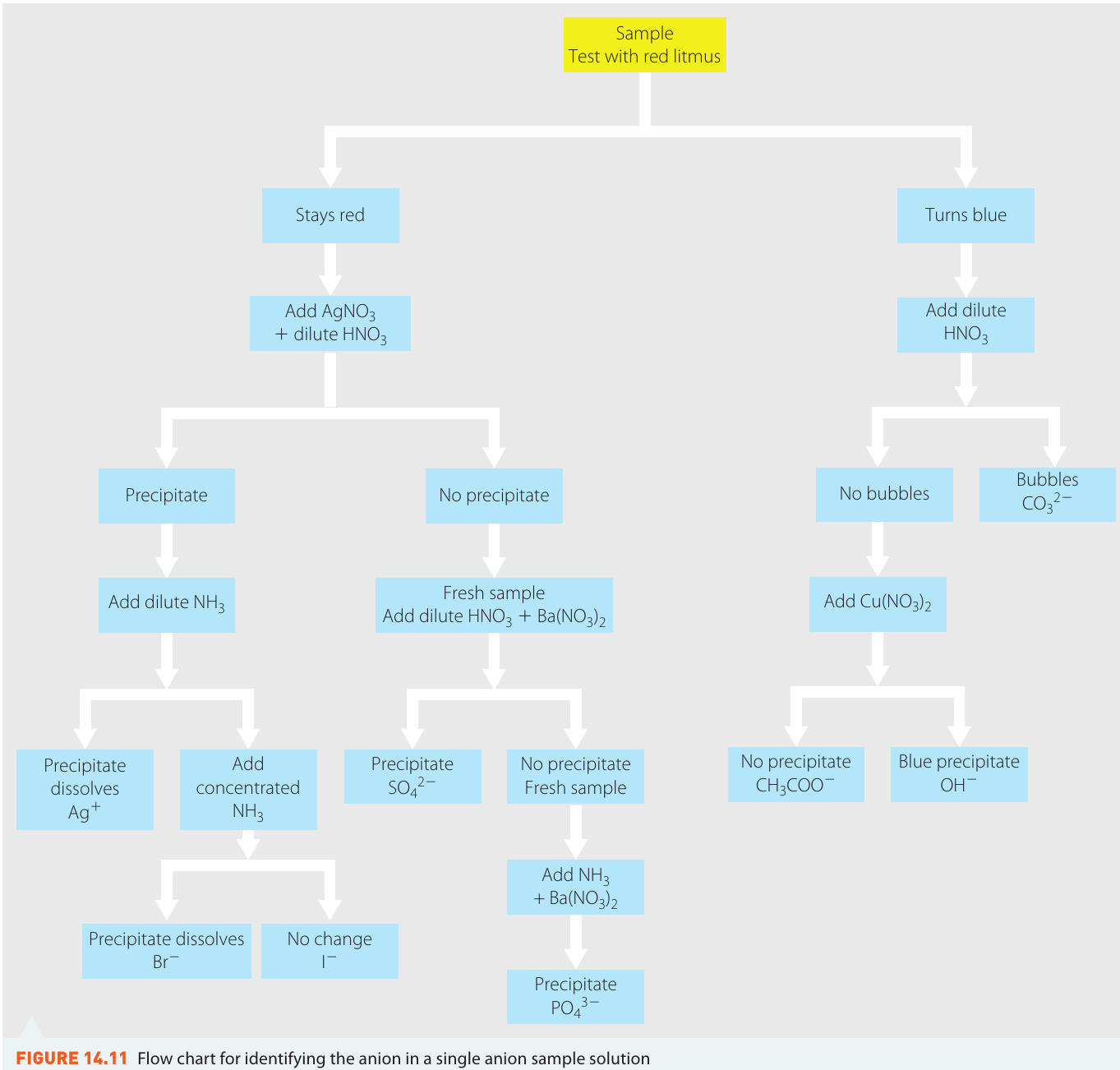
Following the flowchart
Step 1: pH testing
Begin by testing the sample with red litmus paper:
- Red litmus turns blue: The solution is alkaline (pH > 7). Possible anions are hydroxide, carbonate, or acetate. Proceed to add dilute nitric acid.
- Red litmus stays red: The solution is neutral or acidic. Skip to testing with silver nitrate and dilute nitric acid.
Step 2: Acid addition (if alkaline)
Add dilute nitric acid to the alkaline sample:
- Bubbles form: Carbon dioxide gas is produced, confirming carbonate ion. Use limewater as a confirmatory test—it should turn milky.
- No bubbles: Hydroxide or acetate is present. Take a fresh sample and add copper(II) nitrate.
Step 3: Copper(II) nitrate test (if alkaline, no bubbles)
Add copper(II) nitrate to a fresh sample:
- Blue precipitate forms: Hydroxide ion is present. The precipitate is copper(II) hydroxide, .
- No precipitate: Acetate ion is likely present. Acetate doesn't precipitate with most cations. Confirm with the iron(III) chloride test.
Step 4: Silver nitrate test (if not alkaline)
Add silver nitrate and dilute nitric acid:
- Precipitate forms: A halide ion is present. Note the colour and proceed to ammonia testing.
- No precipitate: Sulfate or phosphate may be present. Take a fresh sample and add dilute nitric acid followed by barium nitrate.
Step 5: Ammonia test (if silver precipitate formed)
Add dilute ammonia to the silver precipitate:
- Precipitate dissolves: Chloride ion confirmed. Silver chloride dissolves in dilute ammonia.
- Precipitate remains: Try concentrated ammonia.
- If it dissolves in concentrated ammonia: Bromide ion
- If it doesn't dissolve: Iodide ion
Step 6: Barium nitrate test (if no silver precipitate)
Add dilute nitric acid and barium nitrate to a fresh sample:
- White precipitate forms: Sulfate ion is present.
- No precipitate: Take another fresh sample, add ammonia solution, then add barium nitrate.
- If a white precipitate forms now: Phosphate ion is present
- If still no precipitate: The sample may be too dilute or contain acetate
Important
Important Testing Principles
- Always use fresh samples when changing tests—previous reagents can interfere with new tests
- Record all observations carefully, including negative results
- When in doubt, conduct confirmatory tests
- Consider that very dilute solutions may not give clear results
Practical considerations and exam tips
Common difficulties in anion identification
Similar precipitate colours: The pale colours of silver bromide and silver iodide can be difficult to distinguish. Always conduct the ammonia solubility test rather than relying on colour alone.
Contamination issues: Small amounts of contaminating ions can produce unexpected precipitates. This is why confirmation tests are essential.
Sparingly soluble salts: Very dilute solutions may not provide enough ions to form visible precipitates. If you suspect a particular anion but get negative results, the concentration may be too low.
Multiple anions: The procedures described here assume a single anion is present. Real samples often contain multiple anions, requiring more sophisticated analytical schemes.
Note
Safety Notes
- Concentrated acids (especially nitric acid) and concentrated ammonia solution are corrosive and produce harmful vapours. Always use a fume cupboard when working with these reagents.
- Some metal salts are toxic. Wear appropriate personal protective equipment (safety glasses, lab coat, gloves) and ensure correct disposal.
- Silver compounds are expensive and require careful handling and disposal procedures.
Exam success strategies
- Learn the precipitate colours: Create flashcards for the silver halides and practise distinguishing between them.
- Understand the chemistry: Don't just memorise tests—understand why they work. This helps you adapt to unusual questions.
- Practise flowchart interpretation: Draw out the systematic procedure from memory and check it against the standard flowchart.
- Write balanced equations: Exam questions often ask for equations. Practise writing them in net ionic form.
- Include observations: When describing tests, always state what you would observe, not just what test to conduct.
- Consider pH: Many students forget about pH effects. Always mention when acidification or alkaline conditions are required.
Summary
Key Points to Remember
-
Eight key anions: You need to identify chloride, bromide, iodide, hydroxide, acetate, carbonate, sulfate, and phosphate using systematic precipitation reactions.
-
Silver nitrate for halides: Silver nitrate in acidified solution produces coloured precipitates with chloride (white), bromide (cream), and iodide (yellow). Confirmatory testing using ammonia solubility distinguishes between them—chloride dissolves in dilute ammonia, bromide needs concentrated ammonia, and iodide doesn't dissolve at all.
-
pH controls precipitation: Barium ions precipitate sulfate at any pH, but phosphate only precipitates with barium in alkaline conditions (pH > 6). This pH dependence reflects the different acid strengths of hydrogen sulfate () and hydrogen phosphate ().
-
Carbonate makes bubbles: The distinctive test for carbonate is adding dilute acid—colourless carbon dioxide gas bubbles out, turning limewater milky when the gas is passed through it.
-
Systematic approach: Always follow a logical sequence of tests, starting with pH testing and progressively narrowing possibilities. Use fresh samples for new tests, conduct confirmatory tests when precipitates look similar, and record both positive and negative observations.