Identifying Cations in Solution (HSC SSCE Chemistry): Revision Notes
📚Revision Notes
Identifying Cations in Solution
What are cations?
Cations are positively charged ions. Most cations are metal ions, such as barium (), calcium (), or iron(II) ().
Note
There are two important exceptions to the "cations are metals" rule: the ammonium ion () and the hydronium ion () are both cations but not metal ions.
In qualitative analysis, you need to identify the presence of specific cations in aqueous solutions. The eight cations covered in this topic are:
- Barium ()
- Calcium ()
- Magnesium ()
- Lead(II) ()
- Silver ()
- Copper(II) ()
- Iron(II) ()
- Iron(III) ()
Methods for identifying cations
There are three main methods used to identify cations in solution:
- Flame tests - observing the color produced when metal ions are heated in a flame
- Precipitation reactions - observing whether precipitates form when specific anions are added
- Complexation reactions - observing color changes or precipitate dissolution when complex ions form
Important
The best practice is to combine results from multiple tests to confirm the identity of a particular cation. Never rely on a single test alone.
Flame tests
Understanding the theory
Flame tests work because of electron behavior in atoms. Each element has its own unique arrangement of energy levels where electrons exist. When you heat an atom, the electrons absorb energy and jump up to higher energy levels. This is called the excited state.
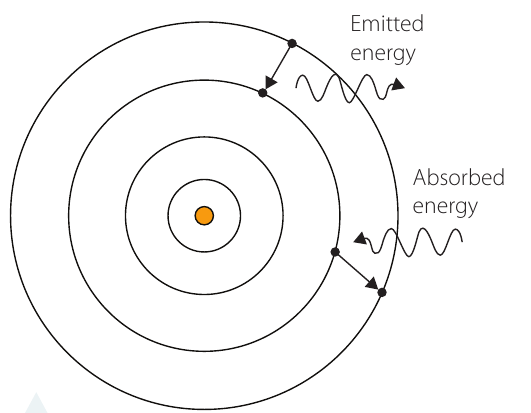
Electrons in excited states are unstable and quickly return to their original positions (the ground state) in less than one-millionth of a second. As they fall back down, they release the absorbed energy as light.
Note
Key points about electron behavior in flame tests:
- Each element has unique energy levels
- Electrons can jump between different levels, releasing different amounts of energy
- Energy released = light emitted
- The wavelength of light depends on the energy gap between levels
- Each element produces a unique pattern (spectrum) of light wavelengths
When the emitted light falls in the visible region of the electromagnetic spectrum, we see a distinctive color. This color can identify the element.
Conducting flame tests
In a flame test, you place a sample in a high-energy flame from a Bunsen burner or blowtorch. Some metal ions gain electrons to become neutral atoms, and it's the electrons in these neutral atoms that produce the colored flame as they return to ground state.
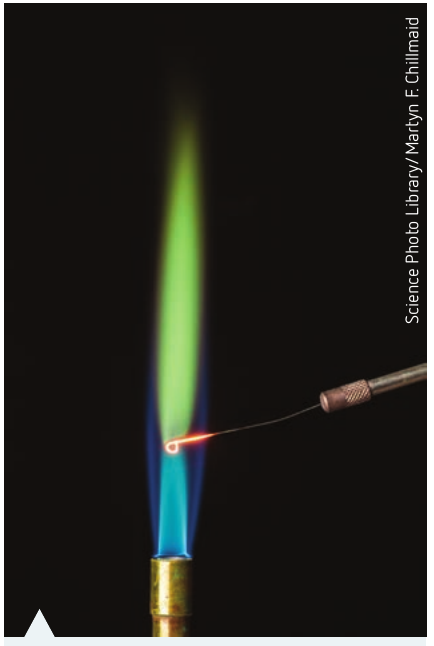
Important
Flame tests only work for some metals - those that emit visible light. They cannot identify anions.
Flame colors of cations
Here are the characteristic flame colors for the eight cations you need to know:
| Ion | Flame Color |
|---|---|
| Brick-red (orange-red) | |
| Pale green (apple green) | |
| Blue (with halides); green (with other compounds) | |
| Light blue-grey | |
| Gold when very hot; bright blue or green turning to orange-brown | |
| Orange-brown |
Note
Magnesium () and silver () do not produce colored flames.
Limitations of flame tests
Important
Common limitations to be aware of:
- Some elements produce similar colors that are difficult to distinguish. For example, barium gives pale green, copper gives green, and zinc gives whitish green.
- Not all metals produce visible colored flames (like magnesium and silver).
- Flame tests only confirm the presence of certain metals - they don't identify anions.
Exam tip: Always confirm flame test results with precipitation tests for accurate identification.
Precipitation reactions
Overview of precipitation tests
Precipitation reactions are the primary method for identifying cations. Different cations form precipitates of characteristic colors when specific anions are added to their solutions. By systematically testing with various reagents, you can identify which cation is present.
The main test reagents used are:
- Hydroxide ion () - usually as sodium hydroxide (NaOH)
- Chloride ion () - usually as sodium chloride (NaCl)
- Iodide ion () - usually as potassium iodide (KI)
- Fluoride ion () - usually as sodium fluoride (NaF)
- Sulfate ion () - usually as sulfuric acid ()
- Permanganate ion () - as potassium permanganate
- Thiocyanate ion () - as potassium thiocyanate (KSCN)
- Ammonia solution ()
Test results for each cation
The following table summarizes the key tests and observations for each cation:
| Cation | OH⁻ Test | Cl⁻ Test | SO₄²⁻ Test | Other Tests | Flame Test |
|---|---|---|---|---|---|
| Brown (milk coffee colored) precipitate | White precipitate that dissolves in ammonia | No precipitate | With : pale yellow precipitate | No color | |
| White precipitate that dissolves in excess | White precipitate (doesn't dissolve in ammonia) | White precipitate | With : yellow precipitate | Light blue-grey | |
| No precipitate | No precipitate | White precipitate | No precipitate with | Pale green | |
| White precipitate (if concentrated) | No precipitate | White precipitate (if concentrated) | With : white precipitate | Brick-red | |
| White precipitate | No precipitate | No precipitate | With : white precipitate | No color | |
| Blue precipitate; dissolves in to form deep blue solution | No precipitate | No precipitate | - | Blue-green | |
| Green or white precipitate (may turn brown) | No precipitate | No precipitate | Decolorizes acidified | Gold (very hot) or blue-green to orange-brown | |
| Brown precipitate | No precipitate | No precipitate | With : deep red solution | Orange-brown |
Note
Important notes about specific tests:
- The silver hydroxide precipitate is actually hydrated (silver oxide) which appears milk coffee colored
- Iron(II) hydroxide most commonly forms a green precipitate, but can sometimes be white
- The green precipitate may gradually turn brown as it oxidizes to
- Calcium tests may not work if the solution is too dilute (need at least )
Systematic identification flowchart
When a solution contains only one cation, follow this systematic approach:
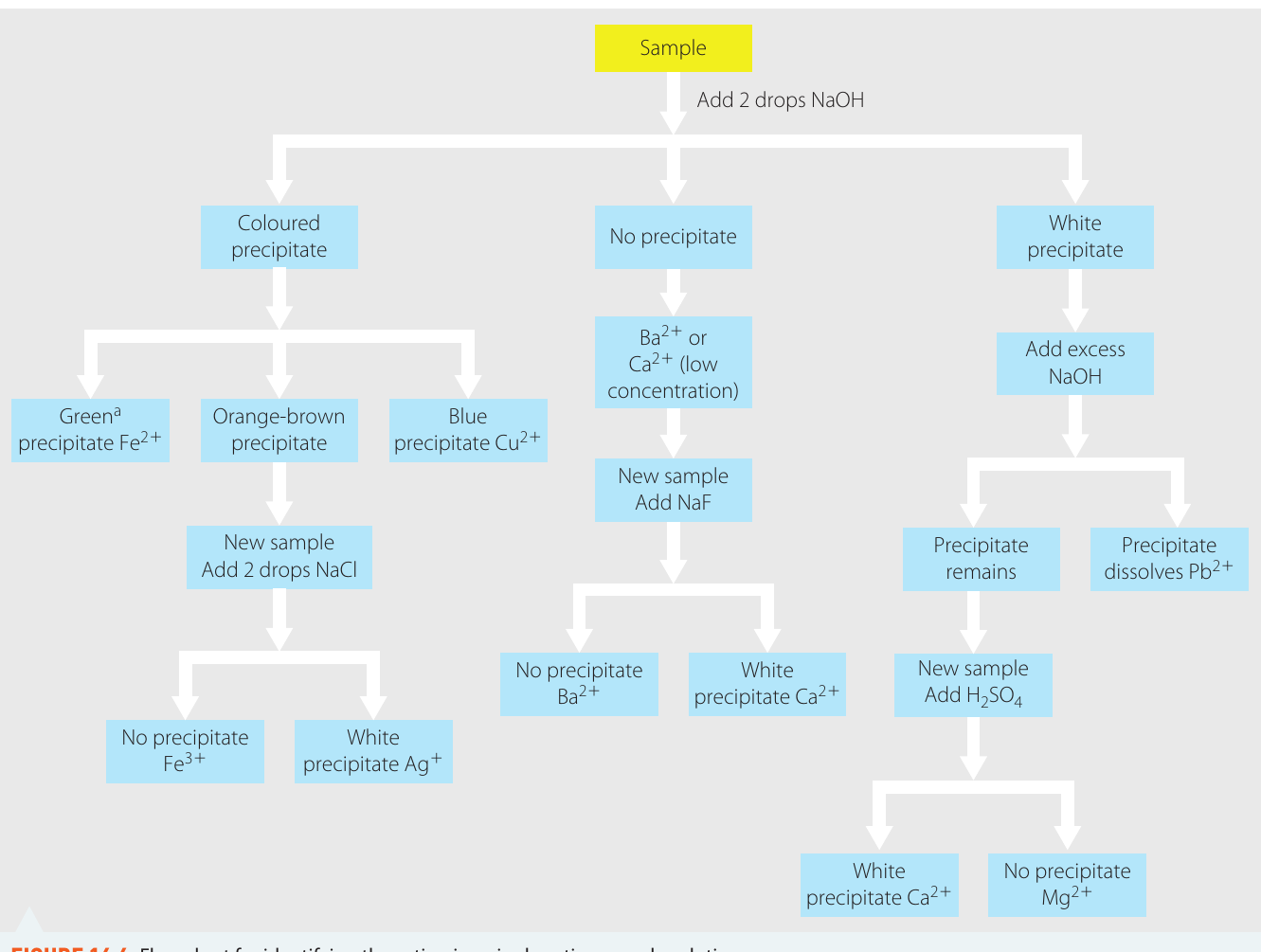
The flowchart shows a logical sequence of tests:
Step 1: Start by adding 2 drops of NaOH
- Colored precipitate → test further to distinguish (green), (orange-brown), or (blue)
- White precipitate → add excess NaOH to see if it dissolves () or remains (, , or )
- No precipitate → could be or low concentration
Step 2: For colored precipitates, use additional tests:
- Green precipitate + 2 drops NaCl: no change confirms ; white precipitate indicates
- Orange-brown precipitate confirms
- Blue precipitate confirms
Step 3: For white precipitates, add excess NaOH:
- Precipitate dissolves = (confirm with - white precipitate)
- Precipitate remains = test with NaCl or
Step 4: For no precipitate with NaOH, test with:
- NaF: white precipitate = ; no precipitate =
- Or use : white precipitate = or (distinguish with flame test); no precipitate =
Confirmatory tests
After identifying a probable cation using the flowchart, always confirm with an additional test:
Important
For lead (): Add iodide ions to a fresh sample. A yellow precipitate of confirms lead:
Important
For iron(II) (): Add purple potassium permanganate (). If iron(II) is present, the purple color disappears:
Important
For iron(III) (): Add potassium thiocyanate (KSCN). A blood red color confirms iron(III) due to formation of :
Note
For distinguishing barium and calcium: Use fluoride test: calcium forms white precipitate with , barium doesn't. Or use flame tests: barium = pale green, calcium = brick-red.
Laboratory investigation tips
When conducting Investigation 14.2 to identify unknown cations:
Important
Safety considerations:
- Wear safety glasses and protective clothing
- NaOH and are corrosive - avoid skin contact
- Metal salts of silver, barium, copper, and lead are poisonous
- Wash hands thoroughly after handling chemicals
- Dispose of chemicals as directed by your teacher
Note
Practical tips:
- Always use fresh samples for each test
- Clean test tubes thoroughly between tests with distilled water
- Record all observations immediately - note colors and whether precipitates form
- Use "NP" for "no precipitate" and "ppt" for precipitate in your results table
- If uncertain about a result, repeat the test
- Compare your results with classmates to check observations
Complexation reactions
What are complex ions?
A complex ion (or simply a complex) forms when one or more small molecules or ions attach themselves to a central cation. The central cation is usually (but not always) a transition metal ion. The resultant complex has different properties - including different colors and solubility - compared to the simple cation.
The surrounding molecules and ions are called ligands. Ligands must contain at least one lone pair of electrons.
Coordinate covalent bonds
The bond between a metal ion and a ligand is special - it's called a coordinate covalent bond (or dative bond). In this type of bond, both electrons come from the ligand (the electron pair donor), rather than one electron from each atom as in a normal covalent bond.
Coordinate covalent bonds form when one atom (like ) doesn't have a complete outer shell and bonds to another atom that has a full outer shell with at least one unshared electron pair.
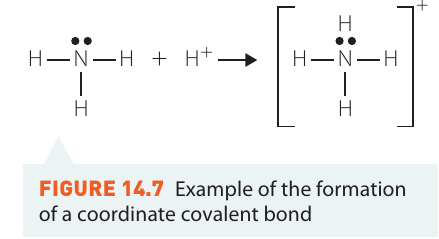
Example
Example: The Ammonium Ion ()
In the ammonium ion, ammonia () donates its lone pair to a hydrogen ion () forming a coordinate bond. Once formed, this bond is identical to the other N-H bonds.
Note
Common ligands include:
- Water ()
- Ammonia ()
- Chloride ion ()
- Hydroxide ion ()
- Thiocyanate ion ()
Copper complexes
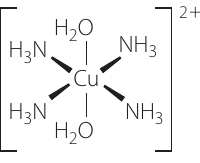
When copper(II) salts dissolve in water, they produce a blue solution due to formation of the hexaaquacopper(II) complex, :
Note
Convention: Square brackets indicate the whole complex, with the charge written outside.
Reaction with hydroxide: When sodium hydroxide is added to a copper(II) solution, a pale blue precipitate forms. Two hydroxide ions replace two water molecules:
This is commonly written more simply as:
Reaction with ammonia: When ammonia solution is added to an aqueous copper(II) solution, water ligands are replaced by ammonia molecules, forming a deep blue solution:
If ammonia is added to the pale blue copper hydroxide precipitate, the precipitate dissolves and forms the same deep blue complex:
Important
Exam tip: The color change from pale blue precipitate to deep blue solution on adding ammonia is a distinctive test for copper(II) ions.
Iron complexes
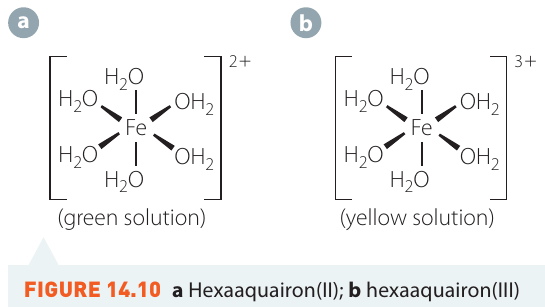
Iron(II) complexes: When iron(II) salts dissolve in water, they form a pale green solution due to hexaaquairon(II), .
Adding hydroxide ions produces a green (or sometimes white) precipitate:
Simplified:
Note
The green precipitate may gradually turn brown as oxidizes to .
Iron(III) complexes: When iron(III) salts dissolve in water, they form a yellow solution due to hexaaquairon(III), .
Adding hydroxide ions produces a brown precipitate:
Simplified:
Note
Adding excess or doesn't dissolve these iron precipitates.
Thiocyanate test for iron(III): Adding thiocyanate ions () to an iron(III) solution produces a distinctive blood red color due to the complex :
Lead and silver complexes
Lead(II): Lead(II) hydroxide precipitate dissolves in excess hydroxide to form a complex ion:
Silver: Although silver is not a transition metal, it does form complexes. Solid silver chloride dissolves in ammonia solution to produce a linear complex ion:
Important
This is an important distinguishing test - silver chloride dissolves in ammonia, but lead(II) chloride doesn't.
Summary
Key Points to Remember:
-
Cations are positively charged ions, mostly metals, but also include and .
-
Flame tests work because electrons absorb energy and jump to excited states, then emit light as they return to ground state. Each element has unique energy levels, so produces characteristic colored flames.
-
Use precipitation tests systematically to identify cations. Different cations form different colored precipitates (or no precipitate) with reagents like , , , and others.
-
Complex ions form when ligands (molecules or ions with lone pairs) bond to central metal ions through coordinate covalent bonds. The complexes have different colors and properties than simple ions.
-
Always confirm identification using multiple tests - combine flame tests, precipitation reactions, and complexation tests for accurate results.