Synthesis Reactions (HSC SSCE Chemistry): Revision Notes
📚Revision Notes
Synthesis Reactions
Introduction to chemical synthesis
When you hear the word "chemical", you might think of dangerous substances like strong acids or bases. However, everything around you is actually made of chemicals. Every day you interact with numerous products created by the chemical industry through a process called synthesis.
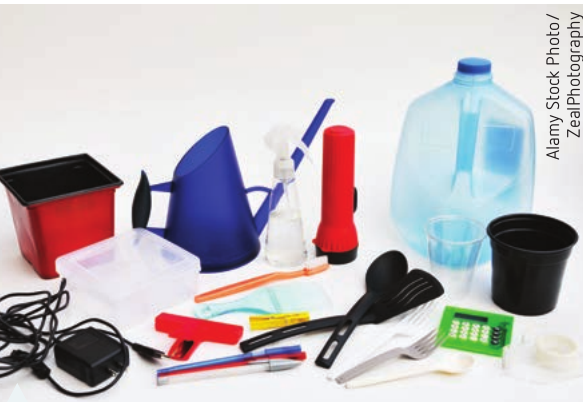
Synthesis means using chemistry to create new products. Common synthesised items include plastics, pharmaceuticals, fuels, cosmetics, and cleaning products. From the aspirin in your medicine cabinet to the sunscreen protecting your skin, synthesis reactions make modern life possible.
Note
In chemistry, the term "synthesis" has two distinct meanings:
- Simple synthesis reactions: These occur when two or more reactants combine to form a single product. For example, in the pop test, hydrogen and oxygen gases combine to produce water:
- Chemical synthesis: This involves deliberately carrying out chemical reactions to produce a specific desired product. This second meaning is the focus of synthesis reactions in applied chemistry.
The goal of chemical synthesis is always to produce the desired product as economically, safely, and efficiently as possible whilst minimising waste.
Uses of synthesis reactions
Chemical synthesis follows a similar process regardless of the product being made. Scientists first identify the desired product, then determine which reactants are needed and develop the best reaction pathway to create it.
Pharmaceutical applications
The pharmaceutical industry synthesises thousands of different medicines each year. Two important examples demonstrate how synthesis improves medicines:
Aspirin (acetylsalicylic acid)
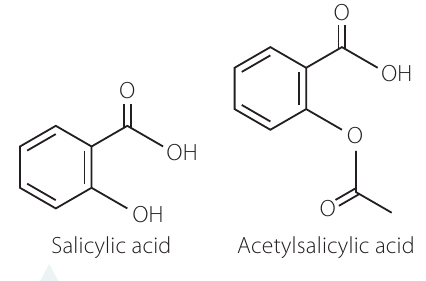
For centuries, people chewed willow bark to relieve pain and fever. The bark contains salicin, which the body converts to salicylic acid. However, salicylic acid irritates the stomach due to its acidic nature.
Scientists searched for ways to modify the molecule to reduce acidity whilst maintaining its pain-relieving properties. Through research and testing, they discovered that converting salicylic acid into an ester called acetylsalicylic acid achieved this goal. This compound became known as aspirin and is now manufactured on a massive scale worldwide.
Note
Exam tip: Remember that esterification can modify molecular properties - in aspirin's case, it reduced stomach irritation whilst preserving therapeutic effects.
Penicillin and ampicillin
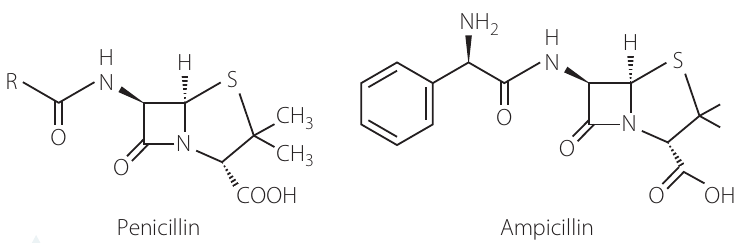
Alexander Fleming discovered penicillin in 1928, originally collecting it from the Penicillium fungus. However, in 1948, John C. Sheehan began nine years of research into manufacturing synthetic penicillin. Although his method wasn't suitable for mass production, one of the intermediate compounds produced could be modified to create various forms of penicillin still used today, including ampicillin.
Important
Key term: Intermediates are products formed during one step of a reaction pathway that are then used as reactants in subsequent steps.
Designing synthesis reactions
Scientists have been developing synthesis reactions since 1828, when Friederich Wöhler accidentally produced urea whilst attempting to make ammonium cyanate. Since then, both the range of compounds that can be synthesised and the techniques used have expanded dramatically.
Choosing the reactants
A common method for designing synthesis reactions works backwards from the desired product. This approach is called retrosynthetic analysis.
Retrosynthetic analysis involves:
- Starting with the final product
- Gradually removing carbon atoms or simplifying the molecular structure
- Continuing until you identify suitable starting reactants
Example
Worked Example: Producing ethanal
Ethanal is an aldehyde containing two carbon atoms. To synthesise it using retrosynthetic analysis:
- Ethanal (2 carbons, aldehyde) ← can be made from
- Ethanol (2 carbons, primary alcohol) ← can be made from
- Ethene (2 carbons, alkene)
Therefore, ethene would be the initial reactant. The forward synthesis pathway would be:
- Ethene + water → ethanol (addition reaction with )
- Ethanol → ethanal (oxidation with catalyst)
Important
Multiple starting points may exist for the same product. Ethanol can also be produced by fermentation using agricultural crops, yeast, and water. Chemists choose the starting reactants based on factors including:
- Availability of materials
- Production method
- Cost
- Safety considerations
Choosing the reaction pathway
Most synthesis reactions involve multiple steps. Chemists must carefully consider numerous factors when selecting the appropriate steps:
- Potential for unwanted side products
- Availability and cost of reactants
- Required reaction conditions
- Reaction speed
- Safety concerns
Although multiple pathways may exist, chemists select the one that produces the product most cheaply, safely, and efficiently.
Understanding multistep reactions
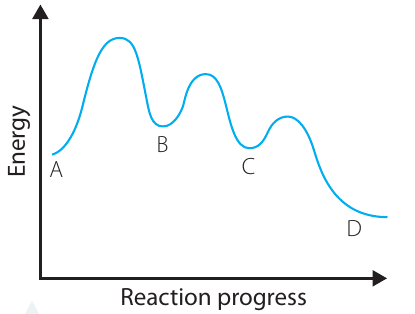
In a multistep reaction, each step has its own reactants, products, and activation energy. These factors affect both the reaction speed and the chemicals available for subsequent steps.
Products from one step often become reactants in the next step. These temporary products are called intermediates because they are consumed during the overall process.
Note
In the energy profile diagram shown:
- A represents the initial reactant
- B and C are intermediates
- D is the final product
Each peak represents an activation energy barrier, whilst valleys represent the energy levels of intermediates. The overall energy change from A to D determines whether the reaction is exothermic or endothermic.
Important
Exam tip: When analysing energy profile diagrams, identify the number of steps by counting the peaks (transition states), not the valleys.
Example 1: The contact process (linear pathway)
The contact process produces sulfuric acid through a multistep pathway designed for maximum efficiency and safety.
Example
Worked Example: The Contact Process
Step 1: Production of sulfur dioxide through combustion of sulfur or sulfide ores:
or
Step 2: Sulfur dioxide reacts with oxygen to produce sulfur trioxide:
Step 3: Sulfur trioxide dissolves in concentrated sulfuric acid:
Step 4: The resulting oleum reacts with water to produce sulfuric acid:
In this process, sulfur dioxide and sulfur trioxide are intermediates - they are produced in one step and consumed in the next.
Example 2: Ethyl ethanoate production
Ethyl ethanoate is used in glues, nail polish removers, and as a solvent for decaffeinating tea and coffee.
Example
Worked Example: Ethyl Ethanoate Synthesis
Step 1: Ethene reacts with steam to form ethanol:
Step 2: Ethanol reacts with ethanoic acid to produce the ester:
Scientists choose specific conditions for each step to optimise yield, control reaction rate, and minimise unwanted side reactions that could reduce product purity.
Linear and convergent pathways
The sequence of steps in a reaction mechanism can follow two main patterns:
Linear sequences
A linear sequence involves one reaction following another, with the product of each step becoming the reactant for the next step.
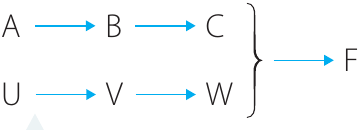
The contact process (described above) exemplifies a linear sequence:
Each product feeds directly into the next reaction in a sequential chain.
Convergent sequences
A convergent sequence uses separate reaction pathways that then merge, with products from different pathways combining as reactants in a final reaction.
Example
Worked Example: Ethyl Butanoate Synthesis
Ethyl butanoate is an ester with a banana-like odour. Its synthesis demonstrates a convergent pathway:
Pathway 1:
- Ethene + → Ethanol
Pathway 2:
- 1-butene + → 1-butanol
- 1-butanol + [O] → Butanoic acid
Convergence:
- Ethanol + Butanoic acid → Ethyl butanoate
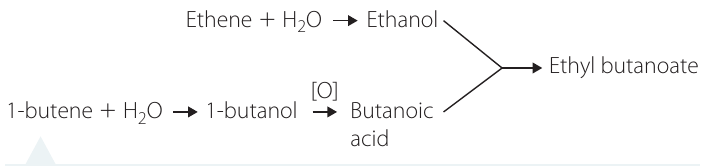
The flowchart shows two parallel pathways producing ethanol and butanoic acid separately. These pathways then converge when the two products react together to form the final ester.
Important
Important consideration: When reaction efficiencies are similar, convergent sequences typically produce higher overall yields than linear sequences because multiple pathways can proceed simultaneously.
Remember!
Summary
Key Points to Remember:
-
Synthesis reactions combine reactants to form products, either as simple combination reactions or as planned processes to create specific desired products.
-
Retrosynthetic analysis is a backwards-thinking approach where chemists start with the target molecule and work step-by-step in reverse to identify suitable starting materials.
-
Intermediates are temporary products formed during one step of a multistep pathway that become reactants in subsequent steps.
-
Linear pathways proceed sequentially with each product feeding into the next reaction, whilst convergent pathways involve separate routes that merge together.