Exothermic and Endothermic Reactions (HSC SSCE Chemistry): Revision Notes
📚Revision Notes
Exothermic and Endothermic Reactions
Understanding energy changes in chemical reactions
Temperature changes are one of the key signs that a chemical reaction has occurred. Nearly all chemical reactions involve changes in both temperature and energy. Understanding these energy changes is crucial for chemistry students.
Energy from chemical reactions powers our daily lives. We use this energy to produce food, clothing and shelter, generate electricity, power transport, run manufacturing processes and provide entertainment. Currently, most electricity comes from burning coal, transport relies on burning petrol and diesel, and many homes burn natural gas for cooking.
Note
The study of energy changes during chemical reactions is called thermochemistry. This field helps us understand the structure and stability of compounds, the nature of chemical bonds, and why substances react in particular ways.
Exothermic reactions
When a reaction releases heat energy to its surroundings, we call it an exothermic reaction. The word "exothermic" tells us that energy is exiting the system.
In an exothermic reaction, the test tube or container becomes hot. This happens because chemical energy decreases during the reaction, and the 'lost' chemical energy converts to heat, which warms the container and its contents.
Important
Exothermic reactions are much more common than endothermic reactions in chemistry.
Common examples of exothermic reactions
Combustion reactions:
- Burning of coal
- Burning of petrol
Synthesis reactions (direct combination reactions):
- or
Reactions of metals with water and acids:
Reactions of acids with bases and carbonates:
Dissolution reactions:
- Dissolving calcium chloride in water
- Dissolving sodium carbonate in water
Endothermic reactions
When a reaction absorbs heat energy from its surroundings, we call it an endothermic reaction. The word "endothermic" indicates that energy is entering the system.
In an endothermic reaction, the test tube or container becomes cold. This happens because the reaction needs to absorb heat, which gets converted into chemical energy. The reaction takes this heat from the container and its contents, causing them to cool down.
Common examples of endothermic reactions
Decomposition reactions:
- Decomposition of copper nitrate
- Decomposition of calcium carbonate
Precipitation reactions:
- (some precipitation reactions)
Biological processes:
- Photosynthesis
Dissolution reactions:
- Dissolving potassium sulfate in water
- Dissolving ammonium chloride in water
Physical and chemical processes
Both exothermic and endothermic terms apply to physical processes as well as chemical reactions.
Example
Examples of Physical and Chemical Processes:
- Dissolving a substance (physical process) can be either exothermic or endothermic
- A chemical reaction can be either exothermic or endothermic
The key point is that energy changes occur in both types of processes, and we can classify them based on whether they release or absorb heat.
Investigation 14.1: Temperature changes in physical and chemical processes
Aim
To measure temperature changes for various chemical and physical processes and determine whether these processes are endothermic or exothermic.
Materials required
Chemicals:
- of
- strip of ribbon
- of
- Water
Equipment:
- 2 medium test tubes
- 3 polystyrene (e.g. Styrofoam) cups
- to thermometer or temperature probe and data logger
- measuring cylinder
- measuring cylinder
- beaker
- Stirring rod
- Bunsen burner
- Heat-proof mat
- Tripod
- Wire gauze
- Spatula
- Test-tube rack
Risk assessment
| What are the risks in doing this investigation? | How can you manage these risks to stay safe? |
|---|---|
| is released in part A. | Part A must be performed in a fume cupboard. Check for students with asthma before performing the experiment. |
Important
Always identify and manage other risks associated with your investigation before beginning practical work.
Method
Part A: Reaction of sodium thiosulfate with hydrochloric acid
- Pour into a medium test tube.
- Measure the initial temperature of the using the thermometer or temperature probe.
- Add one spatula of to the test tube.
- Stir with the stirring rod, then record the highest or lowest temperature reached.
Part B: Reaction of magnesium with hydrochloric acid
- Pour into a medium test tube.
- Measure the initial temperature of the using the thermometer or temperature probe.
- Place a strip of magnesium into the .
- Stir with the stirring rod, then record the highest or lowest temperature reached.
Part C: Dissolving sodium hydroxide in water
- Pour water into a polystyrene cup.
- Measure the initial temperature of the water using the thermometer or temperature probe.
- Add to the polystyrene cup.
- Stir with the stirring rod, then record the highest or lowest temperature reached.
Part D: Dissolving potassium nitrate in water
- Pour water into a polystyrene cup.
- Measure the initial temperature of the water using the thermometer or temperature probe.
- Add to the polystyrene cup.
- Stir with the stirring rod, then record the highest or lowest temperature reached.
Part E: Combustion of methane
Note
Temperature changes for methane combustion cannot be measured directly. Instead, measure the temperature change of a water sample to gain indirect information about the combustion process.
- Pour water into a beaker.
- Measure the initial temperature of the water using the thermometer or temperature probe.
- Place the beaker on wire gauze above a Bunsen burner.
- Turn on the Bunsen burner.
- After minutes, turn off the Bunsen burner and record the final temperature of the water.
Part F: Neutralisation of sodium hydroxide with hydrochloric acid
- Pour of into a polystyrene cup.
- Measure the temperature of the using the thermometer or temperature probe.
- Measure of into a small beaker and record its temperature.
- Calculate the average of the and temperatures. This is the initial temperature for this experiment.
- Pour the into the polystyrene cup containing the , stir and record the highest or lowest temperature reached.
Recording results
Create a results table to collect data about initial and final temperatures for each experiment part (A through F).
Analysis of results
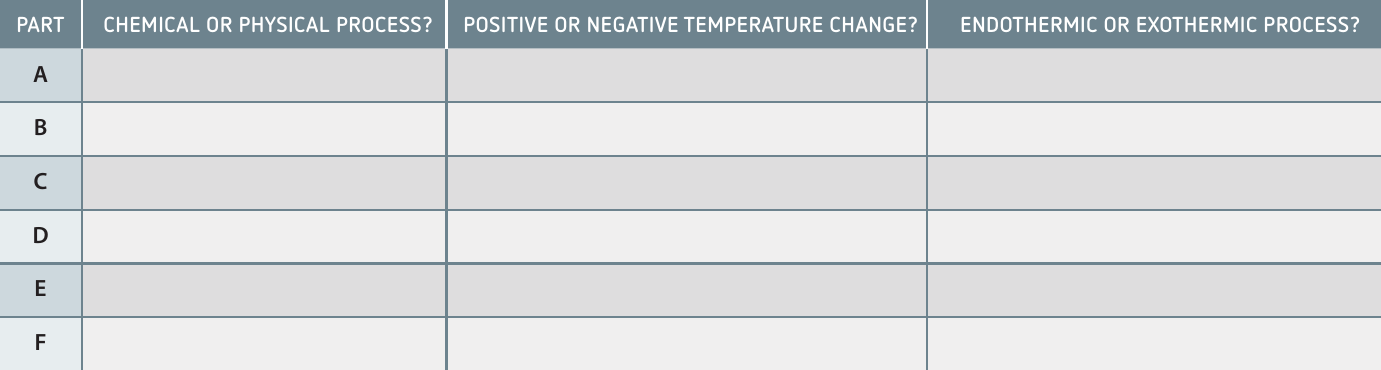
Complete the following table using your experimental results:
Further analysis:
- Compare your results with those from other groups
- Comment on the reliability of your results
- Look for patterns in temperature changes
- Identify which processes are chemical versus physical
Drawing conclusions
For each part of the investigation, justify whether the process is:
- Chemical or physical
- Shows a positive (temperature increase) or negative (temperature decrease) change
- Endothermic or exothermic
Exam tips
Summary
Key Points to Remember for Exams:
- Temperature increase = exothermic reaction (heat released)
- Temperature decrease = endothermic reaction (heat absorbed)
- Combustion reactions are always exothermic
- Most synthesis reactions are exothermic
- Most decomposition reactions are endothermic
- Dissolution can be either exothermic or endothermic depending on the substance
Example
Common Exam Question: Explain why a test tube becomes hot during an exothermic reaction.
Model Answer: During an exothermic reaction, chemical energy decreases. The 'lost' chemical energy is released as heat, which transfers to the test tube and its contents, causing them to become hot.
Remember!
Summary
Essential Takeaways:
- Exothermic reactions release heat energy to their surroundings and cause temperature increases. The test tube becomes hot.
- Endothermic reactions absorb heat energy from their surroundings and cause temperature decreases. The test tube becomes cold.
- Exothermic reactions are more commonthan endothermic reactions in chemistry.
- Both terms apply to physical processes (like dissolving) and chemical reactions.
- Temperature changes can be measured to determine whether a process is exothermic or endothermic.