Explaining Enthalpy Changes (HSC SSCE Chemistry): Revision Notes
📚Revision Notes
Explaining Enthalpy Changes
Why do chemical reactions involve energy changes?
When chemical reactions occur, energy is either released to the surroundings or absorbed from them. This happens because all chemical reactions involve breaking existing chemical bonds in the reactant molecules and forming new chemical bonds in the product molecules. These processes of breaking and making bonds are what cause the energy changes we observe and measure.
Understanding why and how these energy changes occur requires us to explore the concept of bond energy and how it relates to the overall enthalpy change of a reaction.
What is bond energy?
Bond energy is the amount of energy required to break one mole of a particular type of chemical bond in a gaseous molecule. This is an important concept because it helps us understand why some reactions release energy while others absorb it.
Key characteristics of bond energy:
- It is always measured in kilojoules per mole of bonds ()
- It is always a positive value because breaking bonds requires energy input
- Different types of bonds have different bond energies (for example, O—H bonds have a different bond energy than N—O bonds)
- Stronger bonds have higher bond energies and require more energy to break
Note
Why is bond energy always positive?
Bond energy represents the energy needed to break a bond, not make it. Since breaking bonds always requires energy input (you must do work to pull atoms apart), bond energy values are always positive. When bonds form, energy is released - but that's the opposite process!
Bond breaking and bond making
During any chemical reaction, two fundamental processes occur:
Bond breaking is an endothermic process. This means energy must be supplied to break the chemical bonds in the reactant molecules. Think of it like pulling apart two magnets - you need to put in effort (energy) to separate them. The stronger the bond, the more energy is required to break it.
Bond making is an exothermic process. When new chemical bonds form in the product molecules, energy is released to the surroundings. This is like the magnets snapping back together - energy is given out as the bond forms. Again, stronger bonds release more energy when they form.
These two competing processes - one requiring energy and one releasing energy - determine whether the overall reaction will be exothermic or endothermic.
Note
The Magnet Analogy
Think of chemical bonds like magnets:
- Breaking bonds (pulling magnets apart) = You put in energy = Endothermic
- Making bonds (magnets snapping together) = Energy is released = Exothermic
Calculating enthalpy changes from bond energies
The enthalpy change for a reaction, , can be understood by considering the energy changes involved in breaking bonds and forming new ones:
Important
The Enthalpy Change Equation
This equation tells us:
- If more energy is released in forming new bonds than is required to break old bonds → reaction is exothermic → is negative
- If more energy is required to break old bonds than is released in forming new bonds → reaction is endothermic → is positive
Important note: Although the actual reaction pathway may be complex, we can think of it as if all the bonds in the reactants break first (creating individual atoms), and then new bonds form to create the products. This is a useful way to visualise and calculate energy changes.
Examples of bond energy changes in reactions
Let's examine two different reactions to see how bond energies determine whether a reaction is exothermic or endothermic.
Formation of water (exothermic reaction)
Example
Worked Example: Formation of Water
When hydrogen burns in oxygen to form water:
Bond breaking (energy required):
- H—H bonds in hydrogen molecules break
- O=O bonds in oxygen molecules break
Bond making (energy released):
- H—O bonds form to make water molecules
Result: The energy released when the H—O bonds form is greater than the energy required to break the H—H and O=O bonds.
Conclusion: This reaction is exothermic (releases heat), which is why hydrogen burns with a flame.
Formation of nitric oxide (endothermic reaction)
Example
Worked Example: Formation of Nitric Oxide
When nitrogen and oxygen combine during lightning strikes:
Bond breaking (energy required):
- N≡N bonds in nitrogen molecules break (this is a very strong triple bond)
- O=O bonds in oxygen molecules break
Bond making (energy released):
- N—O bonds form to make nitric oxide molecules
Result: The energy required to break the strong N≡N and O=O bonds is greater than the energy released when the N—O bonds form.
Conclusion: This reaction is endothermic (absorbs heat), which is why it needs the high energy provided by lightning to occur.
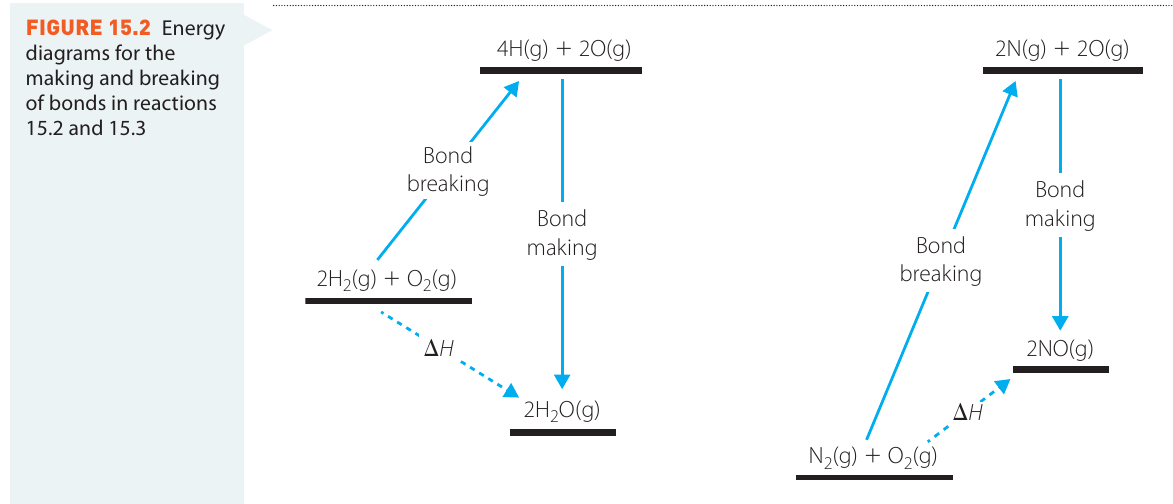
The diagrams above show these energy changes graphically. The vertical axis represents energy levels. Notice how:
- Bond breaking steps (blue arrows pointing upward) show energy being absorbed
- Bond making steps (blue arrows pointing downward) show energy being released
- The overall is the difference between the starting and ending energy levels
Bond energy, stability and reactivity
Understanding bond energies helps us predict how compounds will behave chemically. Two important concepts related to bond energy are stability and reactivity.
Stability is a measure of how difficult it is to decompose a compound in the absence of other substances. For example, how much heat would be needed to break the compound apart by heating it alone? A compound with high bond energies is very stable because it requires a lot of energy to break it down.
Reactivity is a measure of how easily a compound undergoes chemical reactions when mixed with other substances. A compound with high bond energies is generally less reactive because its bonds are difficult to break during reactions.
Important
The Bond Energy-Stability-Reactivity Relationship
This is why chemists are very interested in knowing the bond energies of different types of bonds - it gives valuable information about the properties and behaviour of compounds.
Why can't we measure bond energies directly?
In theory, we could measure a bond energy by breaking one specific type of bond and measuring the heat absorbed. However, in practice this is extremely difficult. When we break a bond in a stable molecule, we create two highly reactive fragments (atoms or molecular fragments). These fragments immediately react with each other or rearrange into other stable molecules before we can accurately measure the energy change from just the bond breaking step.
Note
Fortunately, we can calculate bond energies indirectly by using measurements from reactions we can perform in the laboratory, combined with an important principle called the law of conservation of energy.
Summary
Key Points to Remember:
-
Bond breaking always requires energy (endothermic process), while bond making always releases energy (exothermic process)
-
The enthalpy change of a reaction equals the energy needed to break bonds minus the energy released when new bonds form:
-
Compounds with higher bond energies are more stable and less reactive because their bonds are harder to break