Law of Conservation of Energy (HSC SSCE Chemistry): Revision Notes
📚Revision Notes
Law of conservation of energy
What is the law of conservation of energy?
The law of conservation of energy is a fundamental principle in science stating that energy cannot be created or destroyed. However, energy can be transformed from one form to another. For example, chemical energy can be converted to heat energy, or electrical energy can be changed to light energy.
In chemistry, this law has an important application. When a chemical reaction occurs, the total energy change between reactants and products remains constant, no matter which pathway the reaction follows. This chemical version of the law of conservation of energy is called Hess's law, named after the chemist Germain Hess who first recognised this principle.
Note
Understanding the conservation of energy is essential for grasping why Hess's law works. Since energy cannot appear or disappear, the total energy change in any process must be the same regardless of how many steps are involved or what route is taken.
Understanding Hess's law
Hess's law states that the enthalpy change () for a chemical reaction is the same regardless of the number of steps taken to complete the reaction. Whether you go from reactants to products in one step or through multiple intermediate steps, the total energy change will be identical.
This is incredibly useful because it allows us to calculate enthalpy changes for reactions that are difficult or impossible to measure directly. We can use known enthalpy changes from other reactions to work out the unknown value.
Important
Key Principle of Hess's Law:
The total enthalpy change is independent of the reaction pathway. This means you can:
- Break a reaction into multiple steps
- Add the enthalpy changes of those steps
- Get the same result as the direct pathway
This principle is a direct consequence of the conservation of energy!
Example: carbon combustion
Example
Worked Example: Applying Hess's Law to Carbon Combustion
Let's explore Hess's law using the combustion of carbon as an example.
Indirect pathway (two steps):
When carbon burns in a limited supply of oxygen, carbon monoxide forms first:
Step 1: where
This carbon monoxide can then react with more oxygen to form carbon dioxide:
Step 2: where
When we add these two reactions together, the appears on both sides and cancels out. Collecting the oxygen molecules gives us:
Overall reaction:
The total enthalpy change for this indirect pathway is:
Direct pathway (one step):
Alternatively, carbon can burn directly in excess oxygen to form carbon dioxide:
where
This value is per mole of carbon dioxide. To compare it with the indirect route (which produced two moles of carbon dioxide), we need to double it:
where
Conclusion: Both pathways give the same enthalpy change of -786 kJ per two moles of CO₂. This demonstrates Hess's law perfectly!
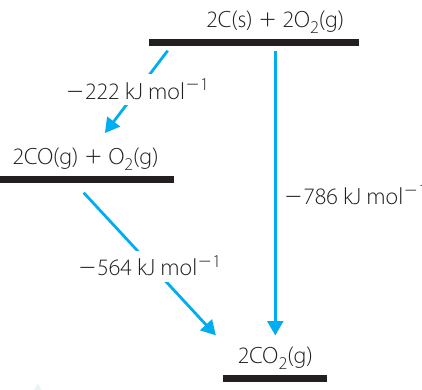
Drawing and using enthalpy diagrams
Enthalpy diagrams are visual tools that help us analyse energy changes in chemical reactions. They are extremely useful for understanding Hess's law problems.
How to draw an enthalpy diagram:
- Draw horizontal lines to represent different energy states:
- Initial state (reactants)
- Intermediate state(s) (if any)
- Final state (products)
- Label each line with the chemical substances:
- Place all reactants on the initial state line
- Place all products on the final state line
- Place intermediate substances on their respective lines
- Draw arrows between states:
- Arrows show the direction of change
- Point from one energy level to another
- Label the arrows with enthalpy changes ( values)
Note
Reading Enthalpy Diagrams:
The enthalpy change shown on each arrow represents the increase in enthalpy when moving from the tail of the arrow to the head of the arrow. When following a series of arrows in sequence, the total enthalpy change is the sum of all individual changes, regardless of whether the arrows point up or down the page.
For example, in the carbon combustion diagram above, you can follow two different paths from to :
- Direct path: One arrow showing
- Indirect path: Two arrows showing then
Both paths give the same total energy change.
Rules for manipulating equations
When using Hess's law to calculate unknown enthalpy changes, you need to manipulate chemical equations. Two important rules apply:
Rule 1: Reversing a reaction changes the sign of ΔH
If you write a chemical equation in the opposite direction, you must change the sign of the enthalpy change.
Important
Reversing Reactions:
When you reverse a chemical equation, the sign of must flip:
- Forward: where
- Reverse: where
This makes sense because if energy is released going forward (negative ), then energy must be absorbed going backward (positive ).
Rule 2: Multiplying or dividing a reaction multiplies or divides ΔH
If you double the coefficients in a chemical equation, you must double the enthalpy change. If you halve the coefficients, you must halve the enthalpy change.
Important
Scaling Reactions:
When you multiply or divide the coefficients in an equation, you must do the same to :
- Original: where
- Doubled: where
The enthalpy change scales proportionally with the amount of substance reacting.
Worked example: phosphorus chlorides
Example
Worked Example: Calculating Unknown Enthalpy Changes
Problem: When excess phosphorus reacts with a small amount of chlorine, gaseous phosphorus trichloride forms with an enthalpy change of . When a small amount of phosphorus reacts with excess chlorine, gaseous phosphorus pentachloride forms with an enthalpy change of . Calculate the enthalpy change for the reaction:
Solution:
Step 1: Write down the given information
Equation 1: where
Equation 2: where
Step 2: Write the target equation
Equation 3: where
Step 3: Plan the manipulation
To create equation 3, we need on the left side and on the right side. Currently, in equation 1, is on the right side, so we must reverse equation 1.
Step 4: Reverse equation 1
Equation 4: where
Note that the sign has changed from negative to positive.
Step 5: Add equations 4 and 2
Step 6: Cancel common terms
appears on both sides, so it cancels out.
cancels from the , leaving on the left side.
This gives us:
Step 7: Calculate the enthalpy change
Verification using enthalpy diagram:
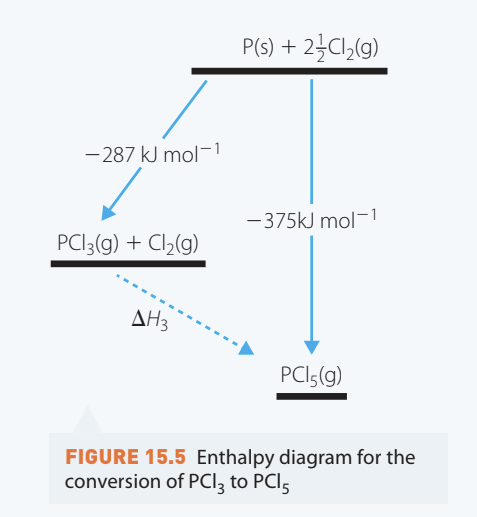
From the enthalpy diagram, we can see that:
Therefore:
This confirms our calculation - the answer is -88 kJ mol⁻¹
Note
About Fractional Coefficients:
In thermochemistry, we often write equations with fractions (like ). This is acceptable because we read these equations in terms of moles, and we can have half a mole of a substance. Remember, we cannot have half a molecule, but we can discuss half a mole of molecules.
Exam tips
- Always check whether you need to reverse, multiply, or divide equations to match your target equation
- Remember to change the sign of ΔH when you reverse a reaction
- Draw an enthalpy diagram if you find the problem confusing—visual representation often makes the solution clearer
- Check that substances appearing on both sides of your combined equation cancel out properly
- Pay attention to coefficients and make sure you scale values appropriately
- When given enthalpy per mole, check what "per mole" refers to (per mole of which substance)
Remember!
Summary
Key Points to Remember:
- Energy conservation: Energy cannot be created or destroyed, only transformed from one form to another
- Hess's law: The total enthalpy change between reactants and products is the same regardless of the pathway taken
- Reversing reactions: If you reverse a reaction, change the sign of (negative becomes positive, positive becomes negative)
- Scaling reactions: If you multiply or divide a reaction equation by a number, multiply or divide by the same number
- Enthalpy diagrams: These are powerful visual tools that show all possible pathways between reactants and products, making it easier to apply Hess's law