Entropy and Gibbs Free Energy (HSC SSCE Chemistry): Revision Notes
📚Revision Notes
Temperature and Reaction Spontaneity
Understanding how temperature affects whether a chemical reaction will occur spontaneously is fundamental to predicting reaction behaviour. While some reactions proceed immediately when reactants are mixed, others require specific temperature conditions to occur. The relationship between temperature and spontaneity is governed by Gibbs free energy, which combines both energy and entropy considerations.
Types of reactions based on spontaneity
Chemical reactions can be classified into four distinct types based on their spontaneity behaviour and temperature requirements. This classification helps us understand not just whether a reaction will occur, but also what conditions are necessary for it to proceed.
Note
This four-type classification system provides a practical framework for predicting reaction behaviour under different conditions. Understanding these categories is essential for laboratory work and industrial processes.
Type 1 reactions occur immediately when reactants are combined at room temperature. These reactions proceed spontaneously without any external energy input beyond initial mixing. Classic examples include the displacement reaction between copper metal and silver nitrate solution, or the vigorous reaction of magnesium with hydrochloric acid:
Type 2 reactions do not proceed at room temperature but occur once given an initial energy "prod" such as ignition with a spark or brief heating. These reactions are characteristically exothermic, meaning they release energy. Once initiated, they generate sufficient heat to sustain the reaction without further external energy input. Common examples include the combustion of fuels like methane (natural gas) or octane (petrol):
Although Type 2 reactions are very slow at room temperature, they proceed rapidly at elevated temperatures. Because they can maintain their own temperature once started, they are considered spontaneous reactions.
Type 3 reactions require continuous heating to maintain an elevated temperature throughout the reaction process. These are endothermic reactions that absorb energy from their surroundings. If heating stops, the reaction mixture cools down and the reaction ceases. An example is the thermal decomposition of limestone (calcium carbonate) at approximately :
Important
Because Type 3 reactions require continuous external energy input, they are classified as non-spontaneous, even though they can proceed at high temperatures. This is a crucial distinction that often confuses students.
Type 4 reactions do not occur even when maintained at very high temperatures. For instance, the decomposition of water into hydrogen and oxygen does not proceed even at :
These reactions are clearly non-spontaneous under normal conditions.
Note
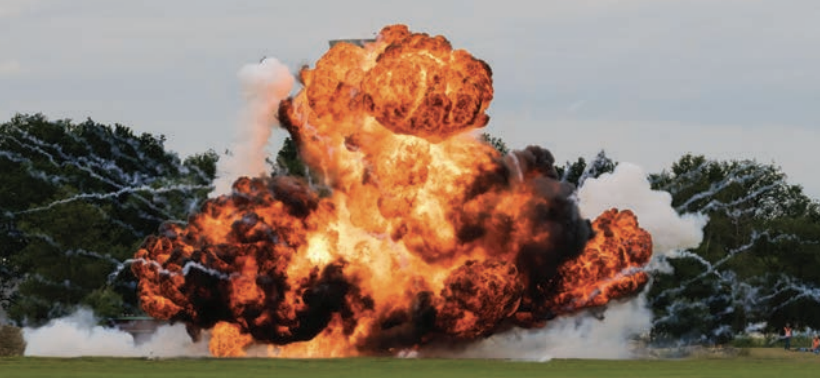
The image above illustrates that spontaneous reactions can vary dramatically in speed—from extremely fast explosions like this, to slow processes like the rusting of iron. Speed and spontaneity are different concepts!
Refined definition of spontaneous reactions
Based on the classification above, we need a precise definition that distinguishes truly spontaneous reactions from those requiring ongoing energy input. This distinction is critical for understanding thermodynamics and predicting reaction behaviour.
Important
A spontaneous reaction is one that occurs without any ongoing input of energy. It may need a small initial input of energy (such as a flame or spark) to overcome an activation barrier, but once started, it continues without further external energy supply.
This definition means:
- Type 1 and Type 2 reactions are spontaneous
- Type 3 and Type 4 reactions are non-spontaneous
The key distinction is whether the reaction can sustain itself. Type 2 reactions, though requiring initiation, are exothermic and self-sustaining, making them spontaneous. Type 3 reactions, despite proceeding at high temperatures, require continuous heating and are therefore non-spontaneous.
Standard vs non-standard conditions
The understanding of when and how to apply standard Gibbs free energy values is crucial for accurate predictions. The standard Gibbs free energy change () applies specifically to standard conditions, which means:
- All gases are present at a pressure of
- All solutes are present at a concentration of
- All species (both reactants and products) are in their standard states
However, in typical laboratory conditions, we usually start with only reactants present, not a mixture of products and reactants. The Gibbs free energy change under these actual conditions is denoted as (without the superscript circle).
Note
The value of differs from and changes as the reaction proceeds because concentrations are changing. An important consequence is that reactions may behave differently under non-standard conditions than predicted by alone.
Interpreting values at
For standard conditions at (room temperature), the following guidelines help predict reaction behaviour:
- If : The reaction is spontaneous and proceeds to virtual completion in the forward direction (until one reactant is consumed)
- If : The reaction does not proceed in the forward direction but is spontaneous in the reverse direction
- If : The reaction is an equilibrium reaction that proceeds to some extent in both forward and reverse directions but not to completion
Note
The threshold value of applies specifically to . At higher temperatures, a larger threshold value is needed (for example, approximately at ).
Important
Exam tip: Be careful to distinguish between (standard conditions) and (actual conditions). The sign of always indicates the actual direction of spontaneous change, but this value is harder to calculate than .
Calculating at different temperatures
While standard thermodynamic data tables typically provide values at , we often need to determine spontaneity at other temperatures. Understanding this calculation is essential for predicting industrial reaction conditions and optimizing chemical processes.
The key insight is that both and change only slightly with temperature, so we can treat them as temperature-independent for practical calculations.
Procedure for temperature-dependent calculations
To calculate at a temperature other than :
Step 1: Calculate at using standard enthalpy of formation data:
Step 2: Calculate at using standard entropy data:
Step 3: Assume that and are independent of temperature (i.e., their values at apply at other temperatures)
Step 4: Calculate at the desired temperature using:
where is the absolute temperature in kelvin.
Important
Watch your units! is typically given in while is in . Convert to by multiplying by before substituting into the equation. This is one of the most common sources of calculation errors!
Worked example: methane-steam reaction
Example
Worked Example: Methane-Steam Reaction Temperature Analysis
Consider the industrial reaction of methane with steam to produce hydrogen:
Let's determine whether this reaction will proceed at and at .
Calculating at :
Calculating at :
At :
Since is positive, the reaction will not proceed in the forward direction at .
At :
Since is negative (and less than ), the reaction will proceed spontaneously in the forward direction at .
This example demonstrates why the industrial production of hydrogen from methane requires high temperatures—the reaction is thermodynamically unfavourable at moderate temperatures but becomes spontaneous at sufficiently high temperatures.
Two important generalisations
Examining the Gibbs free energy equation reveals two valuable generalisations about how temperature affects spontaneity. These generalisations allow us to make quick predictions without detailed calculations.
Generalisation 1: Effect of entropy sign on temperature dependence
If is positive: As temperature increases, the term becomes more positive, making more negative (since we subtract ). This means reactions with positive entropy changes become more likely to be spontaneous at higher temperatures.
If is negative: As temperature increases, becomes more negative, but we subtract it (making less negative or more positive). This means reactions with negative entropy changes become less likely to be spontaneous at higher temperatures.
Note
In simple terms: Reactions that increase disorder (positive ) are favoured by high temperatures, while reactions that decrease disorder (negative ) are favoured by low temperatures.
Generalisation 2: Magnitude of entropy change
If is small compared to : The temperature term has little effect, so changes only slightly with temperature. Spontaneity is largely determined by and remains relatively constant across a temperature range.
If is large: The temperature term dominates, causing to change significantly with temperature. Spontaneity is strongly temperature-dependent, and reactions may switch from non-spontaneous to spontaneous (or vice versa) as temperature changes.
Note
In simple terms: Large entropy changes mean that temperature has a strong effect on whether a reaction will proceed.
These generalisations explain why:
- Decomposition reactions (which increase the number of gas molecules) often require high temperatures
- Combustion reactions (already exothermic) remain spontaneous across wide temperature ranges
- Some reactions that won't proceed at room temperature become spontaneous when heated
Remember!
Summary
Key Points to Remember:
-
Four reaction types: Type 1 (immediate), Type 2 (needs spark), Type 3 (needs continuous heating), Type 4 (doesn't occur). Only Types 1 and 2 are truly spontaneous.
-
Spontaneous means self-sustaining: A spontaneous reaction proceeds without ongoing energy input, though it may need initial activation.
-
Temperature strongly affects spontaneity: Use to calculate Gibbs free energy at different temperatures, assuming and are temperature-independent.
-
Positive favours high temperatures: Reactions that increase disorder become more spontaneous as temperature increases.
-
Large means temperature matters: When entropy changes are significant, spontaneity is highly temperature-dependent.