The Mole and Conversions (HSC SSCE Chemistry): Revision Notes
📚Revision Notes
The Mole and Conversions
What is a mole?
The mole is one of the most fundamental concepts in chemistry. It provides a bridge between the microscopic world of atoms and molecules and the macroscopic world we can measure in the laboratory.
Scientists discovered that the carbon-12 atom has a mass of g. This means there are exactly atoms in 12 g of carbon-12. This huge number is called Avogadro's constant.
Important
Key definition: A mole of a substance is the quantity that contains as many elementary units (atoms, ions or molecules) as there are atoms in exactly 12 g of the carbon-12 isotope.
Avogadro's constant () is the number of particles in one mole:
The concept extends to all elements and compounds. For any element, if you take a mass in grams equal to its relative atomic mass, you will have exactly atoms.
Note
Examples of molar quantities:
- Copper has a relative atomic mass of 63.55, so 63.55 g of copper contains atoms
- Titanium has a relative atomic mass of 48, so 48 g of titanium contains atoms
- Water (H₂O) has a relative molecular mass of 18, so 18 g of water contains molecules
Two ways of understanding a mole
There are two complementary ways to think about a mole, and both are equally important for solving chemistry problems.

As a number of particles: One mole contains exactly elementary units (atoms, ions, or molecules).
As a mass: One mole has a mass in grams numerically equal to the relative atomic mass (for elements) or relative molecular mass (for compounds).
This dual nature is what makes the mole so useful. We can measure mass easily in the lab, but we can then use this to work out how many particles we have.
Note
Understanding the dual nature:
One mole of silver (relative atomic mass 108) can be described as:
- atoms of silver, OR
- 108 g of silver
Similarly, one mole of sucrose (relative molecular mass 342) is:
- molecules of sucrose, OR
- 342 g of sucrose
Molar mass
Molar mass is the mass of one mole of a substance. This term can be used for both elements and compounds, making it very convenient.
Molar mass is expressed in grams per mole, written as g mol⁻¹ or g/mol.
Note
Key points about molar mass:
- For elements: molar mass equals the relative atomic mass in g mol⁻¹
- For compounds: molar mass equals the relative molecular mass (or relative formula mass) in g mol⁻¹
Examples:
- The molar mass of copper is 63.6 g mol⁻¹
- The molar mass of nitrogen dioxide (NO₂) is 46 g mol⁻¹
Important
Important abbreviation: The accepted abbreviation for mole is mol, such as 3.9 mol of zinc or mol of carbon. The word 'molecule' is always written in full to avoid confusion.
Special case: Gaseous elements
When dealing with gaseous elements that exist as diatomic molecules (such as oxygen, nitrogen, chlorine, hydrogen), you must be careful to specify whether you mean atoms or molecules.
Important
Critical distinction for gaseous elements:
Oxygen example:
- One mole of oxygen atoms has a mass of 16 g (relative atomic mass = 16)
- One mole of oxygen molecules (O₂) has a mass of 32 g (relative molecular mass = 32)
- One mole of oxygen molecules contains two moles of oxygen atoms
Chlorine example:
- One mole of chlorine atoms has a mass of 35.5 g
- One mole of chlorine gas (Cl₂ molecules) has a mass of g
This distinction is important when writing calculations and interpreting results. Always specify whether you're referring to atoms or molecules of gaseous elements.
Converting between mass and moles
One of the most common calculations in chemistry involves converting between the mass of a substance and the number of moles present.
The key equation is:
where:
- = number of moles (mol)
- = mass (g)
- = molar mass (g mol⁻¹)
This equation can be rearranged to find mass if you know moles:
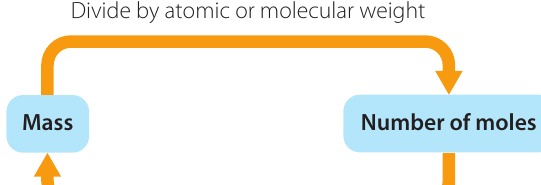
The diagram shows this relationship visually. To go from mass to moles, you divide by the molar mass. To go from moles to mass, you multiply by the molar mass.
Example
Worked Example: Mass to moles calculation
Let's calculate the number of moles in 4.63 g of magnesium chloride (MgCl₂).
Step 1: Identify the formula
- Magnesium chloride is MgCl₂
Step 2: Calculate the molar mass
Step 3: Use the formula to calculate moles
The answer is rounded to 3 significant figures because the given mass (4.63 g) has 3 significant figures.
Converting between moles and number of particles
To convert from moles to the actual number of atoms or molecules, we use Avogadro's constant.
The equation is:
where:
- = number of atoms or molecules
- = number of moles (mol)
- = Avogadro's constant ( mol⁻¹)
To convert in the opposite direction (from number of particles to moles):
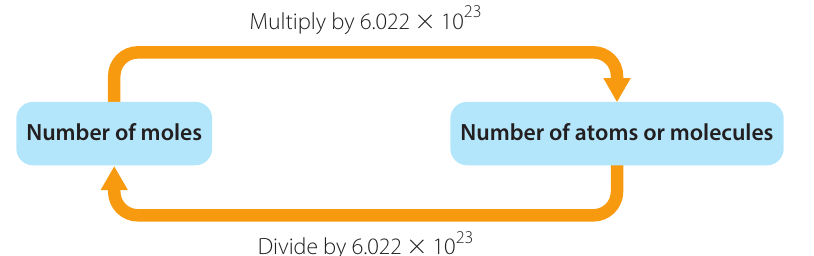
The diagram illustrates this bidirectional conversion. Multiply by Avogadro's constant to go from moles to particles. Divide by Avogadro's constant to go from particles to moles.
Complete conversion pathway: Mass to particles
To convert from mass to number of atoms or molecules (or vice versa), you must work through two steps using both equations. You cannot go directly from mass to particles.
Note
The pathway is:
- Convert mass to moles using
- Convert moles to particles using
Example
Worked Example 1: From mass to number of atoms
How many atoms are in a pure copper coin weighing 2.56 g? (Relative atomic mass of copper = 63.6)
Step 1: Calculate moles of copper
- Molar mass of copper = 63.6 g mol⁻¹
Step 2: Calculate number of atoms
Example
Worked Example 2: From number of molecules to mass
What is the mass of molecules of sulfur dioxide (SO₂)?
Step 1: Convert molecules to moles
Step 2: Calculate molar mass of SO₂
Step 3: Calculate mass
Exam tips
Note
When solving mole problems:
- Always start by identifying what you're given and what you need to find
- Draw a simple diagram showing the conversion pathway (mass → moles → particles)
- Write down all formulas before substituting numbers
- Keep track of units throughout your calculation
- Round your final answer to the appropriate number of significant figures
- For gaseous elements, always specify whether you mean atoms or molecules
Important
Common mistakes to avoid:
- Trying to convert directly from mass to number of particles without going through moles
- Forgetting to use the molecular mass for diatomic gases (O₂, Cl₂, etc.)
- Using the wrong units (mixing grams and kilograms)
- Not maintaining significant figures correctly
Summary
Key Points to Remember:
- A mole is particles (atoms, ions, or molecules)
- One mole of any substance has a mass in grams equal to its relative atomic mass (for elements) or relative molecular mass (for compounds)
- The key conversion formulas are: and
- To convert from mass to number of particles, you must always work through moles as an intermediate step
- For gaseous elements like oxygen and chlorine, always specify whether you're referring to atoms or molecules, as this affects the molar mass