Gay-Lussac’s Law and Avogadro’s Law (HSC SSCE Chemistry): Revision Notes
📚Revision Notes
Gay-Lussac's Law and Avogadro's Law
Introduction to gas reactions
When studying chemical reactions, we need different approaches depending on the state of matter involved. While previous work covered calculations using masses (for solids and pure liquids) and concentrations (for solutions), gases require special consideration.
Gases behave very differently from solids and liquids because their volumes are highly sensitive to both pressure and temperature changes. The pioneering work of Joseph Gay-Lussac and Amadeo Avogadro in the early 19th century made it possible to calculate volumes of gases involved in chemical reactions.
Note
Unlike solids and liquids, which have relatively fixed volumes, gas volumes change dramatically with temperature and pressure variations. This unique property requires specialized laws and calculation methods for gas reactions.

Gay-Lussac's law of combining volumes
In 1808, Gay-Lussac studied how gases react together and proposed an important principle based on his experimental observations.
Important
Gay-Lussac's law states: When gases react together, and their volumes are measured at constant temperature and pressure, these volumes always show simple whole-number ratios to each other.
This means that if you measure the volumes of gases taking part in a reaction carefully (keeping temperature and pressure constant), you'll find they combine in ratios like 1:1, 2:1, 1:2, and so on.
Examples of Gay-Lussac's law
Example
Worked Example 1: Hydrogen reacting with chlorine
When of hydrogen gas reacts with of chlorine gas, they produce of hydrogen chloride gas.
The volume ratio is 1:1:2 (one volume of hydrogen + one volume of chlorine → two volumes of hydrogen chloride).
Example
Worked Example 2: Hydrogen reacting with oxygen
When of hydrogen gas reacts with of oxygen gas, they form of water vapour (steam) at temperatures above .
The volume ratio is 2:1:2 (two volumes of hydrogen + one volume of oxygen → two volumes of steam).
These simple ratios aren't just coincidence - they reveal something fundamental about how gases react at the molecular level.
Avogadro's law
Amadeo Avogadro noticed an important connection between Gay-Lussac's volume ratios and what scientists were learning about how atoms and molecules react. In 1811, he proposed what was initially called Avogadro's hypothesis, now known as Avogadro's law.
Important
Avogadro's law states: When measured at the same temperature and pressure, equal volumes of different gases contain the same number of molecules.
This is a remarkable principle. It means that of hydrogen contains exactly the same number of molecules as of oxygen, or of any other gas, provided they're all measured at the same temperature and pressure.
Rearranging Avogadro's law
We can express Avogadro's law another way: Equal numbers of molecules of different gases occupy the same volume at the same temperature and pressure.
Note
This alternative statement is particularly useful when thinking about chemical equations, as it allows us to connect molecular ratios directly to volume ratios.
Connecting the two laws
The combination of Gay-Lussac's law and Avogadro's law helped scientists understand important facts about common gases:
- Hydrogen, chlorine, and oxygen exist as diatomic molecules (, , )
- Water has the formula , not HO
Let's see how these laws work together by examining the hydrogen-chlorine reaction:
Example
Worked Example: Connecting Gay-Lussac's and Avogadro's Laws (Hydrogen-Chlorine Reaction)
Gay-Lussac's observation (experimental): 1 volume hydrogen + 1 volume chlorine → 2 volumes hydrogen chloride
Avogadro's interpretation: 1 molecule hydrogen + 1 molecule chlorine → 2 molecules hydrogen chloride
Chemical equation:
Example
Worked Example: Connecting Gay-Lussac's and Avogadro's Laws (Hydrogen-Oxygen Reaction)
Gay-Lussac's observation: 2 volumes hydrogen + 1 volume oxygen → 2 volumes water vapour
Avogadro's interpretation: 2 molecules hydrogen + 1 molecule oxygen → 2 molecules water
Chemical equation:
These connections allowed chemists to write accurate chemical equations for gas reactions.
Practical verification: Investigation 9.1
Gay-Lussac's law can be verified experimentally by studying the reaction between hydrogen and oxygen gases. The investigation uses compressed gas cylinders to supply hydrogen and oxygen into a modified burette, where they can be mixed and ignited.
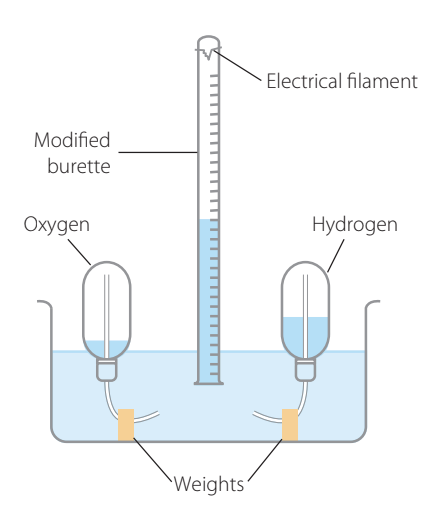
The experimental setup uses wash bottles filled with hydrogen and oxygen gas, submerged in water. By squeezing the bottles, measured volumes of each gas are injected into a burette. When the mixture is ignited using a heated filament, the gases react. By measuring volumes before and after reaction, we can verify Gay-Lussac's simple volume ratios.
Key results from the investigation:
| Volume of hydrogen added (mL) | Total volume of reactants (mL) | Final volume after reaction (mL) |
|---|---|---|
| 2.2 | 20.2 | 16.8 |
| 3.9 | 20.1 | 14.2 |
| 7.2 | 20.0 | 9.4 |
| 9.8 | 20.3 | 5.5 |
| 14.9 | 20.2 | 4.6 |
| 17.9 | 20.3 | 13.2 |
Note
When the results are analysed, they confirm that hydrogen and oxygen react in a 2:1 volume ratio, exactly as Gay-Lussac's law predicts. This experimental verification demonstrates the reliability and practical application of the law.
Molar volume of a gas
Avogadro's law leads to an extremely useful concept: the molar volume of a gas.
Since a mole is a fixed number of molecules ( molecules), Avogadro's law tells us that one mole of any gas occupies the same volume as one mole of any other gas (at the same temperature and pressure). This volume is called the molar volume.
Why temperature and pressure matter
Unlike solids and liquids, gas volumes change significantly with temperature and pressure. Therefore, we must always specify the temperature and pressure when stating a gas volume.
Important
Temperature and pressure dependence: Gas volumes are highly dependent on temperature and pressure conditions. Always specify these conditions when working with gases - this is a critical requirement that distinguishes gas calculations from those involving solids and liquids.
Standard conditions and molar volumes
Standard pressure is defined as exactly .
Important
Standard molar volumes to remember:
At standard pressure, the molar volume of all gases is:
- 22.71 L at and
- 24.79 L at and
These values are fundamental constants in gas calculations.
Visualising a mole of gas
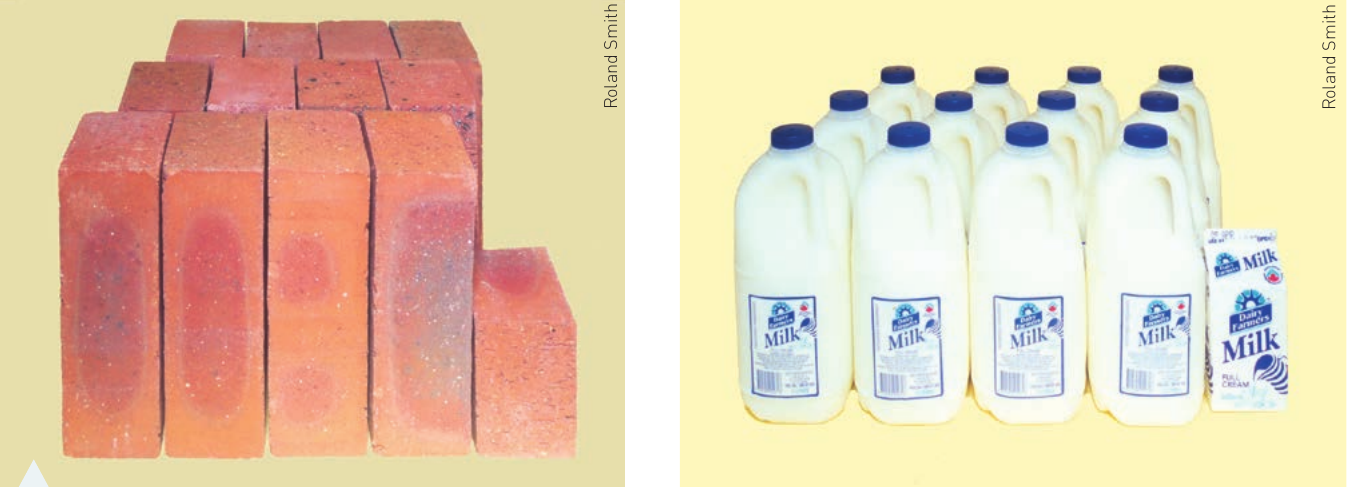
To help understand the size of a mole of gas, at and , one mole of any gas occupies approximately:
- The volume of 12 house bricks, or
- The volume of twelve 2-litre milk bottles
Note
This visualisation helps you appreciate that gases at normal conditions occupy considerable volumes compared to solids and liquids. A mole of gas takes up a significant amount of space that you can easily picture in everyday terms.
Practical application: Investigation 9.2
The concept of molar volume can be used to determine the molar mass of an unknown gas. Investigation 9.2 demonstrates this by measuring the molar mass of butane gas from a disposable lighter.
The principle: By measuring both the mass and volume of a gas sample, and knowing the molar volume, we can calculate the molar mass.
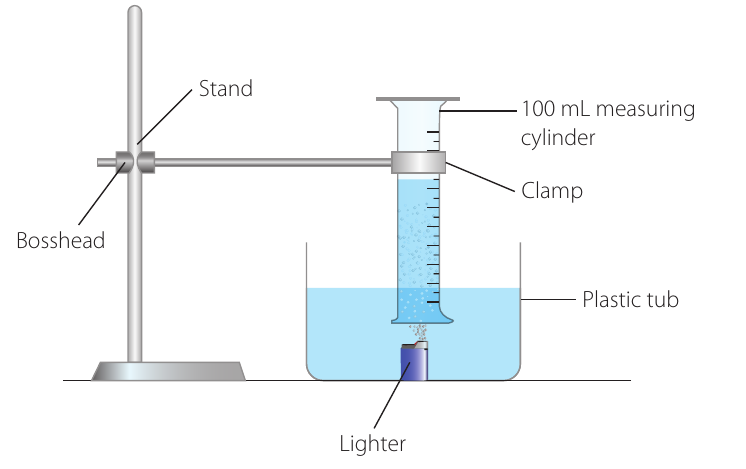
Method overview:
- Weigh a butane lighter
- Release butane gas into an inverted measuring cylinder filled with water (the gas displaces the water)
- Record the volume of gas collected
- Weigh the lighter again to find the mass of butane released
- Record the water temperature
Important
Safety considerations:
| What are the risks? | How to manage them |
|---|---|
| Butane gas is flammable | Remove all ignition sources from the laboratory |
| Butane gas is a respiratory irritant | Work in a well-ventilated area. Do not inhale the gas |
Example
Basic calculation:
Using the approximation that the pressure is and the temperature is , you can use the molar volume () to calculate the number of moles of butane collected, and hence determine its molar mass.
Step 1: Calculate moles of gas
Step 2: Calculate molar mass
More accurate calculation:
The butane gas collected is saturated with water vapour. For greater accuracy, the water vapour pressure must be subtracted from atmospheric pressure. The water vapour pressure depends on temperature:
| Temperature (°C) | Vapour pressure of water (kPa) | Temperature (°C) | Vapour pressure of water (kPa) |
|---|---|---|---|
| 15 | 1.71 | 23 | 2.81 |
| 16 | 1.82 | 24 | 2.98 |
| 17 | 1.94 | 25 | 3.17 |
| 18 | 2.06 | 26 | 3.36 |
| 19 | 2.19 | 27 | 3.57 |
| 20 | 2.34 | 28 | 3.78 |
| 21 | 2.49 | 29 | 4.01 |
| 22 | 2.64 | 30 | 4.25 |
Note
For butane (), the theoretical molar mass is 58.12 g mol⁻¹. Comparing your experimental result with this value helps evaluate the accuracy of the method and identify sources of experimental error.
Exam tips
Important
Key exam strategies:
-
Always state temperature and pressure when working with gas volumes. Unlike solids and liquids, these factors significantly affect gas volumes.
-
Remember the two standard molar volumes: 22.71 L at and 24.79 L at (both at ).
-
Look for simple ratios in gas reaction problems. Gay-Lussac's law tells us these ratios will be whole numbers.
-
Connect volumes to moles: Since equal volumes of gases contain equal numbers of molecules (Avogadro's law), volume ratios equal mole ratios for gases at the same temperature and pressure.
-
Use coefficients from balanced equations: The numbers in front of substances in balanced equations tell you the volume ratios for gases.
Remember!
Summary
Key Points to Remember:
-
Gay-Lussac's law states that gases react in simple whole-number volume ratios when measured at constant temperature and pressure.
-
Avogadro's law states that equal volumes of different gases contain equal numbers of molecules when measured at the same temperature and pressure.
-
One mole of any gas occupies 24.79 L at and (or 22.71 L at and ). This is called the molar volume.
-
Together, these laws allow us to use chemical equations to calculate volumes of gases in reactions, and to determine molar masses of unknown gases.
-
Always specify temperature and pressure when working with gas volumes, as gases are highly sensitive to these conditions.