Orbitals and Sublevels (HSC SSCE Chemistry): Revision Notes
📚Revision Notes
Orbitals and Sublevels
Introduction to electron orbitals
You may have learned a simple way to describe electron arrangement in atoms based on Bohr's theory, where electrons occupy specific energy levels or "shells". However, this simple model cannot explain some important observations. For example, why does an energy level sometimes get "half-filled" with eight electrons before the next level starts filling? Why are the noble gases so stable when their outer level has only eight electrons?
Scientists developed a more detailed picture of electron arrangement that explains these puzzling observations. This advanced model introduces the concept of orbitals and sublevels.
Note
The simpler Bohr model works well for basic chemistry, but the orbital model provides a more accurate and complete picture of electron behavior. Understanding orbitals helps explain chemical bonding, molecular shapes, and the structure of the periodic table.
What is an orbital?
An orbital is a three-dimensional region of space around the nucleus where we are most likely to find one or two electrons moving randomly. Think of it as a "cloud" or zone where electrons spend most of their time.
Key points about orbitals:
- Each orbital can hold a maximum of two electrons
- Orbitals have different shapes and sizes
- Different energy levels contain different numbers and types of orbitals
- Orbitals in higher energy levels are generally larger than those in lower levels
- Orbitals can overlap with each other in space
Note
Because electrons are extremely small and carry negative charges (which repel each other), the two electrons in an orbital rarely collide despite sharing the same space. The electrons also have opposite spins, which allows them to occupy the same orbital without violating quantum mechanical principles.
Types and shapes of orbitals
There are four main types of orbitals, each with a characteristic shape:
s orbitals
s orbitals are spherical in shape, like a ball centred on the nucleus. Different s orbitals (1s, 2s, 3s, etc.) have the same shape but different sizes. The higher the number, the larger the sphere.
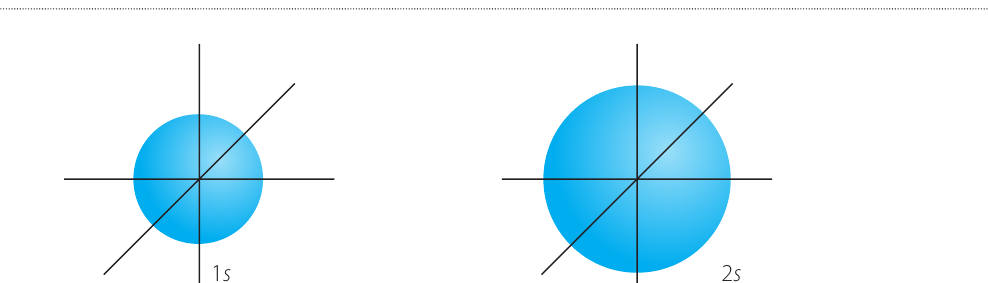
The diagram above shows how the 1s orbital (smaller sphere) compares with the 2s orbital (larger sphere). Both are perfectly spherical but the 2s orbital extends further from the nucleus.
p orbitals
p orbitals have a distinctive dumbbell shape, like two teardrops or pears joined at their narrow ends. Each p sublevel contains three p orbitals oriented at right angles to each other along the x, y, and z axes.
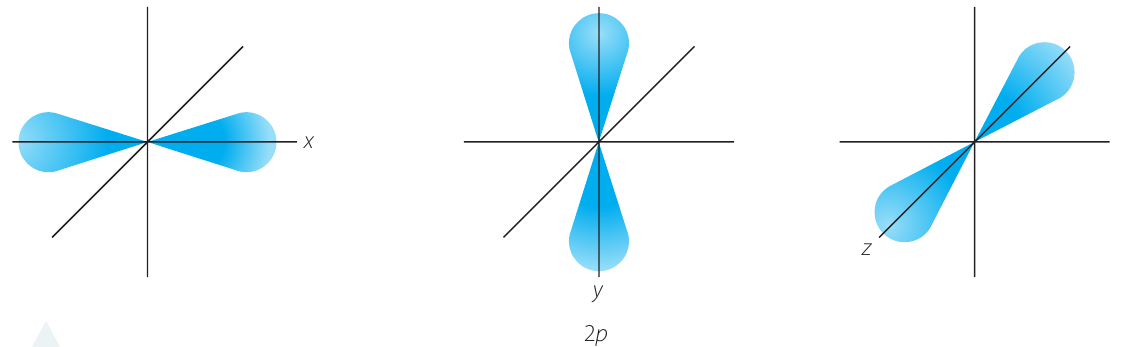
The figure shows the three p orbitals and how they are arranged perpendicular to one another in three-dimensional space. This arrangement ensures the orbitals cover space efficiently around the nucleus.
Note
The three p orbitals are often labeled as , , and to indicate their orientation along the three spatial axes. Despite their different orientations, all three p orbitals within the same sublevel have identical energy.
d orbitals
d orbitals have more complex shapes than s or p orbitals. Each d sublevel contains five d orbitals, meaning it can hold up to 10 electrons in total.
f orbitals
f orbitals have even more complicated shapes. Each f sublevel contains seven f orbitals, allowing a maximum of 14 electrons.
Energy levels and sublevels
The main energy levels (often called shells) that you learned about in simpler models are actually made up of smaller groups called sublevels or subshells.
Structure of energy levels
Each main energy level contains one or more sublevels:
First energy level:
- Contains only 1 sublevel: the 1s sublevel
- Maximum capacity: 2 electrons
Second energy level:
- Contains 2 sublevels: 2s and 2p
- Maximum capacity: 8 electrons (2 in 2s, 6 in 2p)
Third energy level:
- Contains 3 sublevels: 3s, 3p, and 3d
- Maximum capacity: 18 electrons (2 in 3s, 6 in 3p, 10 in 3d)
Fourth energy level:
- Contains 4 sublevels: 4s, 4p, 4d, and 4f
- Maximum capacity: 32 electrons (2 in 4s, 6 in 4p, 10 in 4d, 14 in 4f)
Notice the pattern: the first level has 1 sublevel, the second has 2 sublevels, the third has 3 sublevels, and so on.
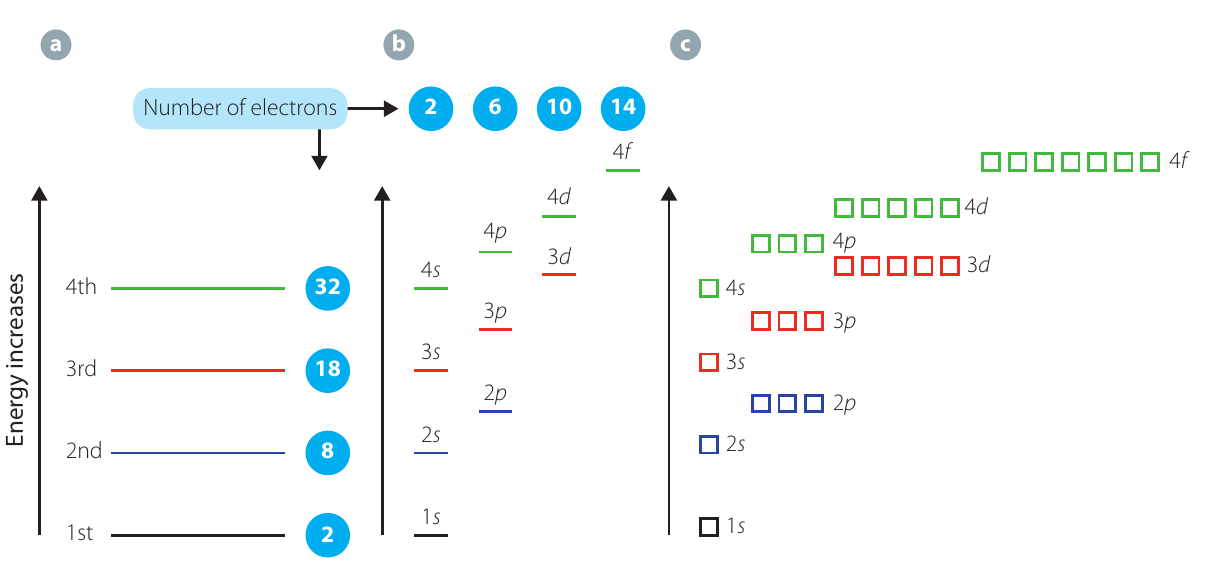
This comprehensive diagram shows three related views: (a) the main energy levels with their total electron capacity, (b) how these levels split into sublevels, and (c) the individual orbitals within each sublevel. Energy increases as you move upward in the diagram.
Electron capacity of sublevels
Each type of sublevel can hold a specific maximum number of electrons:
- s sublevel: 1 orbital → maximum 2 electrons
- p sublevel: 3 orbitals → maximum 6 electrons
- d sublevel: 5 orbitals → maximum 10 electrons
- f sublevel: 7 orbitals → maximum 14 electrons
To remember the capacity: 2, 6, 10, 14 (each doubles the previous increase).

The table summarises how the sublevels within each main energy level add up to give the total electron capacity. This explains why the main energy levels can hold 2, 8, 18, and 32 electrons respectively.
Important energy consideration
Important
Sublevels don't always fill in the order you might expect. The 4s sublevel has slightly lower energy than the 3d sublevel, so 4s fills before 3d. This explains why we sometimes add electrons to a new main level before completely filling the previous one.
The typical filling order is: 1s → 2s → 2p → 3s → 3p → 4s → 3d → 4p → 5s → 4d, and so on.
Orbital notation
There is a specific way to write electron configurations that shows exactly which sublevels contain electrons. This method is called orbital notation or writing in terms of shells and subshells.
How orbital notation works
In orbital notation, we write:
- The number of the main energy level
- The letter of the sublevel type (s, p, d, or f)
- A superscript number showing how many electrons are in that sublevel
For example: means 2 electrons in the 1s sublevel.
Examples of orbital notation
Example
Worked Example: Writing Orbital Notation
Nitrogen (7 electrons):
- Orbital notation:
- Simple form: 2,5
- This means: 2 electrons in 1s, 2 in 2s, and 3 in 2p
Neon (10 electrons):
- Orbital notation:
- Simple form: 2,8
- This means: 2 electrons in 1s, 2 in 2s, and 6 in 2p (completely filled)
Phosphorus (15 electrons):
- Orbital notation:
- Simple form: 2,8,5
- This means: the first and second levels are completely filled, then the third level has 2 in 3s and 3 in 3p
Electron configuration diagrams
We can also represent electrons in orbitals using a box diagram, where each box represents one orbital and arrows represent electrons:
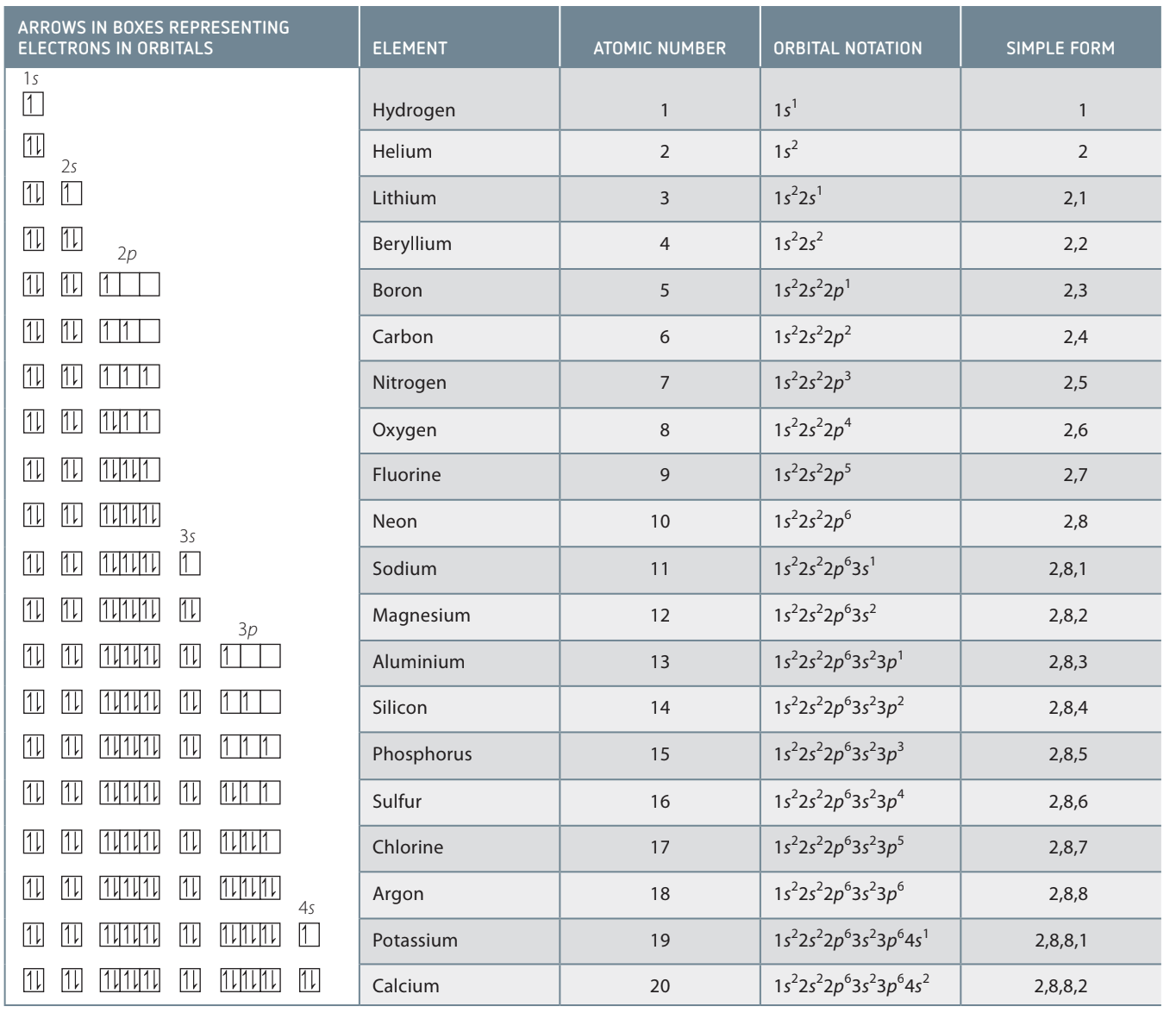
These tables show three ways to represent electron configuration for elements 1-20:
- Box diagrams: Arrows in boxes (↑↓ means two electrons with opposite spins in one orbital)
- Orbital notation: Using the format
- Simple form: Using comma-separated numbers like 2,8,1
Note
Notice how the electrons fill orbitals systematically, starting from the lowest energy orbitals. When p orbitals begin filling, electrons occupy separate orbitals with parallel spins before pairing up (this follows Hund's rule, which you may learn about later).
Why this matters
Understanding orbitals and sublevels helps explain:
- Why noble gases are so stable (they have completely filled s and p sublevels in their outer level)
- Why the periodic table has its particular structure (elements in the same group have similar outer sublevel configurations)
- Why there are 10 transition metals in each row (they correspond to filling a d sublevel with 10 electrons)
- The chemical behaviour of elements (which depends largely on outer electron arrangement)
Exam tips
Important
Key Points for Exams:
- When writing orbital notation, always include the main energy level number with the sublevel letter (e.g., 2p not just p)
- Remember that the superscript in orbital notation () shows the number of electrons, not the number of orbitals
- The 4s sublevel fills before 3d, even though 3d is in the third energy level
- Practice drawing box diagrams to visualise electron arrangements clearly
- Noble gas configurations (outer level with 8 electrons) correspond to filled s and p sublevels, which is why they are so stable
Remember!
Summary
Key Points to Remember:
- An orbital is a three-dimensional region where up to two electrons can be found, with different shapes (spherical s, dumbbell-shaped p, and more complex d and f)
- Each main energy level contains one or more sublevels (s, p, d, f), and each sublevel contains a specific number of orbitals (1, 3, 5, 7 respectively)
- Maximum electron capacity follows the pattern: s=2, p=6, d=10, f=14, giving main level capacities of 2, 8, 18, 32
- Orbital notation (like ) shows the distribution of electrons across sublevels, with the superscript indicating the number of electrons in each sublevel
- Electrons fill orbitals starting from the lowest energy, following the order: 1s → 2s → 2p → 3s → 3p → 4s → 3d → 4p, and so on