Covalent Bonding (HSC SSCE Chemistry): Revision Notes
📚Revision Notes
Covalent Bonding
What is covalent bonding?
Covalent bonding is a type of chemical bonding where atoms share pairs of electrons to form stable compounds. This sharing of electrons allows atoms to achieve a stable electron configuration, similar to that of noble gases.
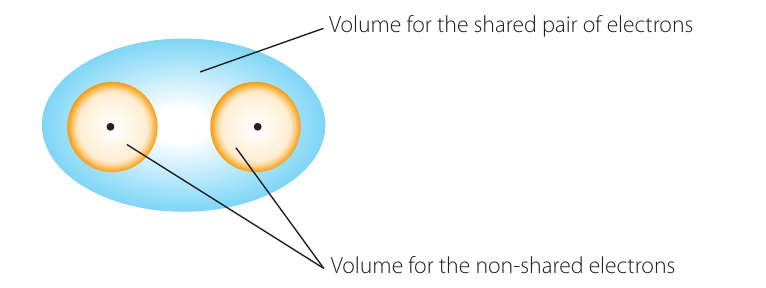
When atoms form covalent bonds, each shared pair of electrons is considered to belong to both atoms involved in the bond. This means both atoms can "count" the shared electrons as part of their own electron configuration, helping them achieve stability.
Note
The shared electron pair exists in a region of space that surrounds both atomic nuclei, holding the atoms together. Meanwhile, electrons that are not shared (called lone pairs) remain in regions surrounding only one nucleus.
Examples of covalent bonding
Chlorine molecule ()
A chlorine atom has the electron configuration , meaning it needs one more electron to achieve the stable configuration of argon (). When two chlorine atoms come together, they can both achieve this stable configuration by sharing a pair of electrons.
Example
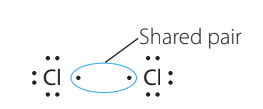
How Chlorine Forms a Covalent Bond:
In this arrangement:
- Each chlorine atom contributes one electron to the shared pair
- Each atom considers both electrons in the shared pair as its own
- Both atoms now have the stable electron configuration
We can represent the chlorine molecule using a structural formula:
The dash represents one shared pair of electrons (one covalent bond). The molecular formula is , and we call this a covalent molecule.
Hydrogen chloride ()
Hydrogen has only one electron and needs one more to become like helium (a stable configuration). Chlorine, with configuration , also needs one electron to become like argon ().
When these atoms combine:
- Each atom contributes one electron to form a shared pair
- The hydrogen atom achieves a helium-like configuration
- The chlorine atom achieves an argon-like configuration
- The covalent molecule is formed
Structural formula:
Water ()
Oxygen has the electron configuration and needs two more electrons to become like neon (). Hydrogen needs one electron to become like helium.
To satisfy both requirements:
- One oxygen atom bonds with two hydrogen atoms
- Each hydrogen shares its electron with the oxygen
- The oxygen shares one electron with each hydrogen
- All three atoms achieve stable noble gas configurations
Structural formula:
The molecular formula is , showing that each water molecule contains two hydrogen atoms and one oxygen atom.
Representing covalent bonds
Electron-dot structures (Lewis structures)
Electron-dot structures are diagrams that show the valence electrons (outer shell electrons) as dots around element symbols. These structures help us visualise how electrons are shared in covalent bonds.
Note
For example:
- A chlorine atom: with seven dots representing valence electrons
- A chlorine molecule: the dots show paired electrons between the two atoms, representing the shared pair
These structures display all the valence electrons in the molecule, making it easy to see which electrons are shared and which remain as lone pairs.
Structural formulae
Structural formulae use dashes to represent covalent bonds between atoms. Each dash represents one shared pair of electrons. For example:
- for chlorine
- for hydrogen chloride
- for water
Note
Structural formulae show the bonding arrangement but don't necessarily show the actual three-dimensional shape of the molecule.
Shapes of simple covalent molecules
Different covalent molecules have different three-dimensional shapes:
- Chlorine (): linear molecule
- Hydrogen chloride (): linear molecule
- Water (): bent or V-shaped molecule
Note
While strong covalent bonds hold atoms together within each molecule, the molecules themselves can move independently of one another. This is why covalent molecular substances can exist as gases, liquids, or low-melting solids.
Covalent molecular substances and molecular formulae
Covalent molecular substances (or simply molecular substances) are materials made up of discrete covalent molecules. Examples include , , and .
A molecular formula tells us the exact number of each type of atom present in one molecule of the substance. This differs from an empirical formula, which only shows the simplest ratio of atoms.
Important
Molecular Formula vs. Empirical Formula:
- is a molecular formula (tells us there are exactly 2 chlorine atoms per molecule)
- is an empirical formula (shows the ratio of ions in an ionic compound)
Remember: Molecular formulas give exact numbers, while empirical formulas give the simplest ratio.
Covalency and the periodic table
Covalent bonding occurs when both elements involved need to gain electrons to achieve noble gas configurations. Elements in the centre and right side of the periodic table tend to form covalent compounds, including:
- Carbon ()
- Silicon ()
- Nitrogen ()
- Phosphorus ()
- Oxygen ()
- Sulfur ()
- Fluorine ()
- Chlorine ()
Note
Pattern in Bonding:
The number of covalent bonds an atom forms depends on how many electrons it needs to gain for a stable configuration:
- Hydrogen and chlorine: need 1 electron, form 1 bond
- Oxygen: needs 2 electrons, forms 2 bonds
- Nitrogen: needs 3 electrons, forms 3 bonds (e.g., in ammonia, )
- Carbon: needs 4 electrons, forms 4 bonds (e.g., in methane, )
An element's position in the periodic table tells us how many covalent bonds it will typically form.
Valency in covalent compounds
Valency (or valence) in covalent compounds refers to the number of covalent bonds an element forms. This is equivalent to the number of electrons the atom needs to gain to achieve a noble gas configuration.
Examples:
- Chlorine in : valency = 1
- Oxygen in : valency = 2
- Nitrogen in : valency = 3
- Carbon in : valency = 4
Some elements always display the same valency (fixed valency), while others can have different valencies in different compounds (variable valency).
Common valencies:
Fixed valencies:
- Valency 1: , , , ,
- Valency 2:
- Valency 4: ,
Variable valencies:
- Sulfur (): valency 2, 4, or 6
- Nitrogen (): valency 3 or 5 (can also be 1, 2, or 4 in oxygen compounds)
- Phosphorus (): valency 3 or 5
Determining formulae for covalent binary compounds
If we know the valencies of two elements, we can determine the formula for the covalent compound they form. For a compound with formula , we choose the smallest whole number values of and that satisfy:
Example
Worked Example: Carbon and Chlorine Compound
Carbon has valency 4, chlorine has valency 1.
For compound :
The smallest values are and .
Therefore, the formula is .
Example
Worked Example: Nitrogen and Hydrogen Compound
Nitrogen has valency 3, hydrogen has valency 1.
For compound :
The smallest values are and .
Therefore, the formula is (ammonia).
Remember!
Summary
Key Points to Remember:
-
Covalent bonds form through electron sharing: atoms share pairs of electrons to achieve stable noble gas configurations.
-
Shared electrons belong to both atoms: each atom counts the shared electrons as its own, allowing both to achieve stability.
-
The periodic table predicts bonding: an element's group number indicates how many electrons it needs to gain, and therefore how many covalent bonds it will form.
-
Multiple representations exist: covalent compounds can be shown using molecular formulae (), structural formulae (), or electron-dot structures (Lewis diagrams).
-
Valency determines formulae: use the equation to work out the molecular formula of covalent compounds.