Polar Covalent Bonds and Polar Molecules (HSC SSCE Chemistry): Revision Notes
📚Revision Notes
Polar Covalent Bonds and Polar Molecules
Introduction to molecular polarity
When studying chemical bonding, you'll discover that not all covalent bonds share electrons equally between atoms. The properties of molecular compounds depend significantly on how electrons are distributed within their bonds. Understanding polar covalent bonds and molecular polarity is essential for predicting molecular behaviour, especially when considering intermolecular attractions and physical properties like melting and boiling points.
What are polar covalent bonds?
Equal sharing in identical atoms
In molecules where two identical atoms bond together, such as , , and , the electron pairs are shared very evenly between the atoms. This occurs because both atoms have the same ability to attract electrons, resulting in a balanced distribution of charge throughout the bond.
Unequal sharing in different atoms
However, when molecules contain bonds between different elements—such as , , and —the situation changes dramatically. The electron pairs are shared unevenly because the atoms have different abilities to attract electrons. This unequal distribution means electrons spend more time near one nucleus than the other.
Consider hydrogen chloride () as an example. The shared pair of electrons spends more time near the chlorine atom than near the hydrogen atom. As a result, the chlorine end of the molecule becomes slightly negative (having more electrons around it on average than protons in its nucleus), whilst the hydrogen end becomes slightly positive.
Delta charges
Important
We represent these partial charges using the Greek letter delta (), which means 'a small amount of'. The notation looks like this:
These delta charges are much smaller than whole electron or proton charges—they represent only a partial charge distribution, not a complete transfer of electrons as seen in ionic compounds.
Connection to electronegativity
This uneven sharing of electrons occurs because of differences in electronegativity between the bonded atoms. Electronegativity measures an atom's ability to attract bonding electrons towards itself. When two atoms with different electronegativities form a bond, the more electronegative atom pulls the shared electrons closer, creating partial charges.
Important
Polar covalent bonds are covalent bonds where the electrons are unequally shared between the atoms. Common examples include , , , , , , and bonds.
Understanding dipoles and polar molecules
What is a dipole?
When you have a pair of equal but opposite charges separated in space—like in the molecule—this arrangement is called a dipole. Think of it as a tiny molecular magnet with a positive end and a negative end.
Note
Visualizing dipoles: Picture a dipole as having two poles (like a magnet), with one end slightly positive () and the other slightly negative (). This separation of charge gives the molecule directional properties.
Defining polar molecules
Polar molecules are molecules that possess a net dipole—that is, they have an overall separation of positive and negative charge that doesn't cancel out. For diatomic molecules (molecules with just two atoms), if the bond is polar, then the entire molecule is polar. Hydrogen chloride () is a straightforward example of this.
How molecular shape affects net polarity
Polyatomic molecules and dipole cancellation
For polyatomic molecules (those containing more than two atoms), the presence of polar covalent bonds doesn't automatically mean the molecule will be polar overall. This is because multiple dipoles within one molecule can cancel each other out. The three-dimensional shape of the molecule determines whether individual dipoles add together to create a net dipole or cancel each other completely.
Important
Critical concept: The shape of the molecule determines whether dipoles cancel out or add up. This is why molecular geometry is essential for predicting polarity!
Examples of polar molecules
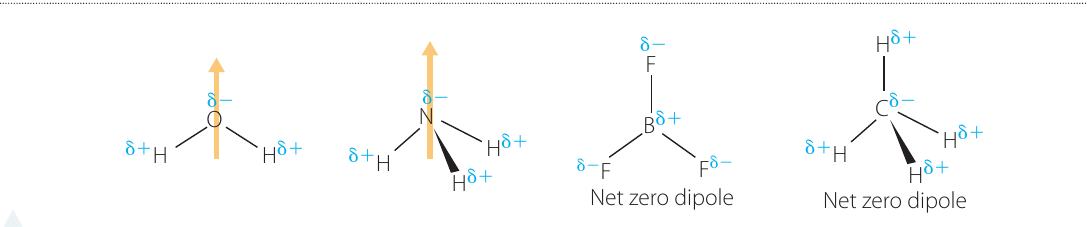
Water (): The two polar bonds in water combine to produce a net dipole. The bent shape of the water molecule means the two bond dipoles point in directions that add together rather than cancel out.
Ammonia (): The three polar bonds in ammonia also combine to give a net dipole. Ammonia has a pyramidal (three-dimensional) shape where the three hydrogen atoms sit below the nitrogen atom, causing the dipoles to add constructively.
Examples of non-polar molecules
Boron trifluoride (): This molecule demonstrates how symmetry can lead to non-polarity despite having polar bonds. is a flat molecule with a trigonal planar shape—the three bonds are arranged at angles of to one another in the same plane. Each bond is polar, but the three dipoles point in directions that perfectly cancel one another out. Contrast this with ammonia's pyramidal (non-planar) shape where cancellation doesn't occur.
Methane (): In the tetrahedrally shaped methane molecule, each of the four bonds is slightly polar. However, when you consider all four bonds together in three-dimensional space, they cancel one another out completely. This makes methane a non-polar molecule, just as if there were no polar bonds at all.
Note
The diagram above illustrates how molecular geometry determines polarity. Notice how the arrows (representing net dipole moments) point upward in water and ammonia, indicating these molecules are polar. In contrast, boron trifluoride and methane show no net dipole because the individual bond dipoles cancel out due to molecular symmetry.
A key point to remember: a polar molecule is one that has a net dipole. If two or more polar bonds in a molecule completely cancel themselves out, then the molecule is a non-polar molecule.
Determining whether a molecule is polar
To work out whether a particular molecule is polar, follow this two-step process:
Note
Two-Step Process for Determining Molecular Polarity:
-
Identify any polar bonds: Look at the electronegativity differences between bonded atoms to determine which bonds are polar.
-
Determine whether dipoles add or cancel: Consider the three-dimensional shape of the molecule to see if the individual bond dipoles combine to give a net dipole or cancel out to make a non-polar molecule.
The first step requires knowledge of electronegativity, whilst the second step requires understanding of molecular shape and geometry.
Electronegativity and bond polarity
Understanding electronegativity
A covalent bond between two atoms will be polar if one atom has greater electron-attracting power than the other. This electron-attracting ability is measured by electronegativity—the ability of an atom to attract bonding electrons towards itself.
If the two elements forming a covalent bond have different electronegativities, the shared pair of electrons will be attracted towards the element with higher electronegativity, making the bond polar.
Electronegativity scale
Important
Electronegativity Order:
For common elements, the order of decreasing electronegativity is:
This sequence is extremely useful for predicting bond polarity. Fluorine is the most electronegative element, whilst elements like silicon are much less electronegative.
Common polar bonds
Based on the electronegativity scale, common polar bonds include:
- (oxygen is more electronegative)
- (nitrogen is more electronegative)
- (oxygen is more electronegative)
- (chlorine is more electronegative)
In each case, the first-named atom becomes the positive end of the dipole (), whilst the second atom becomes the negative end ().
Common non-polar bonds
Some bonds are non-polar because the electronegativities of the atoms are similar:
- (similar electronegativities)
- (similar electronegativities)
- (similar electronegativities)
Special case: bonds
Note
The bond is very slightly polar, but this often doesn't matter in practice. Many molecules contain several bonds, and their tiny dipoles usually combine in such a way that they cancel one another out, leading to non-polar molecules overall.
Exam tips
Note
Exam Strategy:
- Always consider both bond polarity AND molecular shape when determining if a molecule is polar
- Remember that symmetrical molecules often have cancelling dipoles
- Practice drawing three-dimensional structures to visualise how dipoles add or cancel
- Use the electronegativity scale to quickly identify which end of a bond is and which is
- Don't assume that having polar bonds automatically means the molecule is polar
Remember!
Summary
Key Points to Remember:
-
Polar covalent bonds form when electrons are shared unequally between atoms with different electronegativities, creating partial charges ( and )
-
A dipole is a separation of positive and negative charges in space, whilst polar molecules are those with a net dipole that doesn't cancel out
-
Molecular shape is crucial: even molecules with polar bonds can be non-polar if the dipoles cancel due to symmetrical arrangement (like and )
-
Two-step process for determining polarity: first identify polar bonds using electronegativity, then determine if dipoles cancel based on molecular geometry
-
Electronegativity decreases in the order: , with the more electronegative atom attracting electrons more strongly