Predicting Shapes of Molecules (HSC SSCE Chemistry): Revision Notes
📚Revision Notes
Predicting Shapes of Molecules
Understanding the three-dimensional shape of molecules is essential in chemistry. Scientists have developed methods to determine how atoms arrange themselves in space, and from this work, they've discovered a powerful principle that helps us predict molecular shapes.
The valence shell electron-pair repulsion (VSEPR) theory
When chemists compared experimentally determined molecular shapes with electron-dot structures (Lewis structures), they noticed a consistent pattern. This led to the development of the valence shell electron-pair repulsion theory, or VSEPR theory for short.
The key principle is straightforward: electron pairs surrounding a central atom position themselves to maximize their distance from each other. This arrangement minimizes repulsion between the negatively charged electron pairs and represents the most stable, lowest-energy configuration for the molecule.
Note
Think of it like this: if you had several magnets with the same poles facing each other, they would naturally push apart and spread out as far as possible. Electron pairs behave similarly.
Counting electron pairs
To predict molecular shape, you need to count the total number of electron pairs around the central atom. This includes:
- Bonding pairs: electrons shared between atoms in covalent bonds
- Lone pairs: non-bonding electrons that belong to the central atom but aren't involved in bonding
Important
Both types of electron pairs contribute to the overall shape because both occupy space and repel other electron pairs. When predicting molecular geometry, you must count all electron pairs - not just the bonding ones.
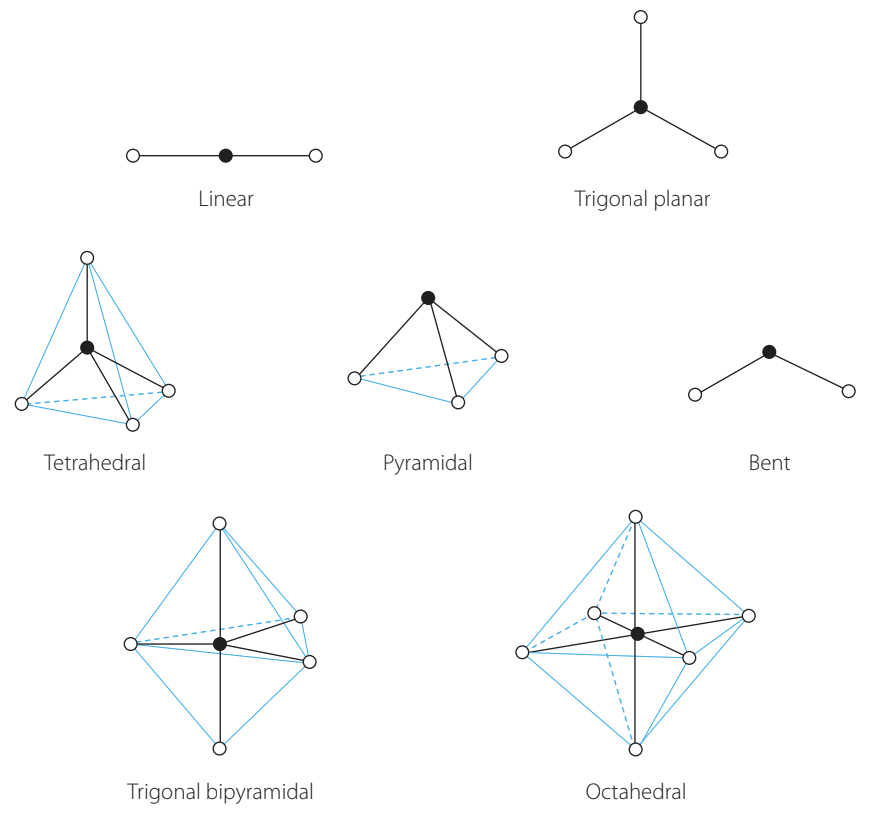
Molecular shapes based on electron pair arrangements
Linear shape (2 electron pairs)
When a central atom has only two electron pairs, they position themselves on opposite sides of the atom, creating a linear molecule with a angle.
Example
Example: Beryllium Chloride ()
In , beryllium has just two bonding pairs. These pairs achieve maximum separation by aligning in a straight line: .
Note
Beryllium and boron compounds are unusual because these central atoms have fewer than eight valence electrons. This occurs rarely in chemistry.
Trigonal planar shape (3 electron pairs)
With three electron pairs, the most stable arrangement is trigonal planar - all three pairs lie in the same flat plane, pointing toward the corners of an equilateral triangle. The angle between any two pairs is .
Example
Example: Boron Trichloride ()
All three chlorine atoms bonded to the boron atom lie in the same plane, with angles between the bonds. The molecule is completely flat.
Tetrahedral shape (4 electron pairs, all bonding)
Four electron pairs arrange themselves pointing toward the corners of a tetrahedron - a three-dimensional pyramid shape with four triangular faces. Each angle in this arrangement measures .
Example
Example: Methane ()
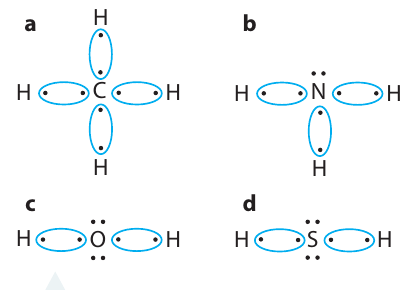
The carbon atom sits at the centre of a tetrahedron, with four hydrogen atoms at the corners. Each bond angle is . This three-dimensional arrangement is not flat - it extends into space.
Pyramidal shape (4 electron pairs: 3 bonding, 1 lone)
When a central atom has four electron pairs but only three are involved in bonding, the electron pairs still adopt a tetrahedral arrangement. However, since only three positions have atoms attached, the resulting molecular shape is pyramidal (like a three-sided pyramid).
Example
Example: Ammonia ()
Nitrogen has four electron pairs arranged tetrahedrally. Three pairs form bonds with hydrogen atoms, whilst the fourth is a lone pair. The three hydrogen atoms and the nitrogen form a pyramid shape, with the lone pair occupying the fourth tetrahedral position.
Important
This explains why ammonia () has a different shape from boron trichloride (), even though both have three covalent bonds. The presence of the lone pair in ammonia is the key difference.
Bent shape (4 electron pairs: 2 bonding, 2 lone)
When a central atom has four electron pairs with only two involved in bonding, the electron pairs maintain a tetrahedral arrangement, but only two positions have atoms attached. This creates a bent or V-shaped molecule.
Example
Examples: Water () and Hydrogen Sulfide ()
In water, oxygen has four electron pairs arranged tetrahedrally. Two pairs form bonds with hydrogen atoms, whilst two are lone pairs. Looking only at the three atoms (two hydrogens and one oxygen), we see a bent shape, not a linear one.
The same principle applies to hydrogen sulfide, which has a similar bent structure.
More complex shapes
For molecules with five or six electron pairs around the central atom, the arrangements become more complex:
- Trigonal bipyramidal (5 electron pairs, all bonding): Five bonding pairs create a shape with three atoms in a triangular plane and two atoms above and below this plane. Example:
- Octahedral (6 electron pairs, all bonding): Six bonding pairs point toward the corners of an octahedron (an eight-faced solid with six vertices). Example:
Summary of molecular shapes
Note
The following table provides a comprehensive overview of molecular shapes based on electron pair arrangements. Notice how the molecular shape differs from the electron pair arrangement when lone pairs are present.
| Total electron pairs | Electron pair arrangement | Bonding pairs | Lone pairs | Molecular shape | Examples |
|---|---|---|---|---|---|
| 2 | Linear | 2 | 0 | Linear | |
| 3 | Trigonal planar | 3 | 0 | Trigonal planar | |
| 4 | Tetrahedral | 4 | 0 | Tetrahedral | , |
| 4 | Tetrahedral | 3 | 1 | Pyramidal | , |
| 4 | Tetrahedral | 2 | 2 | Bent | , |
| 5 | Trigonal bipyramidal | 5 | 0 | Trigonal bipyramidal | |
| 6 | Octahedral | 6 | 0 | Octahedral |
Exam tips
Important
Essential Exam Strategies
- Always count the total number of electron pairs (bonding plus lone pairs) to determine the electron pair arrangement
- The molecular shape is defined by the positions of the atoms only, not the lone pairs
- Remember that lone pairs take up space just like bonding pairs, even though we don't see atoms there
- Draw Lewis structures first to help you count electron pairs correctly
- When answering questions, clearly distinguish between "electron pair arrangement" (geometric arrangement of all pairs) and "molecular shape" (arrangement of atoms only)
Summary
Key Points to Remember:
- VSEPR theory states that electron pairs around a central atom arrange themselves to minimize repulsion by maximizing their separation
- Count all electron pairs - both bonding and lone pairs - to predict the electron pair arrangement
- The molecular shape is determined by where the atoms are positioned, not where the lone pairs are
- Key shapes to know: linear (2 pairs), trigonal planar (3 pairs), tetrahedral (4 pairs all bonding), pyramidal (3 bonding + 1 lone), and bent (2 bonding + 2 lone)
- The same number of bonds can produce different shapes depending on whether lone pairs are present