Reactivity with Water (HSC SSCE Chemistry): Revision Notes
📚Revision Notes
Reactivity with Water
Introduction
Water is a common substance, but did you know that only certain elements can react with it? This fascinating property reveals important patterns in the periodic table and helps us understand how atoms behave. When elements do react with water, the reactions can be quite dramatic, producing hydrogen gas and creating useful compounds called metal hydroxides. Let's explore which elements react with water and why this happens.
Which elements react with water?
A small number of elements undergo reactions with water, and these elements share an important characteristic - they are all metals located on the left-hand side of the periodic table. Understanding which elements react helps us predict chemical behaviour and identify important periodic trends.
Note
The ability to react with water is not random - it follows clear patterns in the periodic table that relate directly to atomic structure and electron configuration.
Group 1 elements (alkali metals)
Every element in Group 1 reacts with water, making this group particularly important for understanding water reactivity. The reactions become increasingly vigorous as you move down the group from lithium to caesium. When lithium reacts with water, you can observe bubbles forming as hydrogen gas is released.
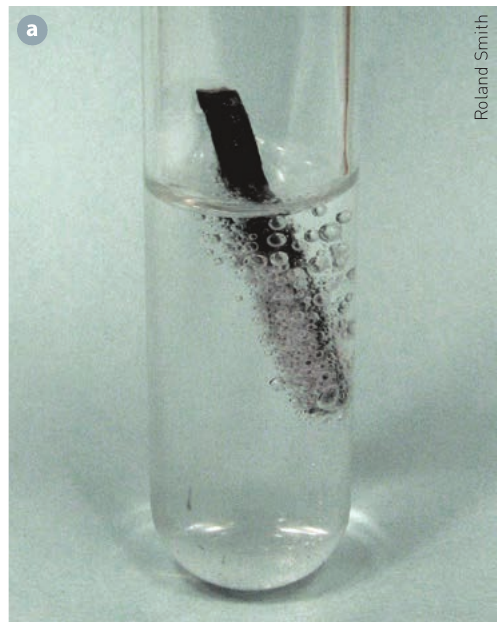
The reaction starts gently with lithium but becomes progressively more energetic with each successive element down the group. By the time you reach caesium at the bottom of the group, the reaction is extremely vigorous and potentially explosive.
Important
Safety Warning: The reactions of Group 1 metals with water become increasingly dangerous as you move down the group. Caesium's reaction with water is so violent that it should only be demonstrated by trained professionals in controlled conditions.
Group 2 elements (alkaline earth metals)
Group 2 elements show varied reactivity with water, creating an interesting pattern:
- Beryllium does not react with water at all, even when heated
- Magnesium only reacts with steam, and only when temperatures are elevated significantly
- Calcium, strontium, and barium react with cold water, though their reactions are less vigorous compared to Group 1 elements
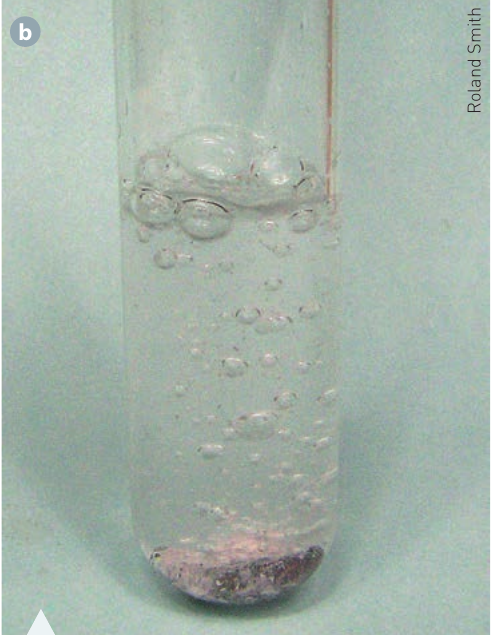
The image above shows calcium reacting with water, producing visible bubbles of hydrogen gas. Notice how the bubbles form throughout the water, demonstrating the ongoing chemical reaction.
Note
Group 2 reactivity with water shows a clear progression: from no reaction with beryllium, through steam-only reaction with magnesium, to cold water reactions with calcium and below. This demonstrates how reactivity increases down the group.
Other elements
No other elements in the periodic table react with cold water. While a few elements can react with steam under specific conditions, these reactions are much less common and require higher energy input. This makes Groups 1 and 2 unique in their ability to react with water at ordinary temperatures.
Products formed during water reactions
When metals react with water, they consistently produce two important substances. Understanding these products helps us write chemical equations and predict reaction outcomes.
The reaction always generates hydrogen gas (), which you can observe as bubbles rising through the water. This gas is highly flammable and can be collected and tested.
Alongside hydrogen gas, the reaction produces a metal hydroxide. The specific hydroxide depends on which metal is reacting. For example:
- Sodium produces sodium hydroxide ()
- Calcium produces calcium hydroxide ()
These metal hydroxides are basic compounds that dissolve in water to create alkaline solutions. This is why the solution becomes slippery to touch and can change the colour of pH indicators.
Example
Worked Example: Writing a Water Reaction Equation
Let's write the equation for sodium reacting with cold water.
Step 1: Identify the reactants
- Sodium metal (Na)
- Water ()
Step 2: Identify the products
- Hydrogen gas ()
- Sodium hydroxide ()
Step 3: Write the unbalanced equation
Step 4: Balance the equation
The balanced equation shows that 2 sodium atoms react with 2 water molecules to produce 1 hydrogen molecule and 2 sodium hydroxide formula units.
Why do some elements react with water?
The key to understanding water reactivity lies in atomic structure, specifically the relationship between an atom's size and how tightly it holds its outer electrons.
The role of atomic radius
Atomic radius plays a crucial role in determining reactivity with water.
Important
Key Relationship: The larger the atomic radius, the more reactive the metal becomes.
This relationship might seem surprising at first, but it makes sense when we consider what's happening inside the atom.
Electrostatic attraction
The size of an atom depends fundamentally on the electrostatic attraction between the positively charged nucleus and the negatively charged outer electrons. This attractive force determines how tightly the electrons are held.
When this electrostatic attraction is weaker, two important things happen:
- The atom becomes larger because outer electrons are held less tightly
- It becomes easier for the atom to lose its outer electrons
Connection to ion formation
During a reaction with water, metal atoms must lose one or more outer electrons to form positive ions. This electron loss is essential for the reaction to occur. When electrostatic attraction is weak (as it is in larger atoms), giving up these outer electrons requires less energy, making the reaction more favourable.
This explains why reactivity increases down Groups 1 and 2 - as atoms get larger, they lose electrons more easily, leading to more vigorous reactions with water.
Note
The ease of electron loss is not just important for water reactions - it's a fundamental property that affects many aspects of chemical reactivity. Metals that lose electrons easily tend to be more reactive in general, not just with water.
Periodic trends in water reactivity
The pattern of water reactivity across the periodic table reveals important principles about element behaviour:
Down the group trend: In both Group 1 and Group 2, reactivity with water consistently increases as you move from the top of the group toward the bottom. This happens because atomic radius increases down the group, making electron loss progressively easier.
Across the period: As you move from left to right across a period, reactivity with water decreases dramatically. Elements on the left side (like sodium and magnesium) react readily, while those on the right side do not react at all.
Location matters: All elements that react with water are metals positioned on the left-hand side of the periodic table. Non-metals and semi-metals do not show this reactivity, highlighting the unique properties of metallic elements.
Note
Understanding the Pattern:
The periodic trends in water reactivity are not random - they directly reflect underlying atomic structure changes:
- Down a group: Atomic radius increases → Electrostatic attraction weakens → Electron loss becomes easier → Reactivity increases
- Across a period: Nuclear charge increases → Electrons are held more tightly → Electron loss becomes harder → Reactivity decreases
Exam tips
When answering questions about reactivity with water, remember to:
- Clearly state that reactivity increases down Groups 1 and 2
- Explain the link between atomic radius and reactivity
- Mention both products (hydrogen gas and metal hydroxide)
- Use specific examples like or
- Connect the explanation to electrostatic attraction and electron loss
Summary
Key Points to Remember:
- Only metals on the left side of the periodic table react with water, specifically Group 1 and Group 2 elements
- Reactivity with water increases down Groups 1 and 2, with caesium being more reactive than lithium, and barium more reactive than magnesium
- All water reactions with metals produce hydrogen gas () and a metal hydroxide compound
- Larger atomic radius leads to greater reactivity because weaker electrostatic attraction makes it easier for atoms to lose outer electrons
- The ability to lose electrons easily is essential for forming positive ions during the reaction with water