Separating Mixtures (HSC SSCE Chemistry): Revision Notes
📚Revision Notes
Separating Mixtures
When we have a mixture of different substances, we can use various physical separation techniques to split them apart. Each method works by exploiting differences in the physical properties of the substances in the mixture. Understanding which method to use depends on recognising the key physical properties of the components you want to separate.
Note
The success of any separation technique depends on identifying a physical property that differs between the components you want to separate. This might be particle size, boiling point, solubility, or density.
Separation using filtration
Filtration is one of the most common laboratory techniques for separating solids from liquids. This method works because of the difference in particle size between the solid and liquid components.
When you filter a mixture, the liquid (or solution) passes through tiny pores in the filter paper, whilst the solid particles are too large to fit through and remain trapped on top of the paper. The liquid that passes through the filter paper has a special name - we call it the filtrate. The solid that remains on the filter paper is called the residue.
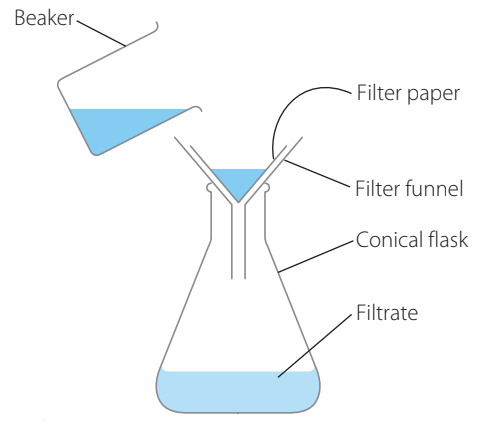
A common example you might encounter is separating sand from sea water. The sand particles are much larger than the water molecules, so the water flows through the filter paper whilst the sand grains stay behind.
Important
This technique only works when you have an undissolved solid mixed with a liquid. If the solid has dissolved, filtration won't separate it because the dissolved particles are too small to be trapped by the filter paper.
The apparatus for filtration is straightforward: you need a filter funnel, filter paper folded to fit inside the funnel, and a conical flask positioned underneath to collect the filtrate. Always ensure the stem of the funnel touches the side of the flask to prevent splashing.
Separation based on solubility
Sometimes you need to separate two solid substances from each other. If one solid dissolves in a particular solvent whilst the other doesn't, you can use solubility differences to separate them.
Example
Worked Example: Separating Salt and Sand
Problem: How do you separate a mixture of salt and sand?
Step 1: Add water to the mixture and stir thoroughly
- The salt will dissolve to form a solution
- The sand remains as solid particles
Step 2: Filter the mixture
- The sand stays on the filter paper (residue)
- The salt solution passes through as the filtrate
Step 3: Evaporate the water from the filtrate
- This recovers the salt as a solid
This method requires careful choice of solvent - you need a liquid that dissolves one component but not the other. Water is the most common solvent used, but sometimes chemists use other solvents like ethanol or propanone depending on what they're trying to separate.
Separations based on boiling points
Many separation techniques exploit differences in boiling point between substances. The method you choose depends on what you want to collect and how different the boiling points are.
Separating a dissolved solid from a solution
When you have a solid dissolved in a liquid, you can separate them by removing the liquid through vaporisation. This works because liquids have much lower boiling points than solids - the liquid will boil and turn to vapour, leaving the solid behind.
There are two ways to vaporise the liquid: boiling (heating until bubbles of vapour form throughout the liquid) or evaporation (allowing the liquid to turn to vapour more slowly from the surface). Evaporation takes longer than boiling but uses less energy.
Chemists use the term evaporation to dryness to describe the process of heating a solution in an evaporating basin until all the solvent has been driven off, leaving only the solid behind. This is how you would obtain salt crystals from sea water.
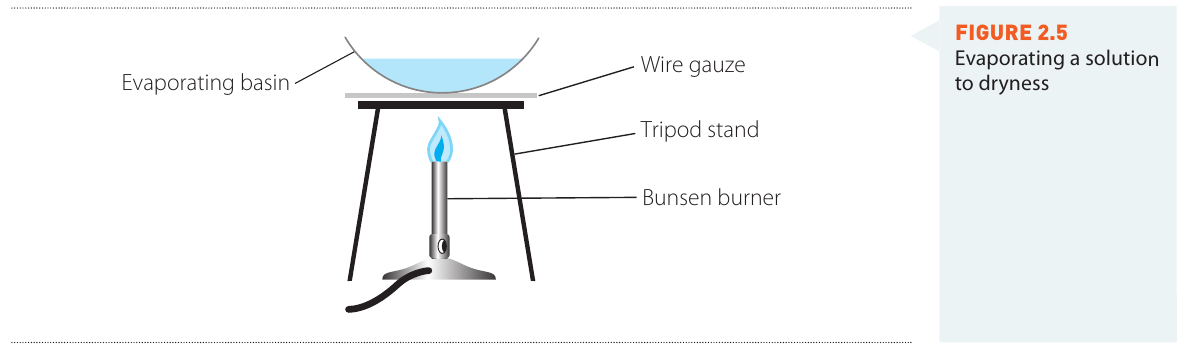
The apparatus shown uses a Bunsen burner beneath a tripod stand supporting wire gauze. The evaporating basin sits on the wire gauze. As the solution heats, the water evaporates, and eventually only the solid salt remains in the basin.
Important
This method only works if you want to keep the solid. If you need to collect the liquid (like getting pure water from sea water), or if you want to keep both components, you must use distillation instead.
Distillation
Distillation is a more sophisticated separation technique that allows you to collect the liquid component. In distillation, you boil a solution or liquid mixture, then cool the vapour to condense it back into liquid in a separate container. The liquid you collect is called the distillate.
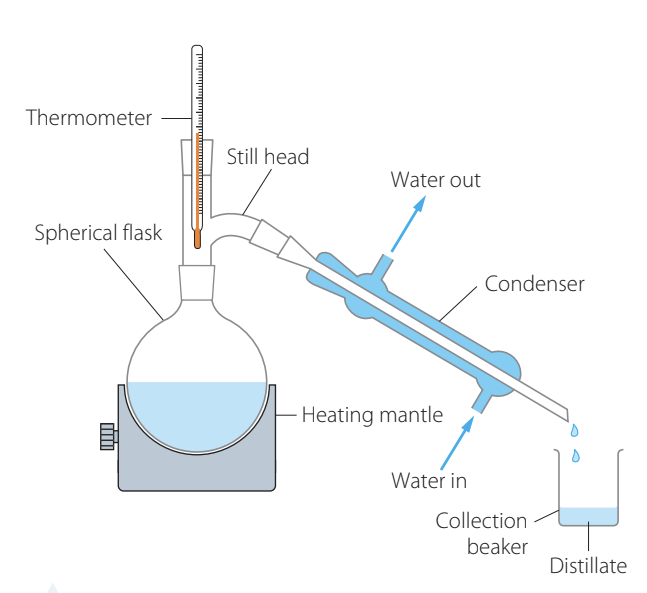
The distillation apparatus consists of several key components working together:
- A spherical flask containing the mixture, heated by a heating mantle
- A thermometer to monitor the temperature of the vapour
- A still head that directs vapour into the condenser
- A water-cooled condenser where vapour condenses back to liquid
- A collection beaker for the distillate
Note
How Distillation Works:
When you heat sea water in the distillation flask, the water boils and turns to vapour, but the salt (which has a much higher boiling point) remains behind as a solid. The water vapour rises up through the still head and enters the condenser. Cold water circulating around the condenser cools the vapour, turning it back into liquid water, which drips into the collection beaker. You end up with pure water (the distillate) in the beaker and salt left behind in the flask.
Distillation can also separate mixtures of two liquids if their boiling points are very different - typically at least to apart. For example, if you distil a mixture of water (boiling point ) and ethylene glycol (boiling point ), the water boils first and is collected as pure distillate, whilst the ethylene glycol stays in the flask.
However, if two liquids have similar boiling points (like ethanol at and water at ), simple distillation doesn't produce a pure distillate. Instead, you collect a mixture that's richer in the lower-boiling substance. A wine containing ethanol, when distilled, produces a distillate of about ethanol. This is actually how spirits like brandy and whisky are made from wine and fermented grain.
Fractional distillation
When you need to separate liquids with similar boiling points, you need a more powerful technique called fractional distillation. This method performs many distillations in sequence, all within a single piece of equipment.
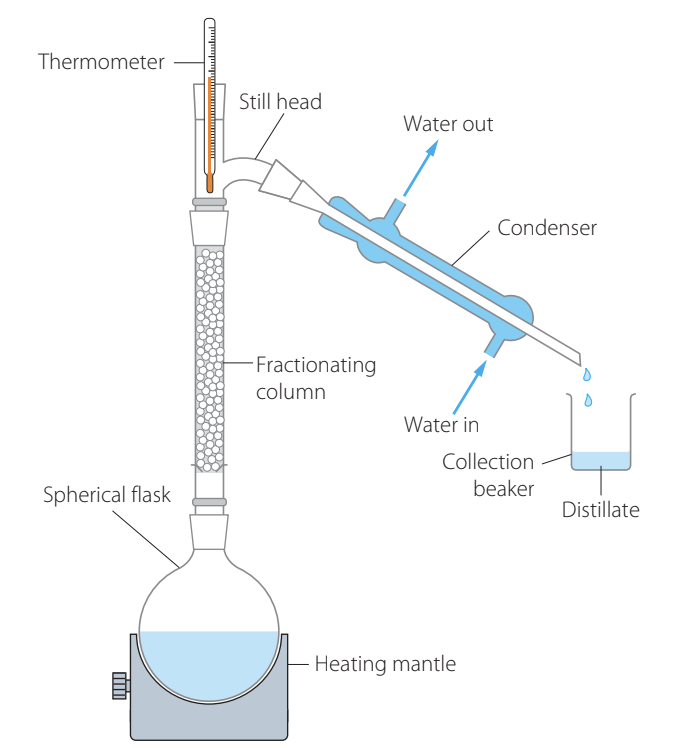
The key difference from simple distillation is the addition of a fractionating column between the flask and the still head. This column is typically to tall and filled with packing material (like glass beads or steel wool). As vapour rises up the column, it repeatedly condenses and re-evaporates. Each time this happens, it's effectively another distillation step.
Note
The fractionating column provides between and separate distillations. This means that eventually, only the vapour from the most volatile (lowest boiling point) substance reaches the top of the column and enters the condenser.
Example
Worked Example: Fractional Distillation of Close-Boiling Liquids
If you fractionally distil a mixture of benzene (boiling point ) and cyclohexene (boiling point ), you can obtain pure benzene as the distillate, even though the boiling points are only apart.
Similarly, fractional distillation of ethanol-water mixtures produces ethanol (with just water), compared to the ethanol from simple distillation. The remaining water forms an azeotrope with ethanol and cannot be removed by distillation alone.
Fractional distillation has crucial industrial applications:
- Separating crude oil into petrol, diesel, and heating oil based on different boiling points
- Purifying ethanol from fermented solutions for use as a fuel additive
- Producing liquid nitrogen and argon gas from liquefied air
Separations based on density
Density differences provide another way to separate mixtures, particularly when dealing with solid particles suspended in liquids.
Sedimentation and decantation
Sedimentation occurs when solid particles settle to the bottom of a container under gravity. This happens because the particles are denser than the surrounding liquid. The process works particularly well with coarse particles like sand in water.
Once sedimentation is complete, you can perform decantation - carefully pouring off the liquid whilst leaving the solid undisturbed at the bottom. When you pour tea away from tea leaves, you're using decantation.
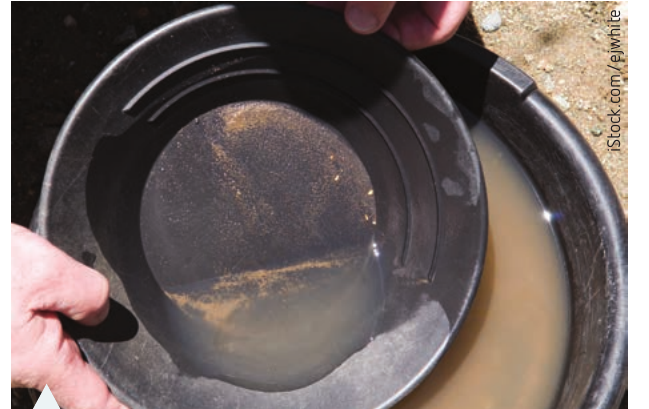
Example
Worked Example: Gold Panning
Gold panning is a classic example of using density separation:
The Process:
- River sand containing tiny gold particles is swirled with water in a shallow pan
- Gold is much denser than sand (gold has a density of about compared to sand's )
- The gold particles quickly settle to the bottom of the pan whilst the lighter sand remains suspended
- By repeatedly decanting the water and suspended sand, prospectors can isolate the gold particles
Separating immiscible liquids
Liquids are described as immiscible if they don't mix together to form a uniform solution. When you shake immiscible liquids together, one forms tiny droplets dispersed through the other. If left to stand, the liquids separate into two distinct layers with the denser liquid settling to the bottom.
Common examples of immiscible liquids include water and kerosene, or water and cooking oil. The opposite of immiscible is miscible - liquids that do mix completely, like water and ethanol.
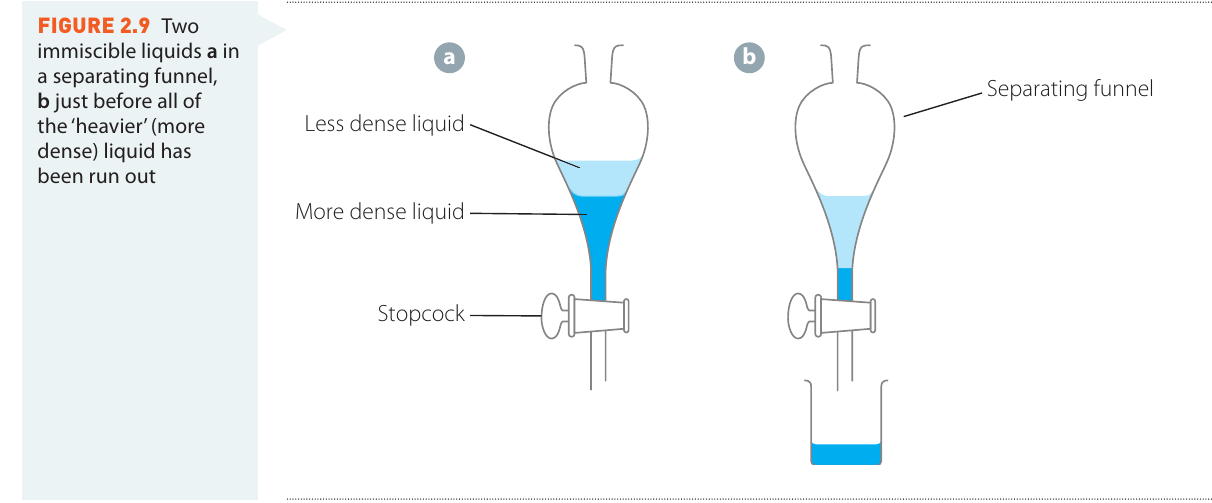
To separate immiscible liquids, chemists use a separating funnel - a pear-shaped piece of glassware with a stopcock at the bottom. The funnel's shape is crucial: it tapers to a narrow tube just above the stopcock, allowing you to drain out the bottom layer without contaminating it with the top layer.
Note
Separating Funnel Technique:
- Pour your mixture of immiscible liquids into the separating funnel
- Let it stand until two distinct layers form (the denser liquid settles at the bottom)
- Open the stopcock carefully and allow the bottom layer to drain into a collection vessel
- Close the stopcock just before the interface between the layers reaches the tap
- Drain the top layer into a separate container
A mixture of petrol and water separates perfectly using this method.
Summary of separation methods
Different separation techniques work by exploiting different physical properties. Choosing the right method depends on understanding what makes your mixture's components different from each other.
| Separation method | Physical property used |
|---|---|
| Sieving | Particle size |
| Filtration | One substance is solid, the other is liquid or solution; particle size differences |
| Vaporisation (evaporation or boiling) | Liquid has much lower boiling point than solid |
| Distillation | Large difference in boiling points |
| Fractional distillation | Moderate difference in boiling points |
| Sedimentation and decantation | Density differences |
| Using a separating funnel | Immiscible liquids with different densities |
| Adding a solvent, then filtering | One substance dissolves in the solvent whilst others don't |
Important
Remember that purifying a substance means removing unwanted impurities, so all these separation methods are also purification techniques. In the laboratory, you'll often combine several methods to achieve complete separation - for example, using solubility differences followed by filtration, then evaporation to dryness.
Summary
Key Points to Remember:
- Filtration separates undissolved solids from liquids based on particle size. The liquid passing through is called the filtrate.
- Evaporation to dryness removes all solvent by heating, leaving only the dissolved solid behind.
- Distillation separates substances with different boiling points by boiling and condensing. The collected liquid is called the distillate.
- Fractional distillation uses repeated vaporisations and condensations to separate liquids with similar boiling points (performs to separate distillations in one apparatus).
- Immiscible liquids don't mix homogeneously and can be separated using a separating funnel based on density differences.