Electricity From Redox Reactions (HSC SSCE Chemistry): Revision Notes
📚Revision Notes
Electricity From Redox Reactions
Introduction to electrochemistry
Chemistry and electricity are closely connected through a branch of science called electrochemistry. This field studies how chemical reactions can produce electrical energy and how electrical energy can drive chemical reactions.
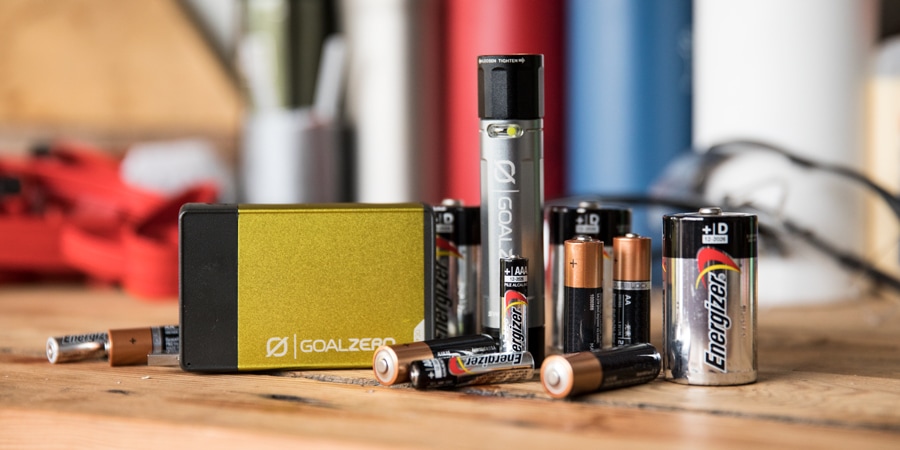
In our everyday lives, we rely on portable sources of electricity called batteries. These power devices like torches, watches, toys, calculators, cameras, cordless shavers, car batteries, and mobile phones. All batteries share one important feature: they generate electricity through chemical reactions.
Note
The connection between chemistry and electricity is fundamental to modern technology. Every battery-powered device you use relies on electrochemical principles to convert chemical energy into electrical energy.
Understanding how batteries work requires us to explore the relationship between redox reactions and the production of electric current.
How redox reactions generate electricity
In redox reactions, electrons transfer from one reactant to another. An electric current is simply a flow of electrons moving through a conductor, such as a wire.
To generate electricity from a redox reaction, we need to set up the reaction in a special way. The key is to separate the oxidation and reduction processes so they occur at different locations. We then connect these locations with a wire, allowing electrons to flow through it. This arrangement creates an electric current. This is exactly how all batteries function.
Important
Key Principle: For a redox reaction to produce electricity, the oxidation and reduction half reactions must occur at separate locations, with electrons flowing through an external wire connecting them. This is the fundamental operating principle of every battery.
The copper-silver galvanic cell
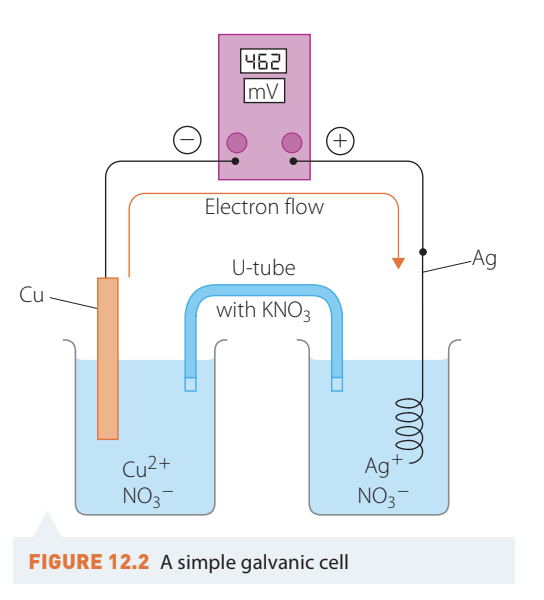
Let's examine a practical example that demonstrates how a redox reaction produces electricity. In this experiment, we create a simple galvanic cell using copper and silver.
Setup of the cell
The apparatus consists of:
- A strip of copper metal suspended in a beaker containing copper nitrate solution ()
- A spiral of silver wire suspended in a separate beaker containing silver nitrate solution ()
- A U-tube connecting the two solutions, filled with potassium nitrate solution () and held in place by cotton wool plugs
- A voltmeter connected across the two metal pieces
The U-tube provides electrical contact between the two solutions, which is essential for the cell to operate properly.
Observations and measurements
When we connect a voltmeter across the copper and silver pieces, we observe:
- The silver wire measures approximately 0.5 V positive relative to the copper
- An ammeter shows that significant current flows through the circuit
- Electrons flow from the copper, through the external circuit, to the silver wire
If we allow the current to flow for some time, we can observe several chemical changes:
- Metallic silver deposits on the silver wire (visible and confirmed by weighing)
- The copper strip dissolves (confirmed by a decrease in its mass)
- Silver ion concentration decreases in the silver nitrate solution
- Copper ion concentration increases in the copper nitrate solution
These observations tell us that a chemical reaction is occurring, and this reaction is producing the electrical energy we measure.
Chemical reactions in the cell
Oxidation at the copper electrode
At the copper strip, copper atoms lose electrons and dissolve into solution as copper ions:
This is an oxidation reaction because copper loses electrons.
Reduction at the silver electrode
At the silver wire, silver ions from the solution gain electrons and deposit as metallic silver:
This is a reduction reaction because silver ions gain electrons.
Overall cell reaction
To find the overall reaction, we combine these two half reactions. We need to balance the electrons, so we multiply the silver half reaction by two:
Note
This is the same reaction that would occur if we simply placed a piece of copper in a silver nitrate solution in a test tube. However, when the reaction occurs in a test tube, the electrons transfer directly between the reactants and no electricity is produced. In a galvanic cell, we force the electrons to travel through an external wire, creating a useful electric current.
Example
Worked Example: Understanding the Copper-Silver Cell
Question: Why does the copper-silver galvanic cell produce electricity while the same reaction in a test tube does not?
Answer:
Step 1: Identify what happens in both cases
- In both cases, the same overall reaction occurs:
Step 2: Compare the electron transfer mechanism
- In a test tube: Electrons transfer directly from copper atoms to silver ions at the metal surface
- In a galvanic cell: The reactions are separated, forcing electrons to travel through an external wire
Step 3: Explain the key difference
- The physical separation of oxidation and reduction creates a pathway for electron flow through the wire, which we can harness as electric current
- Direct contact allows immediate electron transfer with no external current flow
Conclusion: The galvanic cell setup converts chemical energy into electrical energy by controlling the path electrons take during the redox reaction.
Summary
Key Points to Remember:
- Electrochemistry is the study of the connections between chemistry and electricity
- Galvanic cells generate electricity from spontaneous chemical reactions (redox reactions)
- In a galvanic cell, oxidation and reduction occur at separate locations connected by a wire, allowing electron flow to create electric current
- All batteries work on the same principle: chemical reactions produce electricity