Standard Electrode Potentials (HSC SSCE Chemistry): Revision Notes
📚Revision Notes
Standard Electrode Potentials
Introduction
When studying galvanic cells, chemists need to measure and compare the voltages produced by different electrode combinations. Rather than testing every possible cell combination, we can simplify this process by assigning voltage values to individual electrodes. This systematic approach allows us to predict cell voltages and compare the chemical activity of different metals and ions.
Understanding electrical terms
Potential, voltage and EMF
Electrical potential is a measure of the energy that a device can deliver. Scientists use several related terms when discussing galvanic cells:
- Potential difference: The difference in electrical potential between two points, measured in volts ()
- Voltage: Another term for potential difference, often used interchangeably
- Electromotive force (EMF): The maximum voltage a galvanic cell can deliver when only a negligibly small current flows
The EMF represents the cell's potential under ideal conditions. In real cells, the voltage delivered depends on how much current is being drawn - the greater the current, the lower the voltage. For accurate comparisons, we need to measure cells under standardised conditions.
Note
Modern digital voltmeters are high-resistance devices that draw extremely small currents. This means they measure voltages very close to the true EMF of a cell, making them ideal for electrochemical measurements.
The standard hydrogen electrode
To create a reference point for comparing all other electrodes, scientists use the standard hydrogen electrode as a universal standard. This electrode has been assigned a potential of exactly zero volts.
Construction and operation
The standard hydrogen electrode consists of:
- A piece of platinum metal serving as the conductor
- Immersion in a solution of hydrogen ions (typically hydrochloric acid)
- Hydrogen gas () bubbled through the solution at a pressure of
Note
Why platinum? Platinum is chosen because it:
- Conducts electricity very well
- Is extremely chemically inert and won't participate in the reaction
- Provides a surface for the hydrogen gas to interact with the solution
The half-reaction occurring at this electrode is:
Measuring standard electrode potentials
Experimental setup
To determine the standard electrode potential of any electrode, we connect it to the standard hydrogen electrode through a salt bridge, forming a complete galvanic cell. A voltmeter measures the potential difference between the two electrodes.
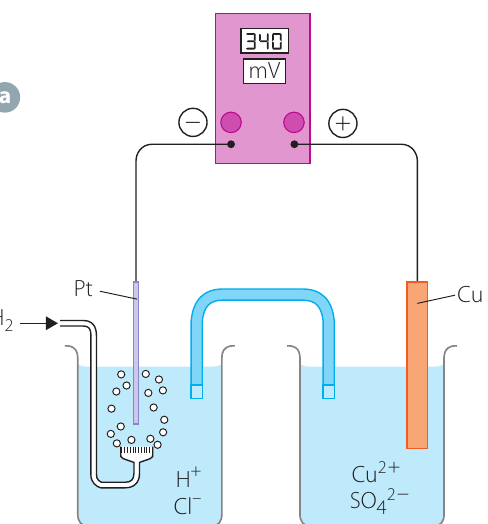
The diagram above shows the setup for measuring the copper electrode potential. The copper electrode is immersed in a solution of ions, while the standard hydrogen electrode is on the left. The voltmeter reads , with the copper electrode being positive.
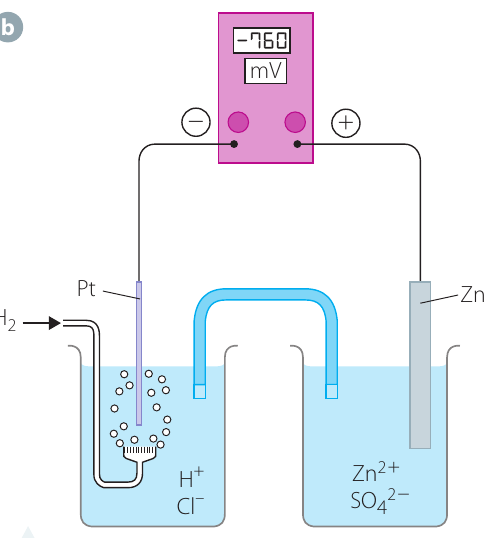
This second diagram shows the measurement for a zinc electrode. The zinc is immersed in a solution of ions. Here, the voltmeter reads , indicating the zinc electrode is negative relative to the hydrogen electrode.
Standard state conditions
Cell voltages vary with concentration and pressure, so we must specify standard conditions for fair comparisons. The standard state for electrochemical measurements is defined as:
- All dissolved substances (solutes) at a concentration of
- All gases at a pressure of
- Temperature typically at
Understanding standard electrode potential ()
The standard electrode potential, symbolised as , is the potential of an electrode in its standard state relative to the standard hydrogen electrode. The superscript (or sometimes written as °) indicates standard state conditions.
Standard electrode potentials are also called:
- Standard reduction potentials
- Standard redox potentials
Important
Both names emphasise that these values always refer to reduction reactions (gain of electrons), not oxidation reactions. This is a critical convention in electrochemistry.
Interpreting the measurements
For the copper electrode: The measured cell voltage is , with copper positive. Therefore:
- The , electrode has
- The reduction half-reaction also has :
For the zinc electrode: The measured cell voltage is , with zinc negative. Therefore:
- The , electrode has
- The reduction half-reaction also has :
For the hydrogen electrode: By definition, the standard hydrogen electrode has :
Important conventions
Important
Standard electrode potentials always refer to reduction reactions. They are written in the general form:
We can discuss the voltage of an oxidation half-reaction, but we never call it an electrode potential - that term is reserved exclusively for reduction reactions.
Table of standard electrode potentials
The following table lists standard electrode potentials for common half-reactions at . The values are arranged in descending order of .
| Oxidised form + | → | Reduced form | (V) |
|---|---|---|---|
| → | |||
| → | |||
| → | |||
| → | |||
| → | |||
| → | |||
| → | |||
| → | |||
| → | |||
| → | |||
| → | |||
| → | |||
| → | |||
| → | |||
| → | |||
| → | |||
| → | |||
| → | |||
| → | |||
| → | |||
| → | |||
| → | |||
| → | |||
| → | |||
| → | |||
| → | |||
| → | |||
| → | |||
| → | |||
| → | |||
| → | |||
| → | |||
| → | |||
| → | |||
| → | |||
| → | |||
| → | |||
| → | |||
| → | |||
| → | |||
| → | |||
| → | |||
| → | |||
| → | |||
| → | |||
| → | |||
| → |
Understanding the trends
The table is organised to show important chemical trends:
Oxidising strength increases up the table (more positive values):
- Species at the top are strong oxidising agents - they readily gain electrons
- Fluorine () is the strongest oxidising agent with
- These species have a strong tendency to be reduced
Reducing strength increases down the table (more negative values):
- Species at the bottom are strong reducing agents - they readily lose electrons
- Potassium () is among the strongest reducing agents with
- These species have a strong tendency to be oxidised
Note
The position of a species in the table tells you about its chemical reactivity. Species with more positive values want to gain electrons (be reduced), while those with more negative values want to lose electrons (be oxidised).
Important
Critical Exam Points:
- Always remember that standard electrode potentials refer to reduction reactions only
- The sign of matters: positive means the reduction is favoured; negative means the oxidation of the reduced form is favoured
- Standard conditions mean and - commit these to memory
- When comparing two half-cells, the one with the more positive will be reduced (gain electrons)
Summary
Key Points to Remember:
- Standard electrode potential () is measured relative to the standard hydrogen electrode, which is defined as
- Standard state conditions are: solutes at and gases at
- EMF is the maximum voltage a cell can deliver when drawing negligible current - modern digital voltmeters measure this accurately
- All standard electrode potentials refer to reduction reactions, never oxidation reactions
- More positive values indicate stronger oxidising agents; more negative values indicate stronger reducing agents