Metal Activity and the Periodic Table (HSC SSCE Chemistry): Revision Notes
📚Revision Notes
Metal Activity and the Periodic Table
Introduction to metal activity patterns
The activity series of metals shows clear relationships with the structure of the periodic table. By examining where metals sit in the periodic table, we can predict and understand their relative reactivity. This connection helps us see that metal reactivity follows predictable patterns based on periodic table position.
Note
Understanding the connection between the activity series and periodic table structure is essential for predicting metal behavior. Once you know the general patterns, you can make educated predictions about how different metals will react.
Patterns in the activity series
When we look at the activity series, we can identify which groups from the periodic table appear where:
- Group 1 metals (like potassium, sodium, and lithium) are the most reactive metals
- Group 2 metals (such as barium, calcium, and magnesium) come next in reactivity
- Group 3 metals (aluminium) follow after Group 2
- Some transition metals (including zinc and iron) appear in the middle range
- Group 14 metals (tin and lead) are less reactive
- Other transition metals (copper, silver, platinum, and gold) are the least reactive, appearing at the end of the series
Trends within groups
An important pattern emerges when we look at metals within the same group. In Groups 1 and 2, reactivity increases as we move from top to bottom. For example:
- In Group 1: lithium is less reactive than sodium, which is less reactive than potassium
- In Group 2: magnesium is less reactive than calcium, which is less reactive than barium
Important
The vertical trend in Groups 1 and 2 is particularly significant: reactivity consistently increases down the group. This pattern is one of the most reliable trends in metal chemistry and is frequently tested in exams.
Summary of periodic trends
There is a general correlation between metal reactivity and position in the periodic table:
- Across a period (left to right): reactivity decreases
- Down a group (top to bottom): reactivity increases
First ionisation energy and reactivity
The reactivity of metals correlates well with an important atomic property called first ionisation energy. Understanding this relationship helps explain why some metals are more reactive than others.
What is first ionisation energy?
Note
Definition of First Ionisation Energy
First ionisation energy measures the ease with which an electron can be removed from an atom. The lower the ionisation energy, the easier it is for the atom to lose one or more electrons and form a positive ion.
The correlation with reactivity
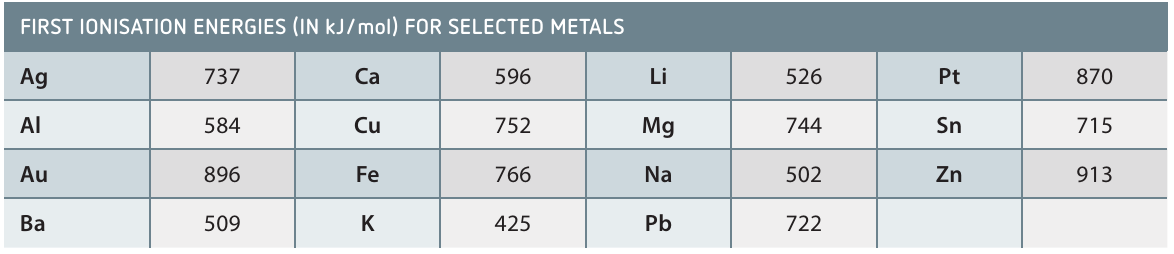
Investigation of the data shows that metal reactivity generally increases as ionisation energy decreases. You can observe this by comparing the rank of metals in the activity series with their first ionisation energy values.
Example
Comparing Potassium and Gold
Consider two metals at opposite ends of the reactivity spectrum:
Potassium (K):
- First ionisation energy:
- Rank in activity series: 1 (most reactive)
- Conclusion: Very low ionisation energy = highly reactive
Gold (Au):
- First ionisation energy:
- Rank in activity series: 16 (least reactive)
- Conclusion: Much higher ionisation energy = very unreactive
This clear inverse relationship demonstrates how ionisation energy can predict reactivity.
Why this correlation exists
This relationship makes sense when we consider what happens during metal reactions. When metals react with water, acids, oxygen, or ions of other metals, the metal atoms lose electrons to become positive ions. Metals with lower ionisation energies can lose electrons more easily, making them more reactive.
Note
The key to understanding metal reactivity is electron loss. Any factor that makes it easier for a metal to lose electrons will increase its reactivity. First ionisation energy directly measures how easily that first electron can be removed.
Important exceptions
Important
Exceptions to the Rule
While this correlation is useful, it's not a rigid rule. There are exceptions - for example, magnesium and zinc are more reactive than their ionisation energies would suggest. This reminds us that the relationship is a helpful guide but other factors can also influence reactivity.
Always state that trends are "general" or "usually observed" rather than absolute rules.
Atomic radius and reactivity
Atomic radius is another periodic property that relates to metal reactivity, particularly when comparing metals within the same group.
The relationship within groups
When we compare how reactivity and atomic radius both vary down Groups 1 and 2, we notice they change in the same way. Going down these groups:
- Both reactivity increases
- Atomic radius increases
This means that within a group, reactivity increases as atomic radius increases.
Why radius affects reactivity
The explanation lies in the position of the valence shell electrons. As the valence shell electrons get further away from the nucleus (as radius increases), the electrostatic force of attraction between the positively charged nucleus and the negatively charged electrons becomes weaker.
Note
Understanding the Radius-Reactivity Connection
Think of it this way: the further the outer electrons are from the nucleus, the less tightly they are held. It's similar to how a ball thrown high in the air is easier to catch than one held firmly in someone's hand.
When the attractive force is weaker, the electrons are more easily lost from the atom. Since losing electrons is what makes a metal reactive, a larger atomic radius leads to higher reactivity within a group.
Trends across periods
When moving across the periodic table from left to right, the correlation between atomic radius and reactivity is less clear. However, for Groups 1, 2, and 13, we do observe that reactivity increases with atomic radius. For example, sodium, magnesium, and aluminium show this pattern.
Electronegativity and reactivity
Electronegativity is another periodic property that shows an interesting relationship with metal reactivity.
The inverse relationship
Electronegativity varies across and down the periodic table in the opposite way to metal reactivity:
- Across a period: electronegativity increases from left to right (while reactivity decreases)
- Down a group: electronegativity decreases from top to bottom (while reactivity increases)
This inverse correlation means that as one property increases, the other decreases.
Why they're inversely related
Note
The Perfect Inverse Relationship
This inverse relationship makes perfect sense when we consider what each property measures:
- Metal reactivity measures the ability of metals to lose electrons
- Electronegativity measures the ability of elements to attract (gain) electrons
These are opposite processes. An element that easily loses electrons (high reactivity) will not attract electrons well (low electronegativity). Similarly, an element that strongly attracts electrons (high electronegativity) will not easily lose them (low reactivity).
Exam tips
Important
Exam Success Strategies
- When asked about trends, always specify the direction: "across a period from left to right" or "down a group from top to bottom"
- Remember that correlation doesn't mean the relationship is absolute - be aware of exceptions like magnesium and zinc
- Link your explanations back to electron behaviour - metal chemistry is all about losing electrons
- In exam questions, you may need to explain WHY a trend exists, not just state that it exists
Remember!
Summary
Key Points to Remember:
-
Group patterns: Group 1 metals are most reactive, followed by Group 2, then Group 3 (Al), with transition metals generally less reactive.
-
Periodic trends: Metal reactivity decreases from left to right across periods and increases from top to bottom down groups (especially in Groups 1 and 2).
-
First ionisation energy: Generally, as ionisation energy decreases, metal reactivity increases because electrons are more easily removed.
-
Atomic radius: Within a group, larger atomic radius means weaker electrostatic attraction between nucleus and valence electrons, leading to higher reactivity.
-
Electronegativity: Shows an inverse relationship with metal reactivity because electronegativity measures electron attraction while reactivity measures electron loss.