Decomposition Reactions (HSC SSCE Chemistry): Revision Notes
📚Revision Notes
Decomposition Reactions
What are decomposition reactions?
A decomposition reaction is a type of chemical reaction where a single complex compound breaks down into two or more simpler substances. These simpler substances can be elements or other compounds. Think of it as the opposite of a synthesis reaction, where instead of building up, you're breaking down.
The key characteristic of decomposition reactions is that you start with one reactant and end up with multiple products. This process involves breaking chemical bonds within the original compound to form new, simpler substances.
Note
Decomposition reactions are essentially the reverse of synthesis reactions. While synthesis reactions combine multiple substances to form one complex compound, decomposition reactions break apart one compound into multiple simpler substances. Understanding this relationship helps you recognize and predict both types of reactions.
Investigation 10.3: Observing decomposition reactions
This practical investigation allows you to observe two different types of decomposition reactions in action.
Safety considerations
Before conducting any decomposition reaction experiment, it's important to understand the potential risks and how to manage them safely:
Important
Safety First - Risk Assessment
| What are the risks? | How can you manage these risks? |
|---|---|
| The cork could pop off the side-arm test tube | Wear safety glasses and move the Bunsen burner in and out to control the heat applied |
| Silver salts can stain skin | Use the dropper to handle silver salts rather than touching them directly |
Always conduct a full risk assessment before beginning any practical work, identifying all hazards specific to your laboratory environment.
Part A: Thermal decomposition of copper carbonate
Aim: To observe the thermal decomposition of copper carbonate and test for the products formed.
What you'll need:
- Copper carbonate sample
- Limewater ()
- Side-arm test tube with cork
- Regular test tube and test-tube rack
- Rubber tubing ( length)
- Bunsen burner and heat-proof mat
- Retort stand with clamp
- Spatula
Method:
The experimental setup is crucial for this investigation. You'll arrange the apparatus so that any gas produced during heating can be collected and tested.
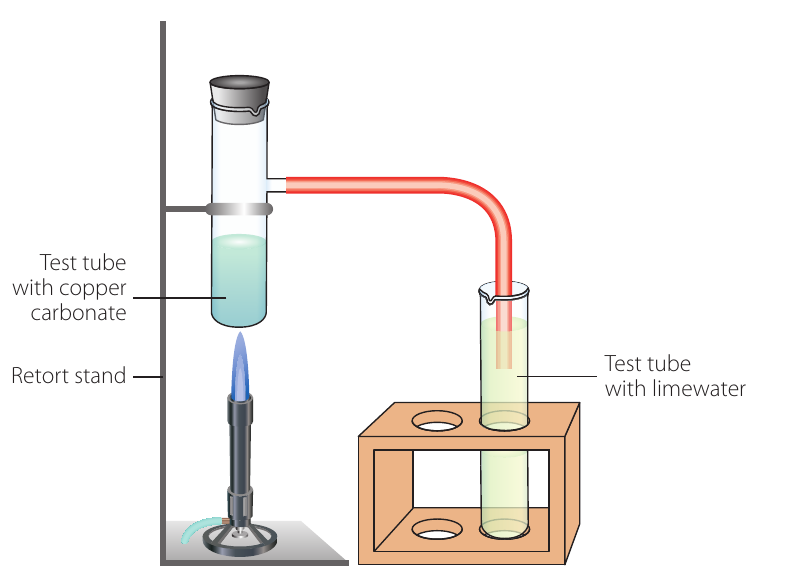
- Set up your equipment as shown in the diagram above, with the side-arm test tube clamped securely above the Bunsen burner.
- Place two spatulas of copper carbonate into the side-arm test tube and seal it with the cork.
- Pour of limewater into the second test tube and place it in the test-tube rack.
- Connect the rubber tubing between the side-arm and the test tube containing limewater. Ensure the end of the tubing sits below the surface of the limewater.
- Light the Bunsen burner and begin heating the copper carbonate. Control the temperature by moving the burner towards and away from the test tube.
- Carefully observe and record any changes in both test tubes.
Understanding the reactions:
Two separate chemical reactions occur during this investigation:
Example
Reaction 1 (in the heated test tube): Copper carbonate undergoes thermal decomposition to form copper oxide and carbon dioxide gas:
You should observe the light blue-green copper carbonate changing to a black solid (copper oxide), whilst a colourless gas (carbon dioxide) travels through the tubing.
Example
Reaction 2 (in the limewater test tube): The carbon dioxide gas reacts with limewater (calcium hydroxide solution) to form calcium carbonate and water:
This reaction causes the limewater to turn cloudy or milky white, which is the classic positive test for carbon dioxide gas.
Important
Classification Note: Only the first reaction is a decomposition reaction. The second reaction is actually a synthesis reaction, as multiple substances combine to form a more complex product. The first reaction is classified as decomposition because one compound breaks down into two simpler substances.
Part B: Decomposition of silver nitrate by light
Aim: To observe the decomposition of silver nitrate when exposed to light.
What you'll need:
- Silver nitrate solution ()
- Filter paper
- Watch glass
- Dropper
Method:
- Place a piece of filter paper on a watch glass.
- Using a dropper, carefully add three drops of silver nitrate solution to the filter paper.
- Record your initial observations.
- Leave the watch glass in a location where it will be exposed to light until your next lesson.
- Record any changes you observe after this time period.
What you should observe:
Initially, the silver nitrate solution appears colourless on the white filter paper. However, after exposure to light for several hours, the paper will darken, showing that a chemical reaction has occurred. This colour change indicates that the silver nitrate has decomposed into simpler substances.
This is a decomposition reaction because a single compound (silver nitrate) breaks down into multiple products when exposed to light energy. The products include metallic silver, which causes the darkening you observe.
Note
Real-world application: This same principle of silver compounds decomposing in light was the foundation of traditional film photography for over 150 years. Understanding this reaction helps explain how photographs were captured before digital cameras became widespread.
Types of decomposition reaction
Compounds can be broken down into simpler substances through three main methods. Each method provides the energy or conditions needed to break the chemical bonds in the original compound.
Thermal decomposition
What is thermal decomposition?
Thermal decomposition occurs when a compound breaks down into simpler substances upon heating. The heat energy provides enough activation energy to break the chemical bonds within the compound.
Common examples:
Many types of compounds undergo thermal decomposition, including:
Carbonates break down to form metal oxides and carbon dioxide gas. A classic example is heating calcium carbonate (limestone) to produce calcium oxide (quicklime):
This reaction is industrially important in the production of cement and lime.
Example
Hydroxides decompose when heated to form metal oxides and water vapour:
Example
Nitrates break down to form metal oxides, nitrogen dioxide, and oxygen gas when heated:
Note
Exam tip: When writing equations for thermal decomposition of carbonates, remember they always produce a metal oxide plus carbon dioxide. For hydroxides, the products are always a metal oxide plus water.
Electrolysis
What is electrolysis?
Electrolysis is a decomposition method where an electric current passes through a molten compound or an aqueous solution, causing it to break down into its constituent elements or simpler compounds. The electrical energy provides the force needed to separate the chemical bonds.
How it works:
The compound must be in a state where its ions can move freely – either molten (melted) or dissolved in water. When electricity flows through the liquid, positive ions move toward the negative electrode, whilst negative ions move toward the positive electrode. At each electrode, the ions gain or lose electrons and are converted into neutral atoms or molecules.
Examples:
Example
The electrolysis of water produces hydrogen and oxygen gases:
Example
Another example is the electrolysis of aqueous copper bromide, which decomposes to form copper metal and bromine gas:
Important
Important note: Electrolysis reactions in aqueous solution can be more complex than these simple equations suggest. Water itself can react at the electrodes, meaning the actual products may differ from what you'd predict by simply breaking apart the dissolved compound. Predicting the exact products requires understanding of electrode potentials and reaction kinetics.
Decomposition by light
What is photodecomposition?
Some compounds are sensitive to light and will decompose when exposed to it. The light energy (photons) provides sufficient energy to break specific chemical bonds within the compound. This process is called photodecomposition or photolysis.
The silver chloride example:
Silver chloride provides an excellent demonstration of photodecomposition. When freshly prepared, silver chloride appears as a white solid. However, when exposed to sunlight, it undergoes a visible colour change:
- First, it turns purple
- Then it darkens to black
- After several hours, the sample has a lower mass than it started with
These observations indicate that a chemical reaction is occurring. The silver chloride is decomposing into metallic silver (which appears black when finely divided) and chlorine gas:
Note
The chlorine gas isn't easily visible because it forms slowly in small amounts and quickly disperses into the surrounding air.
Practical applications:
This light-sensitive property of silver compounds has important real-world uses:
Photochromic sunglasses: These lenses contain silver chloride or similar compounds. In bright sunlight, the lenses darken as the silver compounds decompose. When you go indoors, the reaction reverses, and the lenses become clear again.
Film photography: Before digital cameras, all photography relied on the decomposition of silver compounds by light. Camera film contained silver bromide or silver iodide crystals. When exposed to light in the camera, these compounds would decompose in proportion to the light intensity, creating a latent image that could be developed into a photograph. This technology dominated photography for approximately 150 years before the 1990s.
Note
Silver bromide and silver iodide behave similarly to silver chloride, decomposing when exposed to light to produce metallic silver and the respective halogen gas.
Remember!
Summary
Key Points to Remember:
-
Decomposition reactions involve one compound breaking down into two or more simpler substances (elements or compounds).
-
Three main methods cause decomposition: heating (thermal decomposition), passing an electric current (electrolysis), and exposure to light (photodecomposition).
-
Thermal decomposition commonly affects:
- Carbonates (producing metal oxide + CO₂)
- Hydroxides (producing metal oxide + H₂O)
- Nitrates (producing metal oxide + NO₂ + O₂)
-
Electrolysis requires the compound to be molten or in solution so ions can move freely and react at the electrodes.
-
Light-induced decomposition of silver compounds was the basis of traditional film photography and is still used in photochromic sunglasses today.