Efficiency and Production (HSC SSCE Economics): Revision Notes
📚Revision Notes
Efficiency and Production
Productivity
Productivity measures the amount of output generated from a specific quantity of inputs within a given timeframe. For businesses operating in a market economy, achieving high productivity is essential for minimising costs and maximising efficiency in the production process.
Note
Key definition: Productivity refers to the quantity of goods and services the economy can produce with a given amount of inputs, such as capital and labour.
An increase in productivity occurs when output per factor of production (input) rises per unit of time. This is desirable because it indicates more efficient use of limited resources, allowing firms to satisfy more wants using the same resource base.
Production versus productivity
It is crucial to distinguish between production and productivity:
- Production refers to the total quantity of goods and services produced. Production can be increased simply by using more resources or extending working hours.
- Productivity requires output to increase proportionately more than the increase in resource inputs.
Example
Worked Example: Production vs Productivity in Practice
A concrete paving contractor can increase production by working longer hours or hiring additional workers. However, productivity only increases if the contractor can more than double the area paved when doubling the labour input. This demonstrates more efficient resource use per unit of labour per unit of time.
Benefits of increased productivity
Higher productivity generates substantial benefits for the economy:
- Less wastage of scarce resources: More efficient resource use enables greater output from the same quantity of inputs.
- Lower production costs and higher profits: Each factor of production generates more output in a given period, reducing per-unit costs.
- Lower inflation rate: Reduced production costs mean firms need not raise prices and may even reduce them.
- Higher incomes: Increased labour productivity allows firms to pay higher wages without raising prices.
- Improved international competitiveness: Australian industries become more competitive in domestic and international markets when productivity exceeds that of foreign competitors.
Important
Economists generally recognise that long-term improvements in productivity are fundamental to raising living standards in a country.
Recent productivity trends in Australia

After decades of strong productivity growth, recent Australian data reveals a concerning slowdown. The Productivity Commission's 2019 annual Productivity Bulletin found that labour productivity (output per hours worked) showed zero growth in the previous year, compared with historical growth rates of almost 2% per annum. Falls occurred across numerous sectors including farming, mining, construction, transport and retail trade.
This weakness in labour productivity has been partly attributed to a marked slowdown in capital investment, leading to "capital shallowing" (falling capital-to-labour ratio). This is particularly problematic because without new investment, workers become less productive as technology changes their skill requirements.
Note
Australia's industrial structure differs from most developed economies, with weaker capabilities in high value-added manufacturing industries such as aerospace, automotive design and computer design. However, the Productivity Commission notes potential for catch-up in some industries through improved diffusion of existing technologies and knowledge.
Specialisation and productivity
Specialisation represents a major method for businesses to increase productivity. It involves using factors of production—labour, natural resources and capital—more intensively for a smaller number of production processes.
Three types of specialisation
Division of labour (specialisation of labour)
This occurs when businesses break down production into multiple sub-processes, allowing workers to specialise in particular tasks rather than moving between different processes.
Example
Example: Division of Labour
Assembly-line car production, where each worker completes a specific small task in the construction of each vehicle.
Location of industry (specialisation of natural resources)
This involves numerous businesses producing similar goods and services congregating in the same area to reduce production costs by sharing common infrastructure.
Example
Example: Location of Industry
The concentration of advanced technology industries in Macquarie Park industrial area in Sydney's north-west.
Large-scale production (specialisation of capital)
This occurs when businesses grow sufficiently large to use highly specialised capital equipment in their production processes.
Example
Example: Large-Scale Production
A large wine producer using specialised machines to bottle, cork and label wines.
Internal economies and diseconomies of scale
Internal economies of scale
In many situations, particularly in manufacturing, firms can reduce per-unit production costs as output increases. This concept is known as internal economies of scale.
Note
Definition: Internal economies of scale are the cost-saving advantages resulting from a firm expanding its scale of operations. They occur when a firm's output level is below the technical optimum.
Average cost is the per-unit cost of production, calculated by dividing total production cost by total quantity produced.
Manufacturing businesses often require very high output levels to compete effectively. Assuming adequate demand exists, manufacturers continue expanding while they can lower per-unit costs, thereby increasing overall profitability.
Sources of internal economies of scale
- Specialisation of labour: Larger firms can divide production into different stages more effectively.
- Efficient capital equipment: Large firms can invest in more productive machinery.
- Bulk buying (economies of size): Purchasing raw materials in bulk reduces per-unit input costs.
- By-product markets: Large firms can sell by-products that smaller firms would discard as waste (e.g., furniture manufacturers selling timber off-cuts to trophy manufacturers).
- Research and development: Large firms can invest in R&D to expand product lines and implement improved production techniques. They can also invest in human capital through tailored training programmes.
- Cheaper finance: Larger firms typically find it easier and less expensive to raise funds for business expansion.
Internal diseconomies of scale
Firms cannot grow indefinitely while benefiting from falling per-unit costs. Eventually, costs begin rising due to disadvantages associated with excessive size.
Important
Definition: Internal diseconomies of scale are the cost disadvantages (specifically, increases in marginal costs per unit) faced by a firm when expanding operations beyond a certain point. The firm's output level exceeds the technical optimum.
Sources of internal diseconomies of scale
- Management disconnect: Management loses touch with day-to-day operations, increasing inefficiency.
- Red tape: Large firm size leads to duplication and excessive paperwork, bogging down decision-making.
- Workplace relations problems: Management no longer knows staff personally, becoming unaware of production floor issues. This increases employer-employee tension and can lead to misunderstandings and disputes.
- Decreased managerial efficiency: Overall decline in managerial and administrative efficiency overshadows the advantages of size, increasing per-unit production costs.
The long-run average cost curve and technical optimum
The relationship between production costs and internal economies and diseconomies of scale is illustrated by the long-run average cost (LRAC) curve.
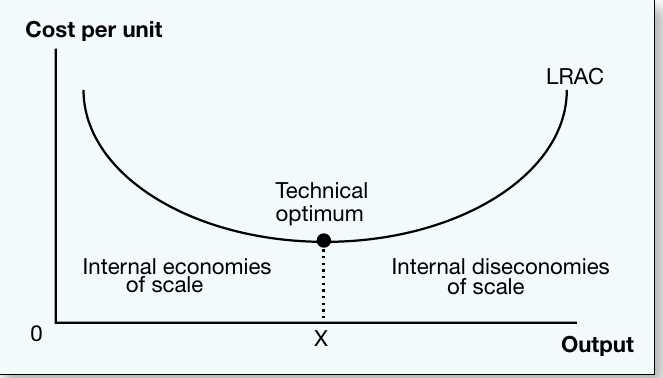
The LRAC curve demonstrates:
- Up to output level X: As the firm increases production scale, per-unit costs decline (falling LRAC curve). The firm continues benefiting from internal economies of scale.
- Beyond output level X: If the firm expands past this point, per-unit costs begin rising (rising LRAC curve). Internal diseconomies of scale now outweigh internal economies.
- Point X (technical optimum): This represents the most efficient production level for the firm. Average costs are at their lowest possible level. The firm has maximised internal economies of scale without suffering excessive internal diseconomies. The firm should grow up to point X but not beyond it.
Important
Definition: Technical optimum is the most efficient level of production for a firm. At this point, average costs of production are at their lowest possible level.
Learning by doing
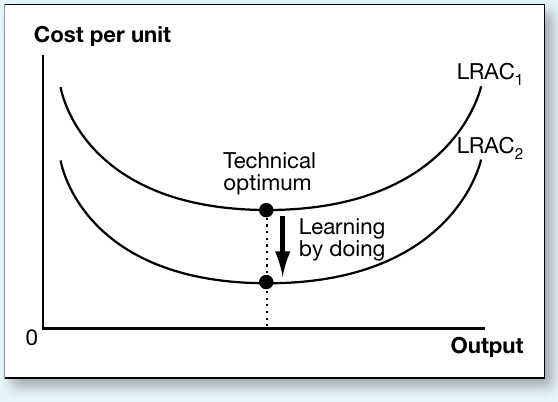
A significant benefit of continuously repeating production processes is that firms gain practice and become more efficient at completing the same tasks over time. This phenomenon, known as learning by doing, results in a downward shift of the firm's LRAC curve—meaning lower per-unit production costs at each output level.
Note
The diagram shows how accumulated production experience reduces costs over time. The LRAC curve shifts from to , demonstrating cost reductions achievable through experience even at the same output levels.
External economies and diseconomies of scale
Beyond factors relating to a firm's own production processes, other cost advantages and disadvantages can affect businesses that lie completely outside their control and occur regardless of production level.
External economies of scale
Note
Definition: External economies of scale are the advantages that accrue to a firm because of the growth of the industry in which the firm operates. They are not the result of the firm changing its own scale of operations.
Cost-saving advantages from external sources include:
- Industrial localisation: All firms in a particular region enjoy cost-saving advantages such as proximity to skilled labour supplies, necessary inputs, and major consumer markets.
- Industry-wide growth benefits: As an industry grows, all firms derive extra benefits. Government may provide special research and development support (e.g., CSIRO developing disease-resistant, high-yielding wheat strains benefiting all wheat farmers). Private enterprises may also provide beneficial services such as transport.
- Sophisticated capital markets: A growing, competitive capital market benefits all firms by providing cheaper investment funds from diverse sources.
External diseconomies of scale
Note
Definition: External diseconomies of scale are the disadvantages faced by a firm because of the growth of the industry in which the firm operates, and they are not the result of a firm changing its own scale of operations.
External diseconomies can result from industry growth or rapid economy-wide growth:
- Increased pollution: Industry growth causes environmental damage. For example, in China, rapid industrialisation combined with weak environmental controls has created severe air pollution in major cities, contributing to illness, premature deaths, factory closures and driving restrictions—all harming business.
- Transport bottlenecks: Increasing concentration of industry and population in urban areas eventually causes congestion. For example, Tokyo's growth has driven extraordinary property price increases, forcing many residents to live far from urban centres. Hundreds of thousands spend several hours daily commuting, increasing costs for all firms.
- Rising raw material costs: As industries grow, increased demand for limited resources forces up prices, raising costs for all firms dependent on those materials.
Summary
Key Points to Remember:
- Productivity measures output per unit of input per unit of time, not just total production. It reflects how efficiently resources are being used.
- Three types of specialisation increase productivity: division of labour, location of industry, and large-scale production (capital specialisation).
- Internal economies of scale reduce per-unit costs as firms grow, but internal diseconomies of scale increase costs when firms become too large. The technical optimum is the ideal production level where costs are minimised.
- Learning by doing shifts the entire LRAC curve downward through accumulated production experience and improved efficiency.
- External economies and diseconomies affect firms through industry-wide or economy-wide factors beyond their control, such as pollution, infrastructure availability, and resource prices.