Sources of Consumer Income (HSC SSCE Economics): Revision Notes
📚Revision Notes
Sources of Consumer Income
Introduction
Consumers receive income from various sources to finance their spending in the market economy. Income primarily comes as a return for providing resources to businesses—these resources are known as the factors of production. Additionally, the government provides income support through social welfare programs to ensure all citizens can meet their basic needs.
Understanding income sources is essential for analysing consumer behaviour and household spending patterns in Australia.
Note
The study of income sources helps economists predict how changes in employment, interest rates, or government policy affect consumer spending and overall economic activity.
Returns to factors of production
Consumer income represents the rewards paid to owners who supply factors of production to businesses. There are four main types of returns, each corresponding to a different factor of production.
Wages from labour
Labour income forms the largest source of household earnings in Australia, accounting for approximately 56% of total income. This income is earned when individuals participate in the labour market by offering their time, skills and effort to employers.
Wages and salaries include:
- Regular wage or salary payments
- Fringe benefits (non-cash perks like company cars or health insurance)
- Employer contributions to superannuation funds
- Workers' compensation for workplace injuries
Note
Analysis Tip: When analysing household income, always recognise that wages dominate income sources. This means changes in employment levels or wage rates have significant impacts on consumer spending and aggregate demand.
Rent from land
Land ownership generates income when the property is leased to others. Investment properties represent a common example where consumers earn rental income by allowing others to use their land or property.
This income source is relatively stable but typically represents a smaller proportion of household income compared to wages—around 9% according to recent data.
Interest from capital
Capital ownership provides income through returns on financial assets and investments. Wealth generates ongoing income streams, meaning wealthier households enjoy higher income levels from their capital holdings.
Most Australians own capital indirectly through:
- Superannuation funds and managed investment schemes
- Share ownership in publicly listed companies (e.g., Telstra, Woolworths, Commonwealth Bank)
- Savings accounts and term deposits earning interest
- Government and corporate bonds
Shareholders receive dividends—payments from company profits distributed to owners. Combined with business profits, capital investments contribute approximately 11% of household income, while returns to enterprise add another 10%.
Example
Case Study: Share Ownership in Australia
The privatisation of Telstra and Commonwealth Bank created opportunities for ordinary Australians to own shares in major corporations, diversifying their income sources beyond wages alone. This democratisation of share ownership allowed middle-income households to access dividend income—a return to capital that was previously concentrated among wealthy investors.
Profit from entrepreneurial skills
Many Australians operate their own businesses, particularly small and medium enterprises (SMEs). When these businesses generate profits, the owners receive income as a return for their entrepreneurial skills—the ability to combine resources, take risks and innovate.
Entrepreneurial income can be highly variable, depending on business performance and economic conditions. This income source rewards those who successfully identify market opportunities and manage business operations effectively.
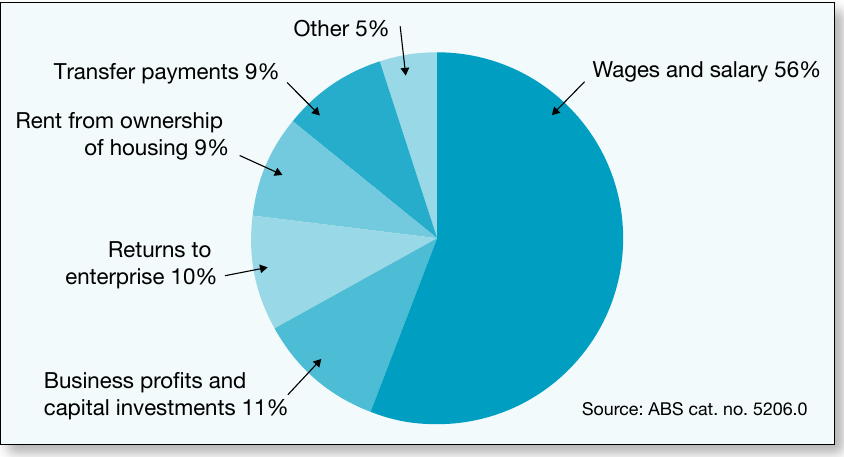
The chart above illustrates how different income sources contribute to total household income in Australia. Notice the dominance of wages and salaries, which highlights the importance of employment for consumer welfare.
Social welfare
Transfer payments represent a significant component of household income in Australia, accounting for approximately 9% of total income. These payments involve income collected through taxation being redistributed from government to consumers who need financial assistance.
Definition and purpose
Social welfare payments are government transfers designed to increase incomes for individuals or families requiring assistance. They provide a minimum income safety net, ensuring all Australians can afford basic necessities like food, housing and healthcare.
Important
Major Government Commitment
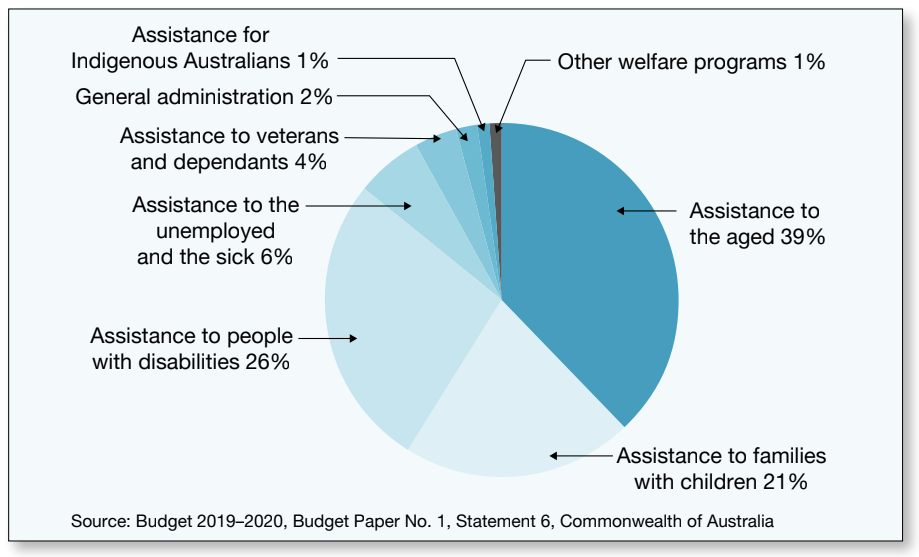
The Australian Government allocated approximately AUD $180 billion to social security and welfare in the 2019–20 Budget—more than one-third of total government revenue. This substantial commitment reflects the welfare system's importance in supporting vulnerable groups and maintaining social cohesion.
Types of transfer payments
Australia's welfare system provides support across several categories:
Assistance to the aged (39% of welfare spending)
- The largest category of welfare expenditure
- Supports people over 65 who have retired from employment
- Recognises that older Australians often have limited capacity to earn income
Assistance to people with disabilities (26% of welfare spending)
- The second-largest welfare category
- Provides income support for individuals unable to work due to physical or mental disabilities
- Ensures these Australians can maintain living standards despite inability to participate in labour markets
Assistance to families with children (21% of welfare spending)
- Helps families meet the costs of raising children
- Payments are means tested—calculated based on family income levels
- Recognises that children increase household expenses while reducing parents' capacity to work
Unemployment benefits (6% of welfare spending)
- Supports people actively seeking work but unable to find employment
- Contrary to popular perception, unemployment benefits represent a relatively small proportion of total welfare spending
- Provides temporary income support during job transitions
Other smaller categories include assistance to veterans and dependants, Indigenous Australians, and general administration costs.
Note
The pie chart above shows the distribution of Commonwealth welfare expenditure, clearly demonstrating that assistance to the aged and people with disabilities dominate welfare spending. The unemployed receive a much smaller share than commonly perceived.
Economic role of social welfare
Beyond supporting individual welfare, transfer payments serve important macroeconomic functions:
Counter-cyclical spending: During economic downturns, governments often increase transfer payments to boost consumer demand. Since welfare recipients typically spend most of their income on necessities, higher payments quickly translate into increased consumption, helping stimulate economic activity during recessions.
Income redistribution: Transfer payments reduce income inequality by redirecting resources from higher-income taxpayers to lower-income recipients, promoting more equitable outcomes.
Automatic stabilisers: Some welfare payments automatically increase during economic downturns (e.g., unemployment benefits rise when job losses increase), helping stabilise aggregate demand without requiring new government decisions.
Note
Policy Analysis Tip: When evaluating government policies during economic downturns, remember that increasing transfer payments can be an effective tool for boosting consumer spending quickly, as welfare recipients have high marginal propensities to consume.
Remember!
Summary
Key Points to Remember:
-
Four main income sources: Wages from labour (largest at 56%), interest from capital, rent from land, and profit from entrepreneurial skills represent returns to the factors of production that consumers supply to businesses.
-
Social welfare provides a safety net: Transfer payments account for 9% of household income, with the government spending AUD $180 billion on welfare in 2019–20 to ensure all Australians can afford basic necessities.
-
Aged care dominates welfare spending: Assistance to the aged (39%) and people with disabilities (26%) together account for nearly two-thirds of welfare expenditure—far exceeding spending on unemployment benefits (6%).
-
Wealth generates income: People with greater wealth enjoy higher incomes because capital ownership creates ongoing returns through interest, dividends and profits, amplifying income inequality over time.
-
Transfer payments stabilise the economy: Government welfare spending increases during economic downturns, boosting consumer demand when private sector activity weakens, helping to moderate the business cycle.