Government Policies and Inequality (HSC SSCE Economics): Revision Notes
📚Revision Notes
Government Policies and Inequality
Introduction
Government policies can directly and indirectly influence inequality in society. While fiscal and labour market policies have the most direct impact on inequality, other policies such as macroeconomic and microeconomic measures can also significantly affect the distribution of income and wealth.
In recent decades, the Australian government has reduced overall market intervention but introduced targeted policies to address economic disadvantage. These include personalised assistance with training and job placement. During major economic crises such as the COVID-19 pandemic and the global financial crisis, governments have implemented large-scale interventions to prevent severe economic downturns that could sharply increase inequality.
Note
This dual approach reflects modern economic policy: allowing market forces to operate efficiently while providing targeted support to those most vulnerable to economic disadvantage.
Macroeconomic management and job growth
Employment and inequality
Employment is the primary source of income for Australian households, making unemployment the leading cause of low incomes and poverty. When people lose their jobs, they must rely on government benefits, which provide significantly lower incomes than wages from employment.
Lower unemployment rates generally reduce the income gap between rich and poor households. Historical evidence shows that periods of high unemployment in Australia have contributed to a widening gap between high and low income earners.
Important
The relationship between employment and inequality is direct: when unemployment rises, inequality increases as more people move from wage income to lower government benefits.
The JobKeeper package
During the COVID-19 recession in 2020, the Australian Government introduced the JobKeeper package. This policy aimed to:
- Maintain the employer-employee relationship during business disruptions
- Minimise job losses during the worst period of the recession
- Prevent "labour market scarring" in the form of long-term unemployment
- Limit the long-lasting increase in inequality that historically follows recessions
By reducing job losses, the government successfully limited the inequality impact that typically accompanies economic downturns.
Changes in the labour market
The rise of casual and part-time work
Underemployment refers to people working less than full time who would like to work more hours but cannot find additional work.
Recent employment patterns have shifted significantly. According to Australian Bureau of Statistics data from 2023:
- 6.8% of all jobs (or 1,061,100 positions) are "secondary" jobs - not the worker's main income source
- Many new jobs created in recent years are casual or part-time rather than full-time positions
- This shift contributes to underemployment and income instability
Note
Workers in the "gig economy" often hold casual or temporary jobs with hours changing week to week. These workers face:
- Lower average incomes
- Greater income fluctuations
- First reductions in hours when the economy weakens
This employment model has become increasingly common in industries such as food delivery, ride-sharing, and freelance services.
Decentralisation and wage dispersion
The decentralisation of the labour market has widened inequality between wage earners. Under enterprise agreements:
- Workers with greater skills and bargaining power achieve higher wage increases
- Less skilled workers who rely on industrial awards receive smaller wage rises
- The pay gap between high-skilled and unskilled work has widened as jobs become more specialised
Important
The Fair Work Act 2009 recognised this problem and includes special provisions to help low-paid workers engage in enterprise bargaining.
The role of the Fair Work Commission
The Fair Work Commission, Australia's national industrial relations regulator, influences inequality through its annual minimum wage decisions. These decisions:
- Establish minimum wage levels for millions of employees covered by awards
- Indirectly influence other wage outcomes throughout the economy
- Have shown willingness to raise minimum wages to assist low-paid workers when affordable for businesses
In June 2023, the Fair Work Commission announced:
- National minimum wage increase: 8.65%, from $21.38 to $23.23 per hour
- Award pay rates increase: 5.75%
- These were the largest increases under the current pay system
The increases responded to surging inflation following the war in Ukraine and recovery from the COVID-19 pandemic. The Commission aims to maintain minimum wages at around 55% of median full-time earnings.
Government policies to reduce inequality
Taxation, transfer payments and other assistance
Government intervention through taxation and welfare payments has the most direct impact on reducing inequality in Australia. The system works by:
- Taxing wealthier groups more heavily
- Redistributing income to lower socio-economic groups
The 2023-24 Budget allocated $250 billion for social security and welfare payments, with the largest categories being:
- Age pension: $59 billion
- Disability support pension: $21 billion
- JobSeeker payment (unemployment): $13 billion
Impact on income distribution
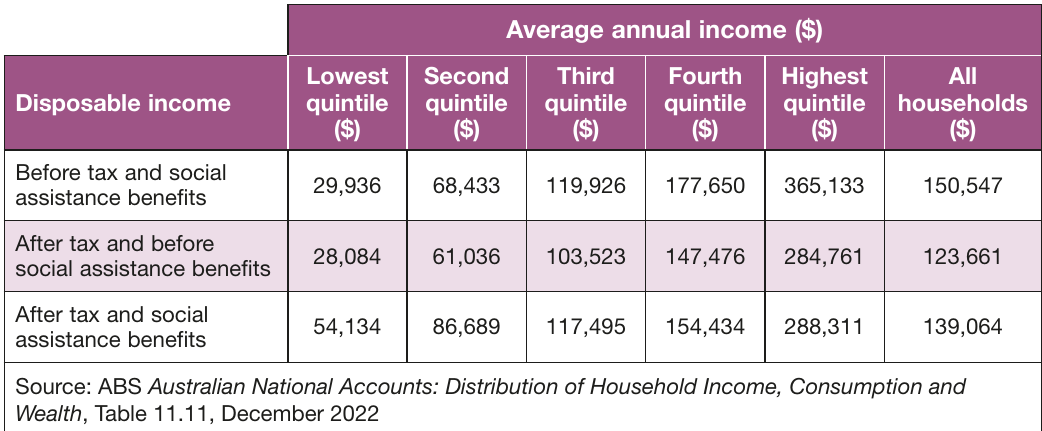
Government intervention significantly reduces income inequality. The table below shows how taxation and transfer payments affect household incomes across five quintiles (each representing 20% of households).
Example
Worked Example: Impact of Government Intervention
Let's examine how government intervention affects the lowest and highest income quintiles:
Before government intervention:
- Highest quintile income ÷ Lowest quintile income = over 12 times
After government intervention:
- The ratio reduces to approximately 5 times
- The lowest quintile's disposable income almost doubles
This demonstrates how taxation and transfer payments significantly reduce income inequality by redistributing resources from higher to lower income groups.
Key observations from this data:
- Before government intervention: The highest quintile earns over 12 times the lowest quintile
- After government intervention: The highest quintile's disposable income is approximately 5 times the lowest quintile
- The lowest quintile's average disposable income almost doubles through government support
Progressive taxation system
Australia has a progressive income tax system, where higher income levels face higher marginal tax rates. As people earn more, they pay a larger proportion of their income in tax.
However, the lowest 40% of income earners face a proportionately larger overall tax burden when indirect taxes are included:
- They earn only 12% of total private income
- But they pay 15% of total taxes
Note
This occurs because of consumption taxes like the Goods and Services Tax (GST), which are not related to household incomes. These regressive effects are offset by transfer payments and government services.
According to a 2018-19 Productivity Commission study, the combined effect of taxes and transfers reduces income inequality by approximately one-third.
Recent tax policy changes
Major changes to Australia's personal income tax system were introduced in three phases from 2017-18 to 2024-25:
- Stage one: Targeted at lower income earners
- Stage three: Taking effect from 1 July 2024, abolishing the 37% tax bracket
The stage-three tax cuts reduce the number of tax brackets from four to three. This means income earners pay the same rate for all earnings between $45,000 (slightly above minimum wage) and $200,000 (two and a half times the average wage).
Important
While a Treasury Working Paper in 2019 found Australia's personal income tax became more progressive between 1994 and 2016, the changes taking effect from 2024-25 make the tax system less progressive.
Compulsory superannuation
Compulsory superannuation has influenced wealth distribution in Australia since its introduction in 1992. Key features include:
- Employers must contribute a minimum of 11% of employee wages (rising to 11.5% from 1 July 2024)
- Contributions go to a superannuation fund employees cannot access until retirement
- Coverage has risen from 42% to 94% of employees since the mid-1980s
Benefits for reducing inequality:
- Superannuation assets boost wealth across all wealth quintiles
- Particularly important for low to middle-income earners, for whom superannuation may be one of few significant financial assets
- Expected to further reduce inequality as contributions rise to 12% from 2025-26
Housing affordability measures
Housing ownership is a key driver of wealth inequality. According to a 2020 ACOSS/UNSW report, 80% of investment properties are owned by the top 20% of wealth holders.
The Albanese Government has announced measures to improve housing affordability:
1. Housing Australia Future Fund: $10 billion to build 30,000 social and affordable homes over five years
2. Shared-equity scheme: Allows first home buyers to purchase partial ownership of properties
- A Commonwealth authority buys and owns up to 40% of the home's equity
- When homeowners sell, they must repay the initial investment plus a share of capital gains
- Modelled on schemes in the UK and Western Australia
The indirect impact of government policies
Government policies aimed at creating more equitable income distribution can be undermined by other policies that unintentionally widen the gap between high and low income earners.
Monetary policy effects
When the central bank uses monetary policy to slow economic growth, it can affect income and wealth distribution:
Effects of interest rate increases:
- Lower disposable incomes for households with large mortgages (higher repayments)
- Higher incomes for those whose main income comes from interest-bearing assets like superannuation
- Potential reduction in house prices, which may slightly improve wealth inequality as wealthier households hold more housing assets
Sharp interest rate increases, such as those in 2022 and 2023, demonstrate these effects. These outcomes are side effects of a policy primarily used to maintain low inflation rather than to address inequality.
Microeconomic reform impacts
Microeconomic reform initiatives can affect inequality in several ways:
Short-term effects:
- Economic restructuring may create unemployment
- Industry closures may result from reforms
- Privatisation often leads to price increases and workforce downsizing
Distribution of costs and benefits:
- Benefits tend to flow to wealthier asset owners (improved efficiency and investment returns)
- Costs tend to be felt most by lower income earners (job losses, higher prices)
Note
Managing inequality impacts:
Governments face the challenge of implementing microeconomic policies without increasing inequality. Strategies include:
- Substantial adjustment packages to compensate lower income groups
- Targeted transitional support for directly affected groups
- Compensation measures when reforms could disadvantage low income earners
Example
Practical Example: GST Reform Proposals
When proposals were raised in 2015 to increase the GST from 10% to 15%, advocates emphasised the need for compensation to ensure low income earners would not be disadvantaged.
This demonstrates how compensation measures can build public support for reform while minimising hardships from structural change.
Summary
Summary
Key Points to Remember:
-
Employment is key: Since employment is the main income source, policies that reduce unemployment directly reduce inequality
-
Progressive taxation and transfers: Australia's tax and welfare system reduces income inequality by approximately one-third through progressive taxation and targeted transfer payments
-
Labour market changes increase inequality: The shift toward casual, part-time work and decentralised wage bargaining has widened income gaps between skilled and unskilled workers
-
Multiple policy impacts: Government policies affect inequality both directly (fiscal policy, minimum wages) and indirectly (monetary policy, microeconomic reforms)
-
Recent policy direction: While some measures like compulsory superannuation and housing initiatives aim to reduce inequality, recent tax cuts have made the system less progressive