Policies to Sustain Economic Growth (HSC SSCE Economics): Revision Notes
📚Revision Notes
Policies to Sustain Economic Growth
Overview
Economic management aims to sustain high rates of economic growth, allowing national wealth to increase and living standards to improve. Governments use a combination of policy tools to influence growth in both the short and long term. These policies work by affecting either aggregate demand (short-term) or aggregate supply (long-term).
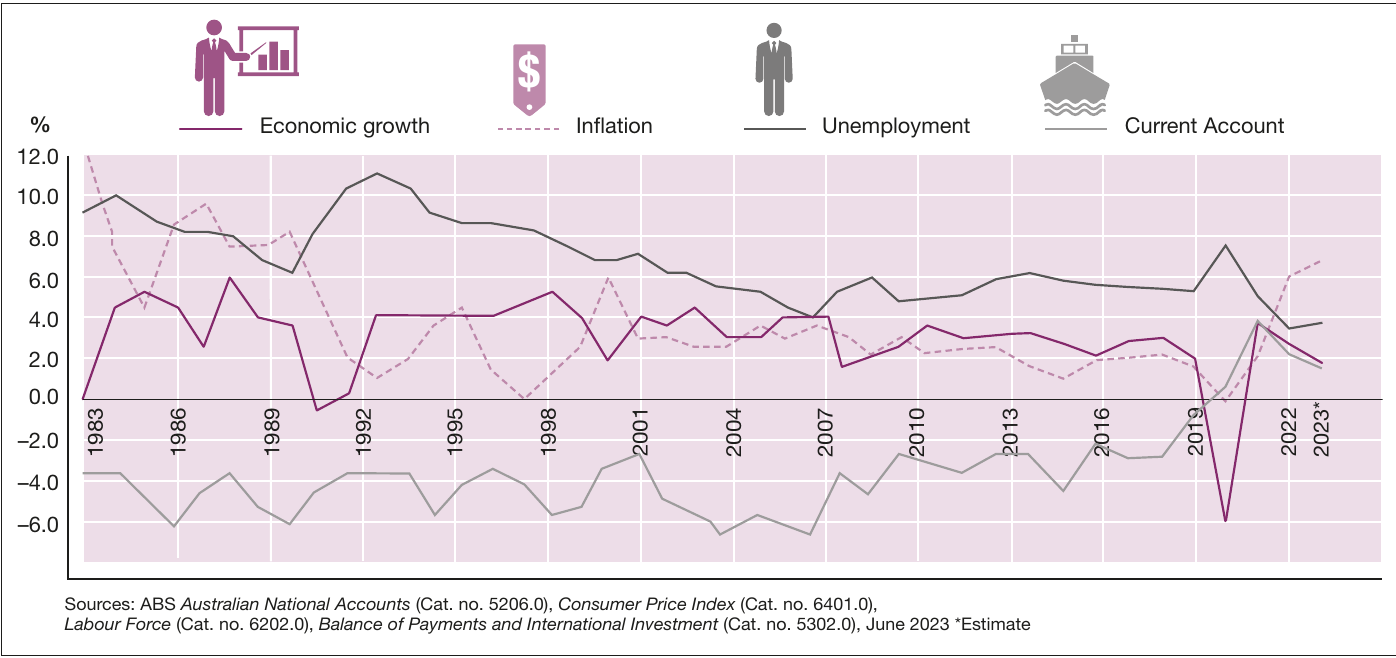
The graph above shows Australia's economic performance over four decades, illustrating the fluctuations in growth, inflation, unemployment and the current account that policymakers seek to manage. Notice the significant contraction during the COVID-19 pandemic around 2020, followed by recovery.
Macroeconomic policies
Note
Macroeconomic policies are used to manage economic growth in the short term by smoothing out fluctuations in the business cycle. These policies primarily work through influencing aggregate demand. However, they have limited impact on the long-run growth rate of the economy.
Fiscal policy
Fiscal policy uses the Commonwealth Government's Budget to influence the level of economic activity. It operates through two main channels:
Government expenditure (injection into the economy):
- Spending on infrastructure, services, welfare and other government programs
- Adds directly to aggregate demand
- Increases economic activity when expanded
Taxation (leakage from the economy):
- Removes money from households and businesses
- Reduces aggregate demand when increased
- Provides revenue for government spending
Stimulating growth:
To increase economic growth, the government can:
- Reduce taxation rates
- Increase government spending
- Implement both measures simultaneously
This increases injections relative to leakages, boosting aggregate demand and economic activity.
Slowing growth:
To constrain economic growth, the government can:
- Increase taxation receipts
- Reduce government expenditure
- Implement both measures simultaneously
This reduces aggregate demand by increasing leakages relative to injections.
Important
Effectiveness considerations:
Fiscal policy works more effectively at stimulating growth during downturns than at slowing an overheating economy. When the economy is weak, increased government spending can directly boost demand. However, reducing spending to slow growth faces political and practical constraints.
Example
Real-world Example: COVID-19 Fiscal Response
The Australian Government's response to the 2020–21 recession demonstrates fiscal policy in action:
- JobKeeper wage subsidy supported businesses and employees
- Increased JobSeeker welfare payments maintained household incomes
- These measures prevented a deeper recession by sustaining aggregate demand
The government essentially increased injections into the economy at a time when private sector spending was collapsing, demonstrating the power of fiscal policy during severe downturns.
Monetary policy
Monetary policy involves the Reserve Bank of Australia (RBA) influencing interest rates throughout the economy. Interest rate changes affect aggregate demand and the pace of economic growth.
How it works:
The RBA sets the official cash rate, which influences:
- Consumer borrowing costs (mortgages, personal loans)
- Business investment decisions
- Saving behaviour
- Exchange rates
Stimulating growth:
When the RBA wants to encourage growth:
- Interest rates are reduced
- Borrowing becomes cheaper
- Consumer spending increases (especially on durables like houses and cars)
- Business investment becomes more attractive
- Aggregate demand rises
Slowing growth:
When the RBA wants to moderate growth:
- Interest rates are raised
- Borrowing becomes more expensive
- Consumer spending decreases
- Business investment slows
- Aggregate demand falls
Important
Recent effectiveness concerns:
Monetary policy has been the main tool for managing economic growth in recent years, but its effectiveness has been questioned:
Before the pandemic:
- Economic growth remained weak despite very low interest rates
- This suggested monetary policy had limited power to stimulate demand at extremely low rates
During 2022–23:
- The RBA sharply increased interest rates (12 rises in 14 months)
- Questions arose about whether monetary policy was too aggressive
- The economy slowed but inflation remained persistent
Microeconomic policies
Microeconomic policies take a different approach by focusing on increasing the economy's sustainable long-run growth rate. Unlike macroeconomic policies that influence demand, microeconomic policies work by increasing aggregate supply.
Key objectives:
Microeconomic policies aim to:
- Increase productive capacity of the economy
- Improve efficiency across industries
- Reduce constraints on growth from inflation and current account problems
- Enable higher sustainable growth rates over the long term
Impact on supply:
These policies increase aggregate supply by:
- Removing barriers to production
- Encouraging innovation and competition
- Improving resource allocation across the economy
- Enhancing infrastructure and productive capacity
Note
Historical context:
The Productivity Commission argues that Australia's strong growth performance in the 1990s and 2000s resulted from extensive microeconomic reforms implemented during the 1980s and 1990s. These reforms restructured the Australian economy and improved its competitiveness.
Important
Recent performance:
Australia's microeconomic reform agenda has deteriorated in recent years:
- The Productivity Commission's 5-year Productivity Inquiry (2022) found that none of its policy recommendations from five years earlier had been fully implemented
- This raises concerns about Australia's future growth potential
Infrastructure investment:
Despite limited policy reform, state governments have made substantial investments in physical infrastructure:
- Road and port improvements
- Transport network upgrades
- These investments help relieve supply chain bottlenecks
- Infrastructure expansion increases the economy's productive capacity
Microeconomic policy is explored in greater detail in specific policy chapters.
Labour market policies
Labour market policies represent a specific type of supply-side policy that focuses on improving labour productivity. While similar to microeconomic policies in targeting aggregate supply, they specifically address workforce capabilities.
Core objectives:
Labour market policies encourage economic growth by:
- Increasing worker productivity
- Improving education outcomes
- Developing workforce skills
- Addressing skills shortages in key industries
Methods:
These policies help workers produce more through:
- Higher education attainment
- Vocational training and upskilling programs
- Apprenticeship schemes
- Skills recognition and migration programs
Example
Recent Policy Focus: 2022 Jobs Summit
The Albanese Government's 2022 Jobs Summit identified critical skills shortages threatening economic growth:
Information technology sector:
- Shortage of qualified IT professionals
- Risk to digital economy growth
Care economy:
- Nurses in short supply
- Aged care workers needed
- Growing demand from ageing population
The government committed to releasing a major Employment White Paper to address these challenges, demonstrating the importance of labour market policies in sustaining long-term growth.
Long-term benefits:
Effective labour market policies generate sustainable growth by:
- Raising labour productivity across the economy
- Reducing skills shortages that constrain expansion
- Improving workforce participation
- Enhancing international competitiveness
Summary
Key Points to Remember:
-
Macroeconomic policies (fiscal and monetary) manage short-term growth by smoothing business cycle fluctuations through changes in aggregate demand, but have limited long-term impact.
-
Fiscal policy uses government spending and taxation to inject or withdraw demand from the economy; it proved crucial during COVID-19 through JobKeeper and JobSeeker programs.
-
Monetary policy adjusts interest rates to encourage or discourage spending and investment, though its effectiveness has been questioned in recent years at both very low and rapidly rising rates.
-
Microeconomic policies focus on long-run sustainable growth by increasing aggregate supply through reforms that improve efficiency, productivity and remove constraints on production.
-
Labour market policies specifically target workforce productivity through education and skills development, addressing critical shortages that could limit future growth potential.