The Components of Aggregate Demand (HSC SSCE Economics): Revision Notes
📚Revision Notes
The Components of Aggregate Demand
Understanding aggregate demand and economic growth
Economic growth in the short to medium term is largely driven by changes in aggregate demand. To understand what drives economic growth, we must examine each individual component of aggregate demand. By analysing the factors influencing these components, we can identify what causes the economy to expand or contract over time, and therefore understand which policies may be effective in increasing economic growth.
Aggregate demand consists of several key components. Understanding how each behaves helps economists and policymakers predict and manage economic activity. Each component responds to different influences and contributes differently to overall economic performance.
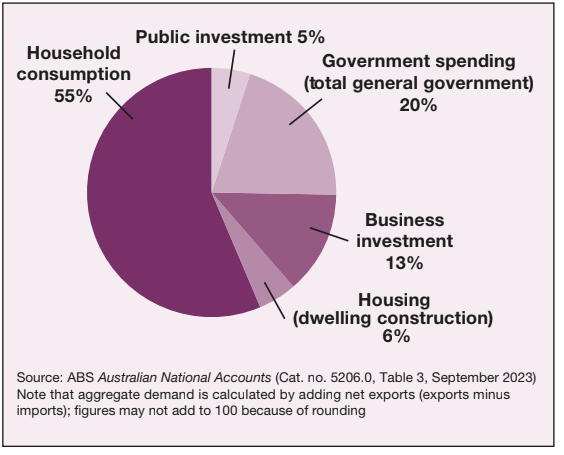
The chart above shows the relative size of each component in the Australian economy. Household consumption is by far the largest component, representing over half of domestic demand. This is followed by government spending, business investment, housing construction, and public investment. Together, these components (plus net exports) make up total aggregate demand.
Influences on consumption
Consumption by households typically forms at least half of aggregate demand in the economy. Any increase in consumption is likely to boost aggregate demand and therefore increase economic activity (both income and supply). This makes consumption a crucial determinant of economic growth.
While income is the most important factor determining consumption levels overall, we need to understand what influences consumption for a given level of income. This helps us understand how consumption itself can drive changes in economic activity. We focus on two key measures:
Note
Average propensity to consume (APC) is the proportion of total income that is spent on consumption.
Average propensity to save (APS) is the proportion of total income that is saved rather than spent on current consumption.
Three main factors influence the APC and therefore affect consumption levels:
Consumer expectations
Consumer expectations about the future significantly influence spending and saving decisions. These expectations operate through several mechanisms:
When consumers expect their incomes to rise, they tend to increase current spending and reduce saving. This is because they feel more confident about their future financial position. Similarly, if consumers anticipate inflation or future shortages of goods, they are motivated to purchase items now rather than wait. This brings forward consumption and boosts current aggregate demand.
Conversely, pessimistic expectations have the opposite effect. If consumers expect their incomes to fall, prices to decrease, or goods to become more readily available in the future, they tend to reduce current spending and increase saving. This behaviour can dampen aggregate demand and slow economic growth.
Important
These expectation effects can become self-reinforcing. If many consumers simultaneously reduce spending due to pessimistic expectations, this can actually lead to the economic slowdown they feared, creating a negative feedback loop.
The level of interest rates
Interest rates affect consumption through both the cost of borrowing and the reward for saving. When interest rates increase, borrowing becomes more expensive, which discourages consumers from taking out loans to finance purchases of goods and services, particularly big-ticket items like cars or home improvements. At the same time, higher interest rates make saving more attractive by offering better returns on savings accounts and term deposits.
Lower interest rates have the opposite effect. Cheaper borrowing costs encourage consumers to finance purchases through credit, while the reduced return on savings makes it less attractive to defer consumption. This typically leads to increased consumer spending and higher aggregate demand.
Example
Practical Example: Interest Rate Impact (2022-23)
During 2022-23, global inflationary pressures prompted central banks to raise interest rates. Australian households responded by becoming more conservative with discretionary spending as they adjusted their budgets to accommodate higher mortgage repayments. This demonstrates how interest rate changes can directly impact consumption patterns.
The distribution of income
The distribution of income across society has a significant effect on overall consumption levels. Generally, a more equitable (even) distribution of income leads to higher rates of overall spending, while a more inequitable (uneven) distribution reduces total consumption.
This occurs because people on lower incomes tend to spend a higher proportion of their income than those on higher incomes. This reflects a fundamental insight from Keynesian economics: as individuals receive more income, they save a higher proportion and spend a lower proportion.
Example
Worked Example: Income and Consumption Patterns
Someone earning a net income of $400 per week might need to spend all of it on essential costs of living such as food, housing, and transport. In contrast, someone earning $4,000 per week could comfortably save half their income while still maintaining a high standard of living.
The lower-income person has an APC close to 1.0 (100%), while the higher-income person might have an APC of 0.5 (50%).
Note
Policy Implications of Income Distribution
Measures that redistribute income from higher-income to lower-income earners (such as increasing unemployment benefits like JobSeeker payments) are more likely to boost consumer spending than policies benefiting high-income earners (such as reducing the top marginal tax rate). Lower-income recipients will spend most or all of any additional income, directly increasing aggregate demand.
Influences on investment
Business investment is historically one of the most volatile components of aggregate demand, typically contributing between 10 and 15 per cent of total expenditure. Investment spending can fluctuate significantly from year to year, making it an important driver of economic cycles. Two main factors influence the level of business investment:
The cost of capital equipment
Several factors affect the cost, or relative cost, of capital equipment, which in turn influences investment decisions:
Changes in interest rates have a direct impact on investment. When interest rates fall, it becomes cheaper for businesses to borrow funds to purchase capital equipment such as machinery, vehicles, or buildings. Lower interest rates also make saving less attractive compared to investing in productive assets.
Interest rates represent an opportunity cost even for firms with their own capital. Businesses with available cash reserves must choose between lending money (for example, buying bonds) or using it to acquire capital equipment or other businesses. They might also choose to return cash to investors through higher dividends. The level of interest rates influences this decision by determining the return from the saving alternative.
Government policies regarding investment allowances and tax concessions affect the effective cost of capital. If the government allows businesses to claim the full cost of capital equipment immediately rather than spreading depreciation over several years, this reduces their tax liability and makes capital effectively cheaper.
Example
Case Study: COVID-19 Investment Incentives
During the COVID-19 recession, the Australian Government permitted firms with turnover up to $5 billion to immediately deduct the full cost of asset purchases until July 2023.
Result: This temporary measure created a powerful incentive for investment, leading to a substantial jump in business investment's contribution to aggregate demand between 2021 and 2023.
Changes in labour costs or productivity affect the relative attractiveness of capital versus labour. Since labour and capital are substitutes in the production process, any change affecting one influences demand for the other. If labour costs increase or if new labour-saving technologies become available at the same price, the relative cost of capital compared with labour decreases, making capital investment more attractive. This can lead to capital deepening, where businesses increase their capital-to-labour ratio.
Business expectations
Business confidence about future prospects, sometimes called entrepreneurial spirit or "animal spirits", plays a crucial role in investment decisions. Several factors shape these expectations:
Expected demand for products is a primary driver. If entrepreneurs anticipate increased future demand for their goods or services, they become more willing to invest in new capital equipment to boost production capacity. This forward-looking behaviour means that positive expectations can stimulate investment even before the actual increase in demand materialises.
The general economic outlook influences investment decisions significantly. When economic growth is expected to accelerate, businesses are more inclined to invest because higher economic activity should improve returns on investment. Conversely, expectations of economic slowdown typically lead to reduced investment as businesses become more cautious.
Important
The Uncertainty Effect of Inflation
Inflation can negatively affect investment by creating uncertainty about future prices and production costs. When businesses cannot reliably predict their future costs or the prices they will receive for their products, they become hesitant to commit to long-term investment projects. This uncertainty effect can substantially reduce investment in productive capital equipment, even if the business fundamentals otherwise appear sound.
Influences on government spending and taxation
Government spending and taxation represent significant components of aggregate demand and supply respectively. Federal government spending typically accounts for around 20-25 per cent of aggregate demand, while taxation represents approximately 20-25 per cent of aggregate supply (national income).
The government uses spending and taxation as deliberate policy tools to influence economic activity. One of the main objectives of fiscal policy (covered in detail in later studies) is to maintain a sustainable rate of economic growth while achieving goals of low unemployment and stable inflation.
Note
Expansionary Fiscal Policy
When the economy needs stimulation, governments may increase spending or reduce taxation (or both):
- Higher government spending directly increases aggregate demand by adding to total expenditure in the economy
- Lower taxation leaves households and businesses with more disposable income, which they typically spend, also boosting aggregate demand
- These measures help accelerate economic growth
Note
Contractionary Fiscal Policy
When the economy is growing too rapidly and generating inflationary pressures, governments may reduce spending or increase taxation (or both):
- Lower government spending directly reduces aggregate demand
- Higher taxation reduces disposable income and therefore private consumption and investment
- These measures help slow economic growth and reduce inflation pressures
The timing and magnitude of these policy changes significantly affect their impact on aggregate demand and economic growth.
Influences on exports and imports
International trade affects aggregate demand through exports (an injection) and imports (a leakage). In Australia, exports and imports each represent between one-fifth and one-quarter of aggregate demand, making trade a significant influence on economic activity.
Net exports (export revenue minus import spending) represent the trade balance. When export revenue equals import spending, net exports are zero and trade neither adds to nor subtracts from aggregate demand. However, when exports exceed imports (a trade surplus), net exports make a positive contribution to aggregate demand. Australia's sustained trade surpluses in recent years have added to aggregate demand and supported economic growth.
Several factors influence Australia's export and import volumes:
Income levels both overseas and domestically affect trade flows. When overseas income levels rise, foreign consumers and businesses have more purchasing power, which typically increases demand for Australian exports. Conversely, when Australian income levels rise, domestic consumers and businesses increase their spending on both domestic and imported goods, leading to higher imports.
Exchange rates significantly affect international competitiveness and trade patterns. When Australia has a weaker exchange rate, the Australian dollar buys less foreign currency. This makes Australian exports cheaper for foreign buyers and imports more expensive for Australian consumers. As a result, exports typically increase and imports decrease, raising net exports and boosting aggregate demand.
A stronger exchange rate has the opposite effect. Australian products become more expensive for foreign consumers, reducing export demand. Simultaneously, imports become cheaper for Australian buyers, increasing import spending. This reduces net exports, detracting from aggregate demand and potentially slowing economic growth.
Note
Other Factors Influencing Trade
Additional factors affecting Australia's trade performance include:
- Relative inflation rates between Australia and its trading partners
- Levels of international competitiveness
- Protectionist trade policies
- Changes in consumer tastes and preferences
Because of trade's substantial impact on aggregate demand and economic growth, improving Australia's trade performance remains a key policy objective for Australian governments.
Summary
Key Points to Remember:
Components of Aggregate Demand:
- Household consumption (55%) - the largest component
- Government spending (20%)
- Business investment (13%) - the most volatile component
- Housing (6%)
- Public investment (5%)
Consumption Influences:
- Consumer expectations about future income and prices
- Interest rates affect both borrowing costs and saving rewards
- Income distribution - more equitable distribution leads to higher overall consumption
Investment Influences:
- Cost of capital equipment - affected by interest rates, government policies, and labour costs
- Business confidence about future prospects and economic outlook
- Investment is highly sensitive to uncertainty, particularly from inflation
Government Policy:
- Government can use spending and taxation as deliberate policy tools
- Expansionary policy (higher spending/lower taxes) increases aggregate demand
- Contractionary policy (lower spending/higher taxes) decreases aggregate demand
Trade Effects:
- Net exports = export revenue minus import spending
- Exchange rates play a crucial role in trade competitiveness
- Weaker dollar → cheaper exports, more expensive imports → higher net exports
- Stronger dollar → more expensive exports, cheaper imports → lower net exports
Key Terms:
- Average propensity to consume (APC): the proportion of total income spent on consumption
- Average propensity to save (APS): the proportion of total income that is saved
- Net exports: export revenue minus import spending (the trade balance)
- Capital equipment: physical assets used in production, such as machinery and buildings
- Aggregate demand: total spending in the economy on domestically produced goods and services