The Role of Aggregate Supply (HSC SSCE Economics): Revision Notes
📚Revision Notes
The Role of Aggregate Supply
What is aggregate supply?
Aggregate supply represents the total amount of goods and services that an economy can produce. It is determined by the quantity and quality of an economy's factors of production:
- Natural resources – land, minerals, energy sources
- Labour – the size and skills of the workforce
- Capital – machinery, equipment, infrastructure
- Entrepreneurship – the ability to combine resources efficiently
Economies with more factors of production, or better-quality factors, can produce more output. This is why aggregate supply is sometimes called an economy's potential – it shows what the economy is capable of producing.
Note
Economic Potential
Economists use the term economic potential to describe aggregate supply because it represents the maximum sustainable output an economy can achieve with its current resources. When an economy operates at its potential, it is using all available factors of production efficiently without creating inflationary pressures.
Impact on economic growth and inflation
While aggregate demand drives short-term fluctuations in economic activity, aggregate supply plays a crucial long-term role in determining sustainable growth rates.
When aggregate supply increases, the economy gains two important benefits:
- Higher total output – the economy can produce more goods and services, raising GDP
- Lower price level – increased productive capacity reduces inflationary pressure
This combination means an economy can grow faster and more sustainably when aggregate supply expands. Growth occurs alongside price stability rather than rising inflation.
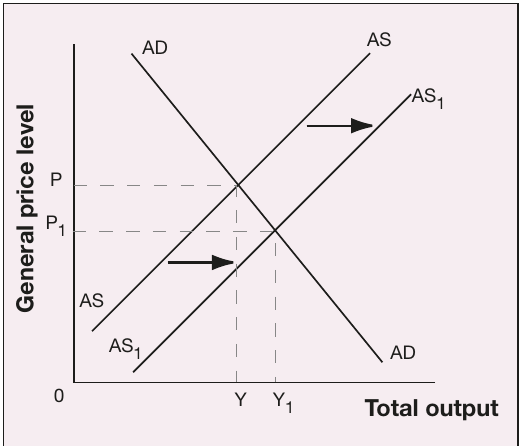
The diagram shows how a rightward shift in aggregate supply (from AS to AS₁) leads to an increase in total output (from Y to Y₁) and a fall in the general price level (from P to P₁). This demonstrates the dual benefit of supply-side improvements.
How to increase aggregate supply
Aggregate supply increases when the economy can produce more output at the same cost. This happens through improvements in the quantity or quality of factors of production.
Note
The Supply-Side Principle
Any economic change that increases the quantity of productive resources or improves the quality and efficiency of existing resources will shift aggregate supply to the right. This enables the economy to produce more output without increasing costs.
The following changes can boost aggregate supply:
| Economic change | Example and impact |
|---|---|
| Population growth | An increase in population through higher migration or birth rates expands the labour force. More workers means the economy can produce more goods and services. Australia's relatively high migration intake has been a major contributor to growth rates above most advanced economies for several decades. |
| Discovery of new resources | Finding new mineral and metal deposits creates additional productive capacity. These resources can be exploited to increase exports and drive economic growth. |
| Workers acquiring new skills | Investment in education and training improves labour quality. For example, highly trained doctors and health professionals can diagnose illnesses more quickly and treat them more effectively, increasing healthcare sector productivity. |
| Increased capital | Investment in capital equipment such as machinery raises productive capacity. While this may replace labour in the short term, it increases the economy's long-term ability to produce goods efficiently. |
| Adoption of new technology | Technological innovation reduces production costs. Businesses investing in artificial intelligence chatbots to handle frequently asked customer questions can reduce the cost of providing customer service. |
| Measures to improve efficiency | Process improvements and automation expand capacity. Amazon established automated package processing centres in metropolitan Sydney, enabling same-day delivery across the city for online purchases. |
| Government policies | Regulatory reform and competition-enhancing measures can lift productivity. Examples include the creation of Australia's national electricity grid to improve energy market efficiency. |
Capacity constraints and the need for supply-side policy
If policymakers focus exclusively on boosting aggregate demand, they will eventually encounter limits imposed by aggregate supply. When aggregate demand exceeds the economy's productive capacity, capacity constraints emerge.
Important
Understanding Capacity Constraints
Capacity constraints occur when aggregate demand exceeds the economy's ability to produce goods and services. These constraints represent fundamental limits on production that cannot be overcome simply by increasing demand. When an economy hits these limits, additional demand creates inflation rather than growth.
These constraints cause problems:
- Rising inflation – when demand outstrips supply, prices increase
- Skills shortages – employers cannot fill specific roles, limiting expansion
- Infrastructure bottlenecks – inadequate roads, ports and facilities constrain production
Australian example: post-COVID skills shortages
Example
Worked Example: Skills Shortages During Australia's COVID-19 Recovery
Skills shortages became a major constraint during Australia's recovery from COVID-19. The rapid fall in immigration during the pandemic reduced labour supply just as demand recovered.
The Scale: In the year to February 2023, ABS data showed an average of 457,000 job vacancies – almost double pre-pandemic levels.
Labour shortage effects:
- They discourage business investment and production expansion (except in labour-saving technology)
- They create upward pressure on wages and prices
This demonstrates how supply-side constraints can limit economic recovery even when aggregate demand is strong.
The role of microeconomic policy
Supply constraints highlight why microeconomic policies are an essential part of the economic policy mix. While macroeconomic policies (fiscal and monetary) primarily affect aggregate demand, microeconomic reforms target aggregate supply.
Supply-side policies include:
- Immigration programs to address skills shortages
- Education and training to improve workforce quality
- Infrastructure investment to remove bottlenecks
- Regulatory reform to enhance efficiency
- Support for research, development and innovation
Important
Without adequate attention to aggregate supply, demand-side stimulus will create inflation rather than sustainable growth. This explains why successful economic policy requires both demand-side and supply-side measures working together.
Remember!
Summary
Key Points to Remember:
- Aggregate supply represents an economy's productive capacity, determined by the quantity and quality of factors of production
- Increases in aggregate supply deliver two benefits: higher economic growth and lower inflation – enabling sustainable expansion
- Seven main factors can boost aggregate supply: population growth, resource discovery, skills development, capital investment, new technology, efficiency improvements, and government policy reforms
- Capacity constraints emerge when aggregate demand exceeds supply, causing inflation and skills shortages
- Microeconomic policies that increase aggregate supply are essential for long-term sustainable growth, complementing demand-side macroeconomic policies