Major Environmental Issues (HSC SSCE Economics): Revision Notes
📚Revision Notes
Major Environmental Issues
Environmental sustainability sounds straightforward in theory: measure the social costs of economic activity, then introduce laws to ensure producers or consumers bear these costs. However, the reality is far more complex. Experts often disagree on how to calculate environmental costs and which policies work best. Industries resist changes that increase their costs, while governments must balance environmental protection with economic objectives.
Note
The complexity of environmental policy stems from conflicting expert opinions, industry resistance, and the challenge of balancing environmental protection with economic growth objectives.
This note examines four major environmental issues that governments must address when developing economic policy.
Preserving natural environments
Why preservation matters
Long-term economic growth depends on a healthy environment. When the environment degrades, several problems emerge:
- Human health suffers from increased air and water pollution
- Resource availability declines
- Social and economic costs accumulate
Environmental preservation aims to prevent these problems before they worsen.
Preservation measures
Governments can protect the environment through various approaches:
- Development restrictions: Limiting activities in sensitive areas (e.g. banning mining in national parks)
- Species protection: Safeguarding native plants and animals from extinction
- Emission controls: Regulating waste product releases
- Reforestation requirements: Mandating new planting where logging occurs
Australia's biodiversity record
Important
Despite being one of the six most biodiverse nations globally, Australia has a poor preservation record with only 20% of total land area protected, compared to 33% in New Zealand and 28% in the UK.
Key statistics reveal the extent of the challenge:
- Only 30% of an estimated 600,000 species have been identified and named
- In 2023, 244 flora and 107 fauna species were critically endangered under the 1999 Environment Protection and Biodiversity Conservation Act
- This number has increased partly due to the 2019-20 bushfire season
The most recent State of the Environment Report found Australia's biodiversity is in decline. While conservation policies have slowed the decline rate for some species, investment has been insufficient to reverse the overall trend. Further extinctions are expected without additional funding.
Case study: The 2019-20 bushfires
Example
Case Study: The 2019-20 Bushfires
Australia experienced an unprecedented bushfire season in summer 2019-20, with devastating environmental, economic and social consequences.
Environmental impacts:
- Over 18 million hectares of land burnt
- Significant damage to high-biodiversity forest areas
- Loss of an estimated one billion birds, mammals and reptiles
- Long-term habitat and food source destruction
- Permanent species extinction risk
Air and water quality:
- Hazardous smoke and ash pollution visible from space
- Air quality impacts reached South America
- Increased respiratory illnesses
- Worsening of pre-existing health conditions
- Water quality degradation
Economic impacts:
- Destruction of agricultural land
- Tourism industry damage
- $4-5 billion in food system losses (World Wildlife Fund estimate)
- Loss of homes and buildings
Recovery will take many years, with permanent ecological damage likely.
Challenges facing governments
Governments encounter several obstacles when implementing environmental preservation policies:
Short-term economic costs: Environmental policies may reduce economic growth through market interventions that increase prices or reduce supply. For example, water allocations for environmental purposes can lower agricultural output in the short term.
Note
Industry lobby groups from farming, mining, and construction sectors often pressure governments to avoid strict regulations, arguing that stricter environmental standards increase production costs and reduce international competitiveness.
Industry resistance: Stricter environmental standards increase production costs. This can make Australian exports less competitive internationally, though weak standards may also trigger penalties like carbon border taxes. Industry lobby groups (farming, mining, construction) often pressure governments to avoid strict regulations.
Cost distribution: Environmental damage repair costs often fall on taxpayers rather than those responsible. Examples include:
- The Commonwealth Government's $200 million Environment Restoration Fund (for erosion management, waste cleanup, and threatened species habitat protection)
- The NSW Container Deposit Scheme (2017), where beverage containers can be returned for a 10-cent refund. This shifts costs to beverage producers while reducing littering and increasing recycling.
EPBC Act review
The Commonwealth Government manages environmental protection through the Environment Protection and Biodiversity Conservation (EPBC) Act. The Act aims to:
- Conserve biodiversity
- Protect matters of national environmental significance
- Streamline environmental assessments and approvals
- Promote ecologically sustainable development
- Recognise Indigenous biodiversity knowledge
Important
A 2021 independent review found that the EPBC Act lacks clear environmental outcome definitions, is too complex, and creates barriers to coordinated environmental management. Major reforms were recommended and accepted by the Government.
The Government accepted reform recommendations, including:
- Establishing National Environmental Standards
- Giving State governments primary responsibility for assessing major project impacts
- Creating a national Environmental Protection Agency for monitoring and enforcement
Pollution
What is pollution?
Pollution occurs when the natural environment is degraded by harmful substances, noise or untreated waste. It affects:
- The atmosphere
- Water resources
- Land
All economic sectors contribute to pollution, including manufacturing, agriculture and households.
Historical context
Pollution has existed since people began living in towns and cities. However, the Industrial Revolution in the 18th century transformed pollution into a major health and economic concern through:
- Waste from production processes
- Population growth
- High urban population concentrations
Mining and manufacturing create toxic waste. The world's most polluted areas are found in industrial cities in developing countries, such as Delhi (India) and Baoding (China).
The global nature of pollution
Important
Pollution impacts are often felt far from their source, making pollution a negative externality. This creates problems for the global economy, international institutions, and national governments.
For example, high levels of industrial pollutants (toxic metals and plastics) now contaminate aquatic life throughout all oceans, even thousands of kilometres from land.
Government policy options
Within individual countries, governments can implement various pollution reduction policies:
- Bans: Laws prohibiting environmentally damaging production techniques
- Quotas: Restrictions on harmful pollutant emissions
- Subsidies: Incentives for environmentally friendly practices
- Taxes: Disincentives for polluting activities
Climate change
Understanding climate change
Climate change (also called global warming) results from greenhouse gas emissions, including:
- Carbon dioxide (CO₂)
- Nitrous oxide (N₂O)
- Methane (CH₄)
The Intergovernmental Panel on Climate Change (IPCC) is the world's most authoritative climate science source, involving hundreds of leading scientists.
IPCC sixth assessment report (2022-23)
Important
Critical Findings from the IPCC Sixth Assessment Report
The latest IPCC report found:
- Changes in Earth's climate are unprecedented across thousands (possibly hundreds of thousands) of years
- Average emissions in the last decade were higher than any previous decade
- Environmental, health and economic impacts of warming are more significant than previously estimated
Temperature projections:
- Global temperatures will reach or exceed 1.5°C of warming over the next 20 years
- Temperatures are expected to keep rising until 2050 under all scenarios
- Warming will exceed 1.5°C unless large greenhouse gas emission reductions occur
Note
Impact Severity at Different Temperature Thresholds
At 1.5°C warming:
- Increasing heat waves
- Longer warm seasons
- Shorter cold seasons
At 2°C warming:
- Heat extremes frequently reaching critical thresholds for agriculture and health
Key implication: Achieving net zero CO₂ emissions from human activity is required to stabilise global temperatures at any level.
Link to economic growth
A close relationship exists between economic growth and carbon emissions in most economies because of worldwide fossil fuel reliance. As living standards improve, greater demands are placed on natural resources for energy and food supply.
- Average carbon dioxide emissions growth: 1.9% per year (2001-2025 estimate)
- Vulnerable communities that contributed least to climate change are disproportionately affected
Australia's energy consumption
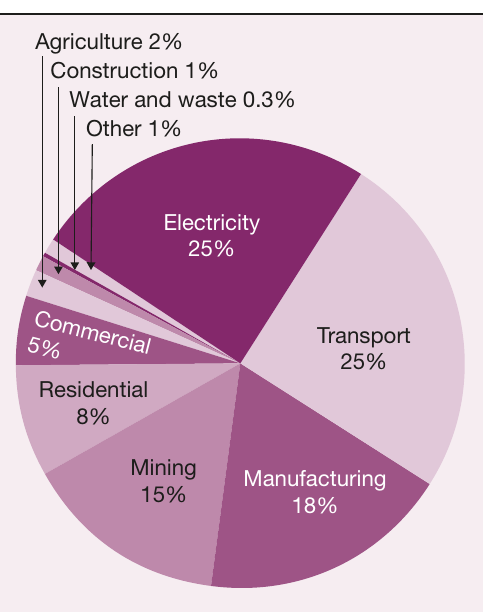
Australia's energy consumption by sector shows:
- Electricity and Transport are the largest contributors (25% each)
- Manufacturing accounts for 18%
- Mining uses 15%
- Residential consumption is 8%
- Commercial sector uses 5%
- Agriculture, construction, water/waste and other sectors make up the remainder
Climate change impacts
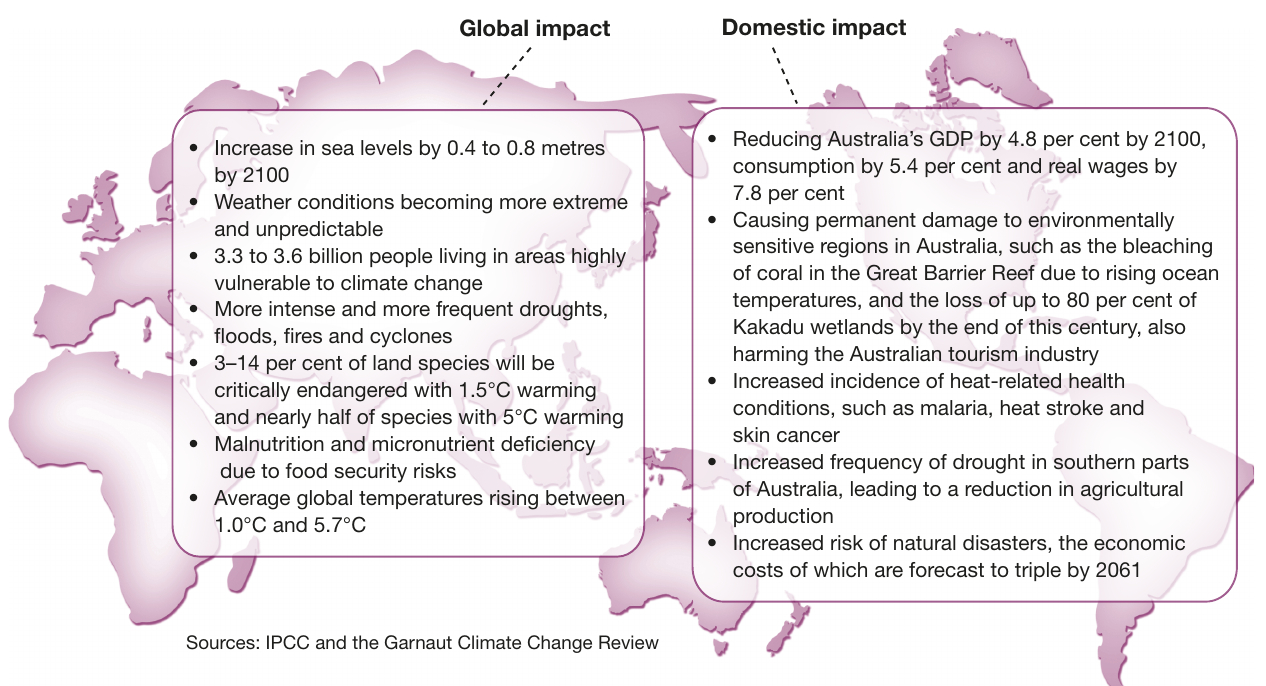
Important
Australia is particularly vulnerable to climate change effects because:
- It is already a hot, dry country
- Fossil fuels are important for energy production and exports
- Neighbouring countries (Indonesia, Bangladesh) will face temperature increases and rising sea levels
The Productivity Commission's 5 Year Productivity Inquiry (2023) noted that Australia's economy is highly exposed to climate change threats (more than any OECD country except Norway), yet Australia lags most OECD countries in transitioning to lower carbon emissions.
Why action is slow
Despite scientific evidence supporting emissions reductions, many nations (including Australia) have been slow to act because:
- Individual countries cannot slow climate change alone
- Measures to address climate change involve short-term costs
- Political and economic pressures delay action
Depletion of natural resources
The problem
Natural resource depletion is both an environmental and economic issue. Market mechanisms alone do not prevent resource overuse. Future generations bear the greatest impact.
Sustainable resource management ensures:
- The present generation does not overconsume renewable resources
- Non-renewable resource depletion is minimised
- Alternative resource uses become possible through new technology
Renewable vs non-renewable resources
Renewable resources can naturally regenerate or replace themselves in a relatively short time. However, they can be depleted to the point where they cannot regenerate and are lost forever.
Example
Example: Overfishing and Resource Depletion
Overfishing may reduce a fish species population below reproduction levels, causing extinction. This demonstrates how renewable resources can become permanently depleted if exploited beyond their regeneration capacity.
Non-renewable resources are in limited supply because they can only be replenished over a long period, or not at all. They include:
- Fossil fuels (petroleum, coal)
- Minerals (copper, iron ore)
Optimal rate of resource use
Economists estimate optimal rates for using resources over time.
For renewable resources:
Establishing an optimal rate means finding a threshold exploitation level that allows resources to regenerate without long-term decline. Examples of practices to prevent:
- Over-fishing
- Over-grazing
- Excessive farming
- Over-exploitation of timber
Note
The critical water shortages in many Australian regions (particularly areas relying on the Murray-Darling River System) reflect long-term overuse of fresh water as a renewable resource.
For non-renewable resources:
Calculating an optimal rate involves determining an acceptable decline rate for present and future generations. This process:
- Starts with eliminating overuse and waste
- May lead to recycling initiatives
- Could result in consumption restrictions
Challenges in calculation
Economists face two main challenges when calculating optimal use rates for non-renewable resources:
- Predicting future needs: Present generations find it hard to anticipate what future generations will require
- Assessing existing stocks: Evidence about remaining resource quantities may be limited or conflicting
Example
Example: The 1970s Oil Crisis Predictions
In the 1970s, experts argued the world's oil supply would be exhausted by the end of the twentieth century. This prediction proved incorrect, demonstrating the difficulty of accurately assessing resource stocks and future technological developments.
Case study: Australia's resource transition
Historical reliance
Throughout Australian history, the economy has depended heavily on natural resource exploitation. Abundant resources underpinned success as a primary commodity producer:
- 19th-20th centuries: Known as the "bread-basket" of the British Empire (wheat exports)
- Economy could "ride on the sheep's back" (wool exports)
- Mid-19th century gold rushes sparked economic development and population growth
Recent decades
Australia has relied on large concentrations of non-renewable mineral and energy resources, including:
- Major deposits: gold, coal, iron ore, copper, gas, oil
- World's largest reserves: zinc, lead, bauxite, nickel, uranium
Note
The global resources boom of the 2000s made mining more central to Australia's prosperity. Mineral and metal exports grew from less than one-third to over half of total export revenue. In 2022, mining and energy exports exceeded $300 billion (driven by Ukraine war price spikes).
Sustainability concerns
Important
Australia's economic reliance on primary commodity exports, especially non-renewable energy resources, is unsustainable long-term because:
- Global economies increasingly focus on renewable energy sources and technologies
- Diversification is needed for economic and environmental sustainability
The renewable energy transition
Australia is well-positioned to shift to renewable energy due to favourable conditions for solar and wind power.
Renewable electricity generation progress:
- 2001: 8% from renewable sources
- 2021: 29% from renewable sources
- Wind: 12%
- Solar: 10%
- Hydro: 6%
- Projected 2030: Up to 48% from renewable sources
Example
Example: Hunter Valley's Energy Transition
Hunter Valley's Liddell coal-fired power station closed in 2023. It previously provided up to 10% of NSW's electricity, demonstrating the practical reality of Australia's transition away from fossil fuels.
Political challenges
Energy and climate policies have been central to Australian political debate for many years. The public has oscillated between:
- Concerns about climate policy impacts on the economy (especially the energy and resources sector)
- Concerns about climate change impacts
Note
These debates contributed to the downfall of the past six Australian Prime Ministers since 2007. Energy and climate policy debates played a key role in the 2022 election, which brought the Albanese Government to power with commitments to accelerate Australia's transition to net-zero emissions and rapidly expand renewable energy.
Policymakers have wrestled with complex challenges:
- Energy supply security and reliability
- Short-term shortages
- Rising prices
- Carbon emissions intensity of electricity generation
Remember!
Summary
Key Points to Remember:
-
Four major environmental issues affect economic policy: preserving natural environments, pollution, climate change, and resource depletion
-
Environmental policies face trade-offs: Short-term economic costs (higher prices, reduced growth) must be balanced against long-term environmental benefits
-
Climate change requires urgent action: The IPCC confirms temperatures will exceed 1.5°C warming without large emission reductions; net zero CO₂ emissions are needed to stabilise temperatures
-
Resource sustainability is critical: Renewable resources need threshold exploitation levels for regeneration; non-renewable resources require optimal decline rates
-
Australia is transitioning: Moving from fossil fuel dependence toward renewable energy (targeting 48% renewable electricity by 2030), though political challenges remain