Market Failure: Private Benefits and Social Costs (HSC SSCE Economics): Revision Notes
📚Revision Notes
Market Failure: Private Benefits and Social Costs
Introduction to the price mechanism
In a modern market economy, the price mechanism acts as the primary decision-making tool for what gets produced, how much is produced, and at what price. This mechanism works through the interaction of supply and demand forces, which balance consumer preferences (shown by demand) against production costs (shown by supply). When these forces reach equilibrium, they determine both the market price and quantity of output.
The price mechanism responds to consumer demand in a straightforward way. When consumers want more of a good or service, and are willing to pay a price that covers production costs, producers will supply it. As demand increases, production follows suit. This system works efficiently for allocating many resources in the economy.
Important
The price mechanism has a critical weakness when it comes to environmental sustainability. It fails to effectively account for the long-term environmental consequences of economic activity. Resources like fish stocks may be harvested until depletion, forests logged until they disappear, and rivers and atmosphere polluted without the market responding appropriately.
This occurs because producers gain private benefits from activities that deplete resources or damage the environment, but they do not directly bear the social costs their actions create. Similarly, the market prices paid by consumers fail to reflect these broader social costs.
Understanding market failure
Important
Market failure occurs when the price mechanism only accounts for private benefits and costs experienced by individual consumers and producers, while ignoring the wider social costs and benefits that affect all of society. These additional costs and benefits that spill over to other members of society are called externalities.
Externalities come in two forms:
- Negative externalities impose costs on society
- Positive externalities provide benefits to society
Note
The fundamental problem is that the price mechanism treats environmental resources and social impacts as if they have no value when they are not bought and sold in markets. This creates a disconnect between market outcomes and socially desirable outcomes.
Negative externalities
What are negative externalities?
A negative externality is an adverse outcome of economic activity whose cost is not reflected in the operation of the price mechanism. Put simply, it is a cost that is imposed on society by production or consumption, but which neither the producer nor the consumer has to pay for directly.
Negative externalities typically refer to the harmful spillover effects that economic activity has on the environment. When a factory produces goods, it might also produce air pollution as a byproduct. The factory owners and their customers benefit from the production, but the pollution affects everyone in the surrounding area, not just those involved in the transaction.
Note
Goods and services that generate negative externalities are known as demerit goods. These are products whose full costs to society exceed the private costs paid by producers and consumers.
The tragedy of the commons
In economies based on private property ownership, a particular problem arises with environmental resources that have no clear ownership, such as oceans and the atmosphere. This lack of property rights is a major economic factor behind the market's failure to protect the environment.
Important
When no one owns a resource, the price mechanism cannot assign it a value or determine a price for its use. As a result, these resources are treated as if they are free and unlimited. This leads to their destruction through overuse, a phenomenon known as the tragedy of the commons.
Examples of the tragedy of the commons include:
- Overfishing of oceans and rivers
- Pollution of the atmosphere with greenhouse gases
- Contamination of waterways with industrial waste
Because these resources can be used without cost, individuals and businesses have no market-based incentive to preserve them, even though their depletion harms society as a whole.
Case study: Single-use plastic
Example
Case Study: Single-Use Plastic as a Negative Externality
Single-use plastic packaging provides a clear example of negative externalities in action. In OECD countries, each person produces an average of 238 kilograms of plastic waste annually. Businesses and consumers strongly favour single-use plastic because it offers convenience, flexibility, and low production costs.
However, after consumers finish using the plastic, it creates environmental problems that impose costs on society:
- It pollutes the environment as litter
- It accumulates in landfill sites, taking up to 500 years to decompose
- It enters waterways where marine life ingests it
- It transfers up the food chain to humans, causing health problems
The Key Problem: None of these environmental and health costs are borne directly by the businesses that supply the packaging or the individual consumers who use it. The costs fall on society as a whole, making this a classic negative externality. The market price of products with plastic packaging does not include the environmental damage and pollution costs, leading to overproduction and overconsumption of these items.
Economic analysis of negative externalities
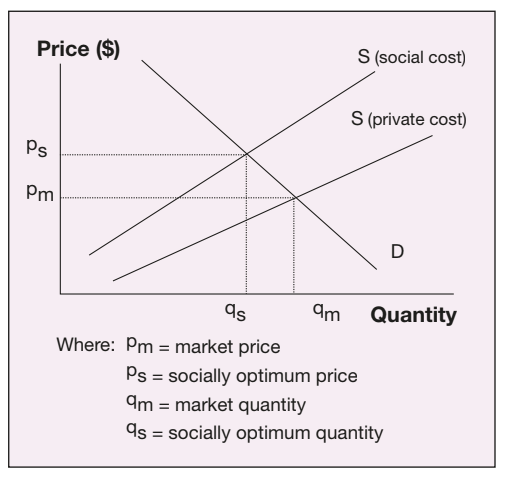
The economic impact of negative externalities can be illustrated using supply and demand analysis. In the diagram above, the private cost curve represents the costs actually borne by producers. However, when we add the costs imposed on society (the negative externality) to the private costs, we get a higher social cost curve.
Note
The vertical distance between the private cost curve and the social cost curve represents the size of the negative externality - that is, the cost imposed on society that is not reflected in the market price.
In a free market, only private costs and benefits are considered. This leads to:
- Market price:
- Market quantity:
However, if the full social costs were accounted for, we would see:
- Socially optimum price: (higher than market price)
- Socially optimum quantity: (lower than market quantity)
Important
Key Insight: Goods with negative externalities tend to be overproduced (). The market produces too much because it ignores the social costs. The difference between and represents the amount of overproduction caused by the market failure.
Positive externalities
What are positive externalities?
While externalities often have negative environmental impacts, not all externalities are harmful. A positive externality is a beneficial outcome of economic activity whose value is not reflected in the operation of the price mechanism. These are benefits that spill over to society beyond those enjoyed by the individual producer or consumer.
Although production rarely generates positive environmental outcomes directly, economic activities can create other beneficial spillover effects for society. Goods and services that generate positive externalities are known as merit goods - products whose full benefits to society exceed the private benefits enjoyed by individual consumers.
Examples of positive externalities
Example
Example: Public Transport Use
Consider the use of public transport. When an individual chooses to take a train or bus instead of driving, they benefit personally through reduced commuting costs. However, their decision also creates positive externalities for society:
- Reduced road congestion, making travel faster for everyone
- Lower carbon emissions, improving air quality and reducing climate change
- Less wear and tear on road infrastructure
Example: Energy-Efficient Appliances
When a household replaces an old, inefficient refrigerator with a new energy-efficient model, they benefit through lower electricity bills. But society also benefits through:
- Reduced overall energy consumption
- Lower greenhouse gas emissions from power generation
- Decreased pressure on electricity grid infrastructure
The Key Point: In both cases, the full social benefit exceeds the private benefit enjoyed by the individual consumer, yet the market price only reflects the private benefit.
Economic analysis of positive externalities
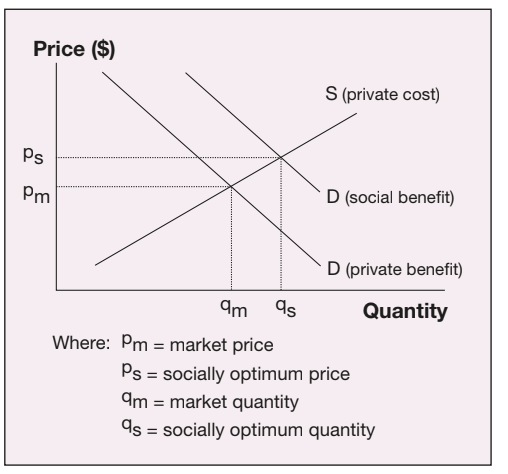
The economic impact of positive externalities can be illustrated using supply and demand analysis. In the diagram above, the private benefit curve represents the demand based on benefits enjoyed by individual consumers. However, when we add the benefits to society (the positive externality) to the private benefits, we get a higher social benefit curve.
Note
The vertical distance between the private benefit curve and the social benefit curve represents the size of the positive externality - that is, the additional benefit to society not captured in the market price.
In a free market, only private costs and benefits are considered. This leads to:
- Market price:
- Market quantity:
However, if the full social benefits were accounted for, we would see:
- Socially optimum price: (higher than market price)
- Socially optimum quantity: (higher than market quantity)
Important
Key Insight: Goods with positive externalities tend to be underproduced (). The market produces too little because it ignores the social benefits. The difference between and represents the amount of underproduction caused by the market failure.
The limited protective role of the price mechanism
While the price mechanism fails to protect environmental resources that can be used for free (like the atmosphere for disposing of gases), it does play a limited role in protecting resources that are bought and sold in markets.
When environmental resources that have a price become scarce, their cost increases, which naturally reduces consumption. For example, if large numbers of trees are cut down and sold as timber, the remaining supply becomes harder to access and more expensive to harvest. Prices rise in response, which:
- Reduces the number of consumers who can afford the product
- Encourages producers to seek alternative materials
- Stimulates development of substitute products
Note
Important Limitations:
This protective mechanism has significant limitations. It only works for resources that are actually traded in markets (like fish and timber), and it cannot protect resources that can be used for free (like clean air or ocean health).
Furthermore, the price increase may occur too late or be too small to prevent serious environmental damage. By the time prices signal scarcity, irreversible harm may already have occurred.
Remember!
Summary
Key Concepts:
- Market failure occurs when the price mechanism ignores social costs and benefits, accounting only for private costs and benefits
- Negative externalities are harmful spillover effects not reflected in market prices (e.g., pollution, resource depletion)
- Positive externalities are beneficial spillover effects not reflected in market prices (e.g., reduced congestion from public transport use)
- The tragedy of the commons describes how resources without property rights (oceans, atmosphere) are overused and depleted
Critical Outcomes:
- Goods with negative externalities (demerit goods) are overproduced: market quantity exceeds socially optimum quantity
- Goods with positive externalities (merit goods) are underproduced: market quantity falls short of socially optimum quantity
- Social costs = private costs + negative externality
- Social benefits = private benefits + positive externality
For Exams:
- Be able to draw and explain supply-demand diagrams showing externalities
- Understand why in both cases but for negative externalities and for positive externalities
- Be ready to provide real-world examples of both types of externalities
- Explain why market failure leads to inefficient resource allocation and environmental problems