Australia's Foreign Liabilities (HSC SSCE Economics): Revision Notes
📚Revision Notes
Australia's Foreign Liabilities
What are net foreign liabilities?
Net foreign liabilities represent Australia's total financial obligations to the rest of the world. They are a long-term consequence of running persistent current account deficits, as Australia must finance these deficits by borrowing from overseas or selling assets to foreign investors.
Net foreign liabilities can be calculated as:
These liabilities consist of two main components:
Net foreign debt
Net foreign debt (also called net external debt) is the total stock of loans owed by Australians to foreigners, minus the total stock of loans owed by foreigners to Australians. When Australia borrows from overseas, this directly increases the net foreign debt.
Important
Key characteristics of foreign debt:
- The borrowed sum must eventually be repaid
- Regular interest payments must be made regardless of economic conditions
- Interest payments are recorded as debits on the primary income account
- These servicing costs contribute to future current account deficits
- Debt servicing costs are mandatory and predictable
Net foreign equity
Net foreign equity represents the total value of Australian assets (such as land, shares, and companies) owned by foreigners, minus the total value of overseas assets owned by Australians.
Key characteristics of foreign equity:
- Does not need to be "repaid" unless the asset is sold back to Australians
- Generates returns in the form of company profits, rent, and dividends
- These returns are only paid when the investment is profitable
- Returns on equity are recorded as debits on the primary income account
- Equity servicing costs are variable and depend on profitability
- In recent years, equity servicing costs have exceeded interest payments on debt
Note
The crucial difference is that equity investors only receive returns when Australian businesses or assets generate profits, whereas debt obligations must be serviced even during economic downturns. This makes equity financing more flexible than debt financing, though both create ongoing obligations on the primary income account.
Historical trends in Australia's foreign liabilities
Australia's net foreign liabilities have grown substantially since the 1980s, reflecting the country's increasing integration with the global economy.
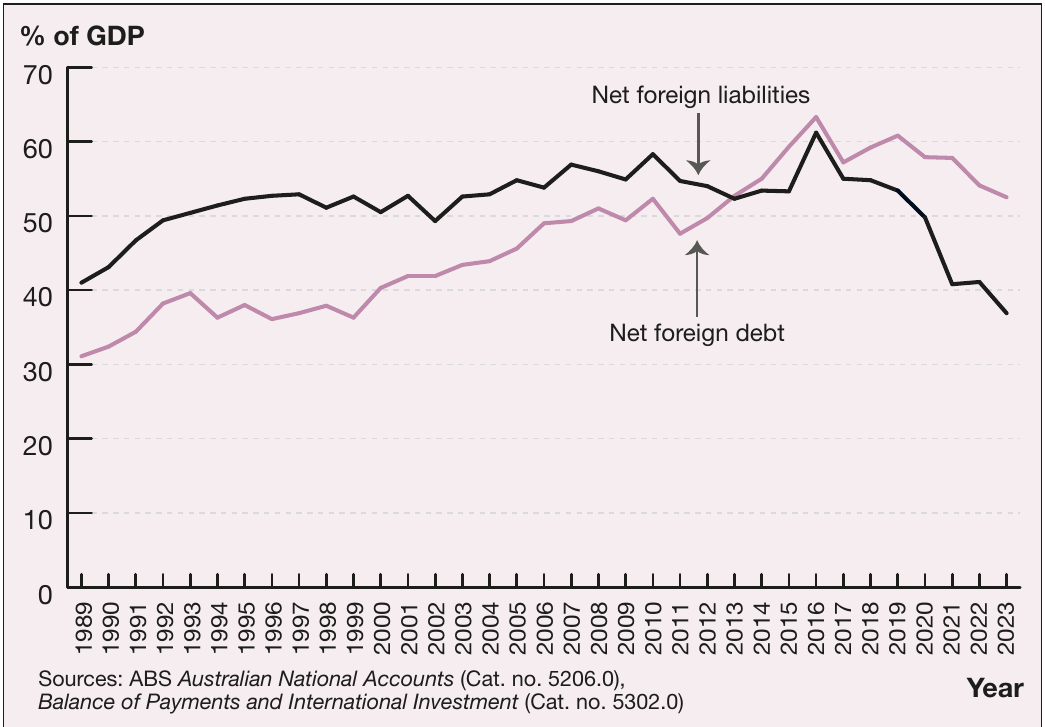
Key trends:
- In 1980-81, net foreign liabilities were $33.4 billion (22.3% of GDP)
- By 2022-23, they had grown to $822.2 billion (36.9% of GDP)
- The ratio peaked at around 60% of GDP in the late 2010s
- Recent years have seen a decline in the ratio, partly due to exchange rate movements and strong export performance
Note
Understanding the fluctuations:
Short-term fluctuations in net foreign liabilities can occur due to:
- Movements in the Australian dollar exchange rate
- Changes in foreign investment flows
- Shifts in the market valuation of assets
- Changes in investor sentiment
For example, exchange rate movements contributed to an increase in net foreign debt in 2018-19, followed by a fall in 2019-20. By 2022-23, Australia's net foreign debt stood at approximately $1.2 trillion, or 52.5% of GDP.
Debt sustainability and the debt trap scenario
While Australia has managed its foreign liabilities relatively well, there are potential long-term concerns if debt grows faster than GDP.
The debt trap scenario
Important
A debt trap occurs when high foreign debt creates a vicious cycle:
- Australia runs a high current account deficit
- This requires an inflow of foreign funds (debt or equity)
- Higher foreign debt means larger interest payments
- Interest payments are recorded as primary income debits
- This increases the current account deficit
- The cycle repeats, with debt growing faster than the economy
Potential consequences:
- Interest payments progressively consume a greater proportion of GDP
- Reduced standard of living as more income flows overseas
- Lower economic growth potential
- Risk of credit rating downgrades
- Higher borrowing costs and difficulty accessing international finance
However, Australia has avoided this scenario due to sustained low global interest rates and strong export revenue, which have ensured the country can service its foreign liabilities.
Debt servicing ratio
The debt servicing ratio is one of the most reliable measures of a country's capacity to manage its foreign debt. It indicates the proportion of export revenue that must be spent on interest payments on foreign debt.
Note
Why export revenue matters:
A country with a high volume of exports earns substantial foreign currency, making it easier to service foreign debt. Australia's export performance is therefore crucial to debt sustainability.
Recent trends:
- The debt servicing ratio peaked at just over 20% in 1990
- It fell to a low of 2.9% in 2021-22
- It rose to 4.8% in 2022-23, reflecting rising global interest rates
- The impact of higher interest rates has been offset by very strong export growth
This relatively low debt servicing ratio indicates that Australia has maintained a strong capacity to service its foreign debt, despite the high absolute level of foreign liabilities.
Sources of foreign investment
Understanding where foreign investment flows helps explain the composition of Australia's foreign liabilities.
Private sector investment
Historically, most foreign investment (both debt and equity) has flowed into the private sector. A significant component was offshore funding of the banking sector:
- Australian banks borrowed on overseas financial markets
- These funds were used to make loans to Australian households and businesses
- After the global financial crisis, banks reduced reliance on offshore funding
- This shift occurred due to increased domestic savings in Australia
Government sector investment
In recent years, a larger share of capital flows has gone into government securities:
- Foreign investors purchase Australian Government debt
- Australia holds a AAA credit rating (one of few countries)
- This high rating represents very low risk for investors
- In 2022, foreign investors held 45% of Commonwealth Government Securities
Note
The AAA credit rating reflects international confidence in Australia's ability to meet its debt obligations. This makes Australian government bonds attractive to overseas investors seeking safe investments.
Gross versus net foreign liabilities
While net foreign liabilities provide important information, they mask significant growth in both Australia's foreign assets and liabilities.
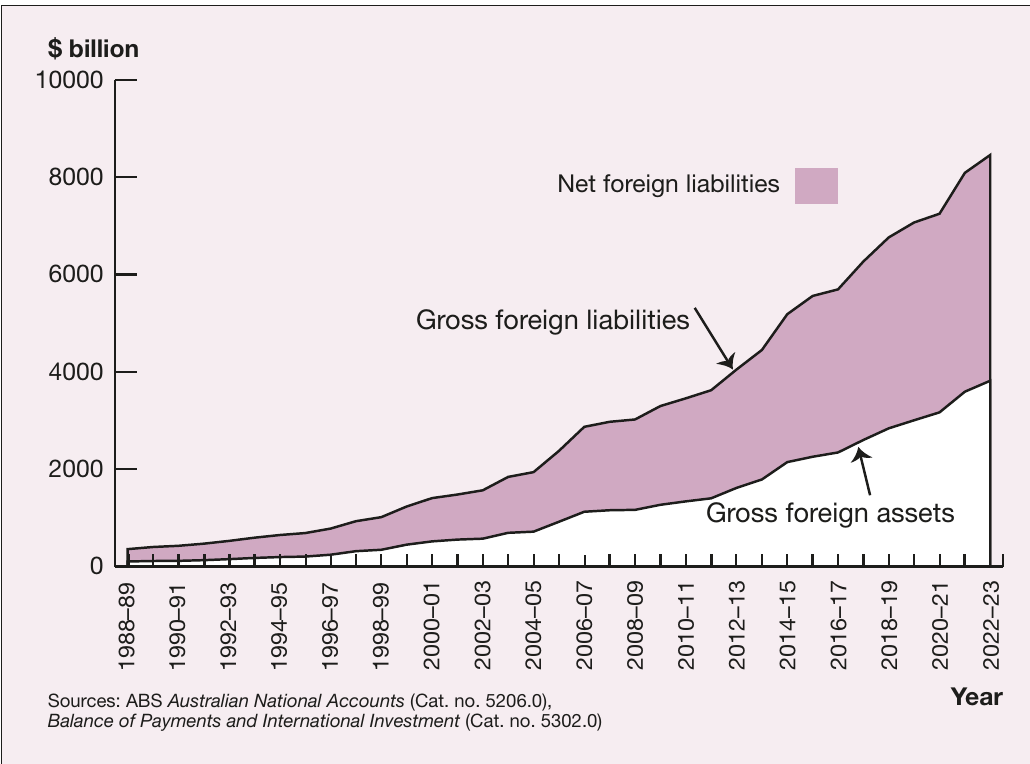
Australia's international investment position
Between 2000-01 and 2022-23, substantial growth occurred in both directions:
Australian investments overseas (foreign assets):
- Equity ownership increased from $0.3 trillion to $2.1 trillion
- Loans to overseas borrowers grew from $0.2 trillion to $1.7 trillion
Foreign investments in Australia (foreign liabilities):
- Foreign-owned equity rose from $0.4 trillion to $1.8 trillion
- Gross foreign debt increased from $0.5 trillion to $2.8 trillion
Note
Key observations:
- Australia's gross foreign debt significantly exceeds Australian lending overseas
- The gap between foreign equity inflows and outflows is much smaller
- Overall, foreigners invest more in Australia than Australia invests overseas
- This reflects Australia's integration into the global economy
Net foreign equity trends
Net foreign equity is the smaller component of Australia's foreign liabilities and shows different patterns to debt:
- Net foreign equity peaked in the 1990s as a percentage of GDP
- Since 2013, Australia's foreign assets exceeded foreign ownership of Australian assets
- This resulted in negative net foreign equity
- The trend reflects increased Australian ownership of foreign assets
Net foreign equity is more volatile than net foreign debt because it is affected by:
- Exchange rate movements
- Changes in market valuation of companies and assets
- Shifts in investor sentiment
- Stock market performance
Potential concerns and vulnerabilities
Australia's relatively high foreign liabilities create some potential vulnerabilities, though these have rarely materialized as serious problems in recent decades.
Comparison with other economies
Among advanced economies, Australia has relatively high foreign liabilities. This makes Australia potentially more vulnerable to adverse global economic developments.
The 2008 global financial crisis example
Example
Example: The Global Financial Crisis and Foreign Capital Dependence
During the global financial crisis, Australia's reliance on foreign capital created significant challenges:
- The Australian financial system depended on ongoing foreign capital inflows
- International credit markets effectively froze
- Banks could not obtain overseas loans under normal conditions
- The Government provided a temporary guarantee for all overseas loans of banks and financial institutions
- Without this guarantee, the financial system could have faced a major crisis
This episode demonstrates how countries with higher external imbalances are more vulnerable to sudden changes in global financial conditions.
Future sustainability
Whether recent improvements in the current account balance prove sustainable depends on external factors:
- Continuation of favourable global economic conditions
- Sustained demand for Australian exports
- Maintenance of Australia's credit rating
- Stability in global financial markets
If global conditions become less favourable, Australia could face renewed challenges in managing its foreign liabilities. However, strong export performance and low debt servicing costs provide some protection against potential problems.
Summary
Remember:
- Net foreign liabilities equal net foreign debt plus net foreign equity—they represent Australia's total financial obligations to the rest of the world
- Foreign debt must be repaid with regular interest payments regardless of economic conditions, while equity only generates returns when investments are profitable
- Australia's net foreign liabilities have grown significantly since the 1980s, reaching $822.2 billion (36.9% of GDP) in 2022-23
- The debt servicing ratio (proportion of export revenue spent on interest payments) is a key measure of debt sustainability and stands at 4.8% in 2022-23
- Australia has avoided a debt trap scenario due to low interest rates and strong export growth, but remains vulnerable to adverse global economic developments