Environmental Management Policies (HSC SSCE Economics): Revision Notes
📚Revision Notes
Environmental Management Policies
Introduction
Environmental management policies aim to address issues of environmental sustainability. These policies focus on:
- Preserving natural environments
- Managing pollution and climate change
- Controlling the use of renewable and non-renewable resources
Like microeconomic policies, environmental policies influence the long-term behaviour of households, businesses and industries. Policymakers use two main tools: regulations and market-based policies. Research bodies and government targets guide environmental management, and international agreements between nations shape policy direction.
Note
The two fundamental approaches to environmental management—regulations and market-based policies—can be used independently or together to achieve sustainability goals. Understanding when and how to use each tool is essential for effective environmental policy.
Government targets
The Australian Government uses targets to guide its environmental policies. The most significant targets relate to reducing carbon emissions.
In 2022, the Albanese Government legislated two key emissions targets under the Climate Change Act 2022:
- 2030 target: 43% reduction in emissions compared to 2005 levels (this is a minimum target)
- 2050 target: Net zero emissions
Important
Net zero emissions means reducing greenhouse gas emissions so that the amount of greenhouse gases the economy produces equals the amount it removes. These targets are now enshrined in law, providing certainty for long-term planning and investment decisions.
The Climate Change Authority, an independent government agency, provides advice on setting future targets. In 2023, the Government established the Net Zero Authority to support the energy transition needed to achieve the 2050 target.
Regulations
What are regulations?
Regulations are laws or rules that govern economic behaviour. In environmental policy, regulations can:
- Prohibit actions that cause environmental damage (such as illegal waste dumping or producing polluting chemicals)
- Specify how goods or services must be produced or consumed (such as agricultural or mining techniques)
In Australia, environmental regulations can be made by local, state or federal governments, or by their agencies.
Quality standards
Some regulations require that goods meet environmental standards. For example:
Fuel Quality Standards Act 2000: This legislation regulates fuel quality in Australia. Its aim is to reduce pollutants and emissions from fuels that may cause environmental and health problems.
Environmental procedures
Regulations can require firms and individuals to follow certain environmental procedures.
Note
Environment Protection and Biodiversity Conservation (EPBC) Act: This Act provides a framework for protecting and managing matters of national environmental significance, including:
- World and National Heritage sites
- Commonwealth marine areas
- Nationally threatened species and ecological communities
- Migratory species
States and territories have responsibility for all other matters of state and local significance.
In response to the 2021 State of the Environment Report, which found significant deterioration in Australia's flora and fauna, the Australian Government is establishing a new national Environmental Protection Agency to strengthen monitoring and compliance with environmental regulations.
Broader regulatory frameworks
Broader regulatory frameworks can also relate to environmental issues. For example, the Australian Competition and Consumer Commission published a 2023 report, Greenwashing by Businesses in Australia. This raised concerns about claims businesses make regarding the environmental impact of their products and services. Of 247 businesses examined, 57% made claims that "raised concerns", including vague statements lacking evidence or confusing use of third-party symbols.
Case study: The Great Barrier Reef
The Great Barrier Reef is the world's largest living structure, covering 344,400 km² with 3000 coral reefs, 1625 fish species, 133 shark and ray species, over 200 bird species and 600 coral types. As the world's largest coral reef ecosystem, it became a UNESCO World Heritage site in 1981. The reef attracts over 2 million visitors annually, contributing approximately $6.4 billion to the economy.
Environmental challenges: The reef is suffering from climate change effects. Changes in ocean temperatures threaten the delicate ecosystem. The latest Great Barrier Reef Outlook Report downgraded the reef's condition from "poor" to "very poor". Recent surveys indicate around two-thirds of the reef has suffered coral bleaching.
Important
Policy response: In response to World Heritage Centre recommendations, the Queensland and Commonwealth Governments committed to a 2050 Long-Term Sustainability Plan with $140 million in funding. This demonstrates how regulations can be combined with significant financial investment to protect critical ecosystems.
Key policy priorities include:
- Ecosystem health and biodiversity
- Water quality improvements
- Community and economic benefits
- Governance
Key policy elements include:
- Establishing the $40 million Great Barrier Reef Trust
- Banning disposal of dredging material within the Marine Park
- Additional protections for turtles and dugongs through anti-poaching laws
- Reversing water quality decline associated with agriculture ($35 million ongoing funding plus $100 million over five years)
- Reducing crown-of-thorns starfish presence to support coral populations
In 2022, the Albanese Government increased funding for the Reef 2050 Plan. Overall, federal and Queensland Governments are jointly investing $2 billion to protect the reef.
Market-based policies
Understanding market failure and externalities
Many environmental problems arise because of market failure. Environmental costs (or benefits), known as externalities, are borne by all of society but are not taken into account by producers and consumers in the marketplace.
Important
In the case of negative externalities, this results in:
- Equilibrium price being too low
- Production being too high
This means the market produces more pollution than is socially optimal because producers don't pay the full cost of their environmental damage.
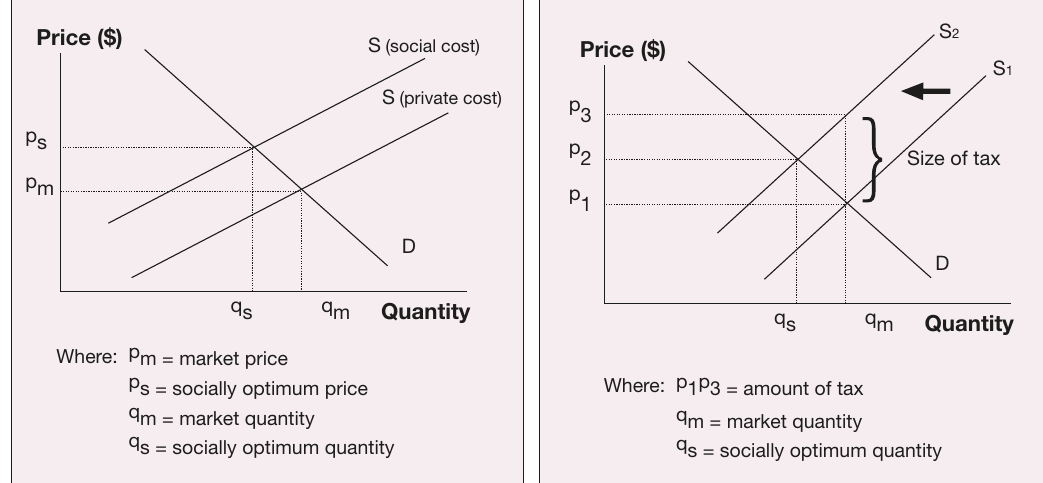
The following diagrams illustrate this problem and its solution:
Example
Understanding the Externality Problem
The left diagram shows how the market equilibrium (where private costs equal demand) differs from the socially optimum equilibrium (where social costs equal demand). The social cost curve lies above the private cost curve because it includes environmental costs.
The right diagram shows how a tax can correct this market failure. By levying a tax equal to the environmental cost, the supply curve shifts left from to . This increases the market price and reduces the quantity consumed, moving the market towards the socially optimum outcome.
Taxes and levies
A market-based response to negative externalities is to levy a tax or fee on production approximately equal to the environmental costs. This is sometimes called "internalising the externality" because it makes consumers and producers pay for environmental costs.
Governments generally prefer taxes over subsidies when influencing economic behaviour because taxes:
- Discourage environmentally damaging activities
- Raise government revenue for other environmental programs
- Send price signals to guide behaviour
Note
Example - Product Stewardship for Oil Program: The Government imposes an 8.5 cents per litre levy on oil purchases to help fund recycling of old oil.
Environmental tax revenues vary between countries. In OECD countries, they range from less than 3% of total tax revenue in the United States to more than 11% in India. Australia's environmental tax revenues are around 5% of the total tax base.
Subsidies
Subsidies are grants provided by government to producers with the aim of reducing production costs and promoting environmentally beneficial activities.
Note
Example - Australian Renewable Energy Agency (ARENA): ARENA provides funding for research and development, as well as large-scale renewable energy projects. This demonstrates how subsidies can accelerate the transition to cleaner energy sources.
Market development
Over time, policy has shifted towards facilitating market development and supporting private sector investment rather than direct government intervention.
Example - Nature Repair Market Bill 2023: This Bill sets out a framework for a voluntary national nature repair market, which would issue tradeable certificates for projects that restore and protect nature. This rewards landowners for supporting biodiversity and enables businesses to invest in nature repair.
Water management
Water management is a contested area of environmental policy that has adopted market-based reforms. A recent Productivity Commission review found that governments' water management efforts had been successful in:
- Lowering household water use
- Increasing water allocations to the environment
- Making industry water use more efficient
The review created clear property rights for water, established water markets and improved water planning. However, it also found that existing efforts were insufficient to meet future challenges associated with population growth and climate change. It recommended changes including water recycling and use of stormwater.
Note
Water policy issues are increasingly linked to international climate change agendas. In 2023, the UN held its first international water conference in 46 years to grow commitments for improved management of water resources globally.
Case study: Murray-Darling Basin
Australia's Murray-Darling Basin is one of the world's largest river systems. It covers 14% of the country, spanning from Queensland through NSW and Victoria to South Australia. It provides water for two million residents, industry and agriculture. For decades, the government has faced challenges managing the basin due to competing economic, social and environmental interests, and recurring water shortages.
The problem: By the early 21st century, conflicts between water users were damaging the basin's health, and insufficient water was reaching downstream users.
Example
Policy Response: Murray-Darling Basin Plan
The Murray-Darling Basin Authority was formed in 2007. In 2010, it released the Murray-Darling Basin Plan, aiming to return up to 4000 gigalitres of water to the basin to improve the river system's health. The plan was controversial, with claims it could reduce agricultural production, increase unemployment, and threaten town viability.
Current approach: In August 2023, the Australian Government announced a new plan to balance environmental needs with different water users' interests. It proposed resuming buying back water licences, a market scheme where water users (such as farmers) can voluntarily sell their licences to the government. Instead of drawing water from the basin, the government 'uses' these licences to 'return' water to the environment, effectively reducing the amount of water that can be drawn to a more sustainable level.
Queensland, NSW and South Australia signed the new plan. Victoria delayed signing due to concerns about social and economic impacts on agricultural communities.
Climate change policies
The scale of the challenge
"Decarbonising" economies (reducing carbon emissions from economic activity) is widely regarded by economists as the greatest economic reform challenge of the 2020s. Climate change poses profound threats to:
- The global economy
- The stability of international relations
- The environment
Important
The Reserve Bank noted in 2019 that climate change threatens disruption to economic output through extreme weather events, as well as higher insurance costs, legal risks and falling asset values. A 2023 IMF analysis found that climate-induced natural disasters increase volatility, particularly inflation shocks, that can harm all sectors of the economy.
Scientists are recording growing evidence of rising sea levels, more intense droughts and floods, and more extreme and unpredictable weather events. Despite widespread agreement on the seriousness of climate change threats, it has been very difficult for governments worldwide to agree on how to respond and who should bear the costs.
International agreements
The Kyoto Protocol (1997): This was the first international agreement requiring industrialised countries to set internationally binding emission reduction targets. 160 nations reached this agreement limiting emissions of carbon dioxide and other greenhouse gases.
The Paris Agreement (2015): Representatives from nearly 200 countries committed to keeping "the increase in global average temperature to well below 2 degrees Celsius above pre-industrial levels". This is the benchmark scientists believe is necessary to prevent the most dangerous impacts of climate change.
Note
The Agreement reflected the difficulty of achieving compromise between high-income and developing countries. High-income countries have large per capita greenhouse gas emissions, whereas developing countries have lower but rising emission levels and rely on cheap fossil fuels to expand output and improve living standards.
The Paris Agreement is significant because, for the first time, it included developing nations such as China and India alongside the United States. It has mechanisms for transparency and monitoring progress, but its weakness is that individual countries set their own targets for emissions reduction. The Agreement came into force in November 2016 and has 193 signatories.
Australia's emission reduction targets
Australia has negotiated lower targets for emission reductions than most other advanced economies, arguing that reliance on emissions-intensive industry and fossil fuels for energy makes it more expensive to achieve 'emissions abatement'. Over time, this has resulted in growing global criticism of Australia's efforts to address climate change.
Australia's emission reduction targets centre on three key dates:
Note
2020 target: Australia adopted a target of reducing carbon emissions by 5% on 2000 levels. Critics argued this was too low. While Australia met the target, it was only possible due to temporary factors including slower growth than anticipated, the way emissions relating to land usage were calculated, and the success of the Renewable Energy Target (which expired in 2020).
2030 target: This was a major issue in the 2022 Federal election. The Coalition parties committed to a 26–28% reduction by 2030 on 2005 levels, while Labor promised to increase this to 43%. Labor won the election and the 43% target was passed into law in the Climate Change Act 2022. The law specifies that 43% is a minimum target, that climate policies should benefit regional communities, and that advice must be sought from the Climate Change Authority before setting future targets.
2050 target: Australia has committed to achieving "net zero" emissions by 2050. This requires reducing greenhouse gas emissions so that the amount the economy produces equals the amount removed.
Market-based policies for climate change
Individual governments have implemented various market-based policies to meet emissions reduction targets.
Carbon pricing scheme (2012-2014): The Gillard Government's carbon pricing scheme put a price on each tonne of carbon dioxide emitted as part of energy or industrial production processes. This gave Australia's 500 largest polluters a financial incentive to switch to lower-emissions processes. The carbon price was initially fixed and was due to be replaced by a "cap and trade" emissions trading scheme. In 2014, the Abbott Government abolished this scheme, arguing it was adding to business and household costs and damaging economic growth.
Note
Emissions trading schemes (ETS): Under an ETS, businesses are issued permits, or need to buy permits, for greenhouse gas emissions. Such schemes can be "internationally linked", meaning businesses with excess emissions may buy permits internationally from businesses that produce fewer emissions. This system effectively puts a price on greenhouse gas emissions and incorporates the real cost of carbon emissions into the price mechanism. It creates market-based incentives for businesses to develop new technologies and processes to reduce emissions.
Important
Critics argue that acting ahead of other economies creates the risk of "carbon leakage" – where emissions-intensive industries simply move to countries with no emissions target, increasing domestic unemployment but with no overall reduction in emissions. Emissions trading is used across the world, including in the EU, China and New Zealand.
Emissions Reduction Fund: Under the previous Coalition Government, this was the centrepiece of emissions reduction policy. Firms were paid to reduce emissions from their production processes, at the lowest cost of abatement. The lowest-price emissions were purchased by the government via an auction where firms bid to sell their emissions reduction projects. After 15 rounds of auctions, the Fund had purchased 217 million tonnes of CO₂ abatement. Uptake declined over time as low-cost abatement opportunities were exhausted.
Safeguard mechanism: This is a baseline level of emissions that top polluters cannot exceed or must account for. This baseline and credit scheme is a market mechanism but not an emissions trading scheme. In 2023, the Albanese Government reformed the safeguard mechanism to improve its effectiveness. From July 2023, top polluters across mining, manufacturing, transport, oil, gas and waste are required to gradually reduce emissions in line with Australia's emissions reduction targets. Firms must reduce their absolute emissions in line with a maximum annual cap that will decline over time.
Regulatory approaches to climate change
Regulations ensure that newly produced goods meet environmental standards consistent with Australia's emission reduction aims.
Examples include:
- 2007: Australia banned older-style incandescent light bulbs, replacing them with more energy-efficient fluorescent and LED bulbs
- 2010: Planning laws in several states changed to require newly constructed homes to comply with six-star energy ratings involving improved insulation, water recycling and other features
- Government policy decisions around agriculture, mining and transport also have major effects on carbon emissions
Note
As part of broader climate change policies, the Albanese Government has committed to applying new standardised reporting requirements for climate risks and opportunities for large businesses.
State Governments are also taking action. For example, the NSW Environmental Protection Agency released its first climate change policy and action plan, signalling stronger regulatory action to facilitate the state government's 2050 net zero commitment.
International agreements
The need for international cooperation
For environmental management policies to be successful, they often require international cooperation. Collective action is necessary because:
- Individual nations cannot successfully address global environmental problems on their own
- Nations are reluctant to impose strict environmental management policies if other nations are not willing to do the same
The Montreal Protocol: A success story
The depletion of the ozone layer (the atmospheric layer that filters out dangerous ultraviolet radiation) is related to emission of chlorofluorocarbons into the atmosphere from industry refrigeration units and aerosols.
Example
The Montreal Protocol Success Story
To reduce this problem, the Montreal Protocol committed members to phasing out production of ozone-depleting products by 2000. According to the United Nations Development Programme, over 98% of ozone-depleting substances were eliminated between 1987 and 2014. Scientists predict that the ozone layer should recover to pre-1980 levels between 2050 and 2065.
This demonstrates that international environmental agreements can achieve remarkable results when there is global commitment and clear targets.
The tragedy of the commons
A number of other international environmental agreements are in force. In many cases, international agreements are required to prevent the overuse of common international resources. This issue is known as the "tragedy of the commons".
For example, the United Nations Fish Stocks Agreement (to which Australia is a signatory) was developed to ensure long-term conservation and sustainable use of highly migratory fish stocks.
Marine protection
In 2023, an international agreement was reached for a new treaty to protect seas and oceans outside country boundaries, which cover 60% of the earth's surface. This agreement was supported by Australia and will establish Marine Protected Areas (MPAs) and processes for environmental impact assessments.
Australia's participation in international treaties
Note
Australia has been a signatory to numerous international environmental treaties covering:
- Endangered species protection (CITES Convention, 1976)
- Ozone layer protection (Vienna Convention 1987, Montreal Protocol 1989)
- Biodiversity (Convention on Biological Diversity, 1993)
- Land degradation (Convention to Combat Desertification, 2000)
- Organic pollutants (Stockholm Convention, 2004)
- Climate change (Kyoto Protocol 2008, Paris Agreement 2016)
These treaties demonstrate Australia's long-term commitment to international environmental cooperation spanning four decades.
Remember!
Summary
Key points:
- Environmental management policies use two main tools: regulations (laws governing behaviour) and market-based policies (financial incentives)
- Australia's climate targets are 43% emission reduction by 2030 and net zero by 2050
- Negative externalities occur when environmental costs are not reflected in market prices, leading to overproduction. Taxes can correct this by "internalising the externality"
- Climate change is the greatest economic reform challenge of the 2020s, requiring both domestic policy action and international cooperation
- International agreements like the Montreal Protocol (ozone layer) and Paris Agreement (climate change) are essential for addressing global environmental problems
Key terms:
- Externalities: Environmental costs or benefits borne by society but not accounted for by producers/consumers
- Net zero emissions: Reducing greenhouse gases produced to equal the amount removed
- Carbon leakage: When emissions-intensive industries move to countries with no emissions targets
- Tragedy of the commons: Overuse of shared international resources
- Emissions abatement: Reducing the amount of greenhouse gases emitted
Critical policy instruments:
- Emissions trading schemes (ETS) create markets for pollution permits
- Carbon pricing makes polluters pay for environmental damage
- The safeguard mechanism requires top polluters to reduce absolute emissions over time
- Water markets allocate scarce water resources efficiently between competing uses