Comparative Advantage and Gains from Trade (HSC SSCE Economics): Revision Notes
📚Revision Notes
Comparative Advantage and Gains from Trade
Introduction to trade theory
Trade theory has long been central to economic debate, particularly regarding whether countries benefit more from free trade or protectionist policies. The COVID-19 pandemic intensified these debates as many countries adopted protectionist measures seeking self-sufficiency. However, the fundamental economic arguments for free trade remain rooted in theories developed centuries ago.
Modern trade theory originated with Scottish economist Adam Smith, widely regarded as the founder of modern economics. In his 1776 work The Wealth of Nations, Smith challenged the prevailing economic doctrine of mercantilism, which advocated for heavy protectionist measures to maximize exports and minimize imports, thereby accumulating wealth in the form of gold and silver.
Note
Mercantilism was the dominant economic philosophy before Adam Smith. It held that national wealth was measured by accumulation of precious metals, leading countries to pursue policies that restricted imports and promoted exports. Smith argued this approach was fundamentally flawed.
Smith argued this approach was flawed because the influx of precious metals could cause inflation if not matched by increased production of goods and services.
Absolute advantage
Adam Smith proposed an alternative approach based on the principle of absolute advantage. This theory suggests that countries should remove trade barriers and specialize in producing goods they can make most efficiently, while importing goods that other countries produce more efficiently.
Important
Absolute Advantage Definition
An economy has an absolute advantage if it can produce a greater quantity of a product with a given level of resources than another economy is able to.
By removing protection and allowing specialization, Smith argued that consumers would gain access to more goods and services at lower prices, thereby improving living standards.
Smith captured this principle clearly: "If a foreign country can supply us with a commodity cheaper than we ourselves can make it, better buy it of them with some part of the produce of our own industry, employed in a way in which we have some advantage."
Note
The Limitation of Absolute Advantage
Absolute advantage has a significant weakness: it suggests that countries unable to produce any product with an absolute advantage—perhaps due to less skilled workers or inferior production techniques—have no basis for participating in international trade. This limitation led economists to develop a more comprehensive theory.
Comparative advantage
David Ricardo, another British economist writing nearly half a century after Smith, developed the theory of comparative advantage. This theory resolved the limitations of absolute advantage and provides the strongest economic argument for free trade.
Important
Comparative Advantage Definition
Comparative advantage states that an economy should specialize in producing goods and services it can make at a lower opportunity cost, even if it cannot produce a greater absolute quantity than another economy.
The key difference from absolute advantage is that comparative advantage focuses on relative efficiency rather than absolute efficiency. This is a crucial distinction that transforms trade theory.
Under this theory, when an economy specializes in products where it has a comparative advantage, it can trade with other economies, using export income to purchase imports of products where it lacks comparative advantage. Importantly, this means every economy can benefit from trade, regardless of its absolute productivity levels.
Calculating comparative advantage
To understand how comparative advantage works, we can use a simplified model with specific assumptions. Consider two economies, Australia and France, which each produce two products: grapes and cheese. We assume both products are identical in quality, both economies have the same resource endowment, and each uses different production techniques leading to different output levels.
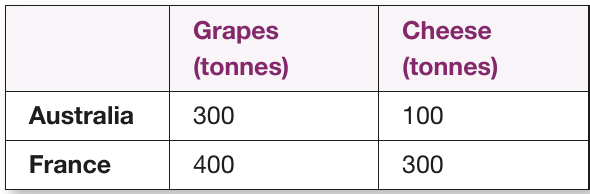
In this example, France can produce either 400 tonnes of grapes or 300 tonnes of cheese with its resources. Australia can produce either 300 tonnes of grapes or 100 tonnes of cheese. France clearly has the absolute advantage in producing both goods since it can make more of each product than Australia with the same resources. Under absolute advantage theory alone, there would be no basis for trade between these countries.
However, to determine comparative advantage, we must calculate opportunity costs within each economy. The opportunity cost represents what must be given up to produce one more unit of a good.
Finding comparative advantage in grapes
To determine which country has a comparative advantage in grape production, we calculate the opportunity cost of producing grapes in each economy.
For Australia, the opportunity cost of producing grapes is calculated using the formula:
Example
Worked Example: Australia's Opportunity Cost for Grapes
Using the production data where Australia can produce 300 tonnes of grapes OR 100 tonnes of cheese:
Result: For Australia to produce one additional tonne of grapes, it must give up production of one-third of a tonne of cheese.
For France, we perform the same calculation:
Example
Worked Example: France's Opportunity Cost for Grapes
Using the production data where France can produce 400 tonnes of grapes OR 300 tonnes of cheese:
Result: For France to produce one additional tonne of grapes, it must give up three-quarters of a tonne of cheese.
Since Australia must give up less cheese ( tonne versus tonne) to produce grapes, Australia has a comparative advantage in grape production. Australia is relatively more efficient at producing grapes, even though France has the absolute advantage.
Finding comparative advantage in cheese
Now we determine which country has a comparative advantage in cheese production by calculating the opportunity cost of cheese in each economy.
For Australia:
Example
Worked Example: Australia's Opportunity Cost for Cheese
Using the production data:
Result: To produce one additional tonne of cheese, Australia must sacrifice three tonnes of grapes.
For France:
Example
Worked Example: France's Opportunity Cost for Cheese
Using the production data:
Result: To produce one additional tonne of cheese, France must give up only one and one-third tonnes of grapes.
Since France sacrifices fewer grapes ( tonnes versus tonnes) to produce cheese, France has a comparative advantage in cheese production.
Important
Key Principle: No Country Can Have Comparative Advantage in Everything
A crucial insight from this analysis is that it is impossible for one economy to have a comparative advantage in both products. If one economy is relatively better at producing one good, it must be relatively worse at producing the other. This ensures that every economy can find a basis for trade.
Following the theory of comparative advantage, Australia should specialize in grape production and import cheese from France, while France should specialize in cheese production and import grapes from Australia.
Gains from trade
Normally, an economy's consumption is limited by its production possibilities curve (PPC). In a closed economy—one that does not engage in international trade—the economy consumes only what it produces. Without improvements in production methods or discovery of new resources, the economy cannot consume beyond its PPC.
However, international trade enables an economy to consume at a point beyond its production possibilities curve. When an economy specializes in products where it has comparative advantage and trades with other economies, the total amount of goods and services available globally increases. This allows each trading economy to consume more than it could produce independently.
To demonstrate these gains from trade, let us return to our Australia-France example where Australia specializes in grapes and France specializes in cheese. We must now introduce prices to show how trade enables increased consumption.
Suppose cheese is twice as expensive as grapes. This means one tonne of cheese can purchase two tonnes of grapes, or equivalently, one tonne of grapes can buy half a tonne of cheese.
Australia begins by specializing completely in grape production, making 300 tonnes of grapes. It then exports some grapes. For each tonne of grapes exported, Australia can import half a tonne of cheese. If Australia wanted to export all its grapes, it could import a total of 150 tonnes of cheese—50 tonnes more than it could produce domestically.
Note
Production vs. Consumption Possibilities
The consumption possibilities curve represents what an economy can consume with trade. This curve starts at the economy's specialization point and extends to show the maximum imports it could afford. Crucially, this curve lies above the production possibilities curve, demonstrating that trade allows consumption beyond what can be produced independently.
Similarly, France specializes in cheese production, making 300 tonnes of cheese. For each tonne of cheese France exports, it can import two tonnes of grapes. To purchase all of Australia's 300 tonnes of grapes, France would need to sell only 150 tonnes of cheese, leaving it with 150 tonnes of cheese for domestic consumption.
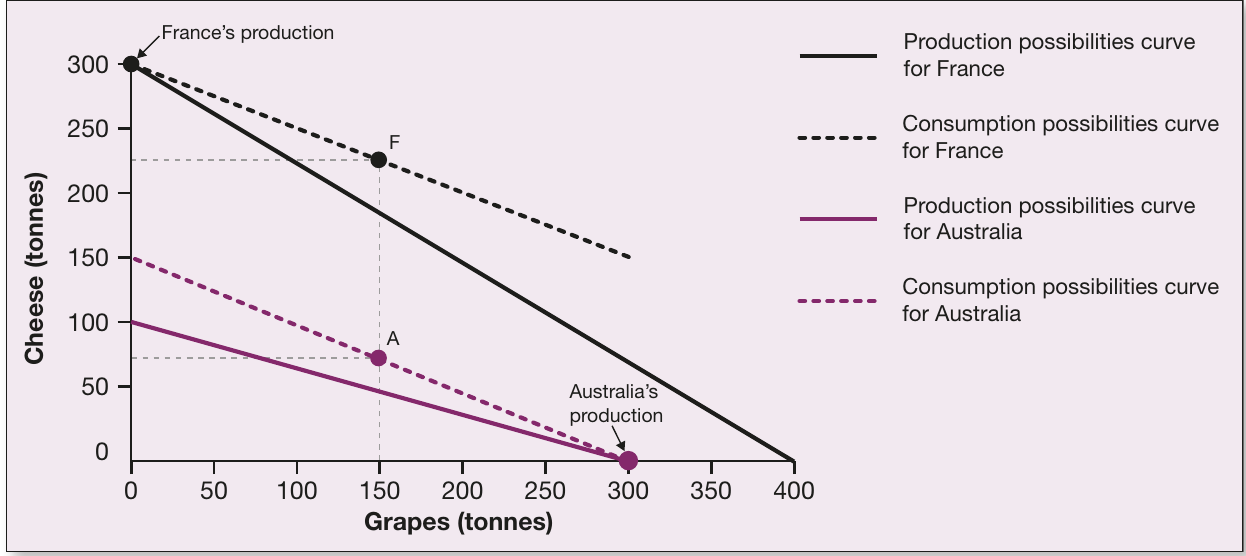
The crucial point illustrated in this diagram is that for each economy, the consumption possibilities curve lies above the production possibilities curve. This demonstrates that trade allows each economy to consume more than it could produce on its own.
The actual consumption bundle each country chooses depends on consumer preferences and demand patterns within each economy. In our example, suppose Australia sells 150 tonnes of grapes to purchase 75 tonnes of cheese. Australia would consume at point A: 150 tonnes of grapes and 75 tonnes of cheese. This represents 25 more tonnes of cheese than Australia could have produced independently.
France sells 75 tonnes of cheese and purchases 150 tonnes of grapes, consuming at point F: 150 tonnes of grapes and 225 tonnes of cheese. France also consumes more than it could have produced without trade.
Both countries benefit from specialization and trade because the global economy now produces and distributes goods more efficiently according to comparative advantage.
Terms of trade
The position of a country's consumption possibilities curve depends on its terms of trade. The terms of trade measure the price level of an economy's exports relative to the price of its imports. When the terms of trade improve, an economy can purchase more imports with a given quantity of exports. When the terms of trade deteriorate, the economy can purchase fewer imports with the same export volume.
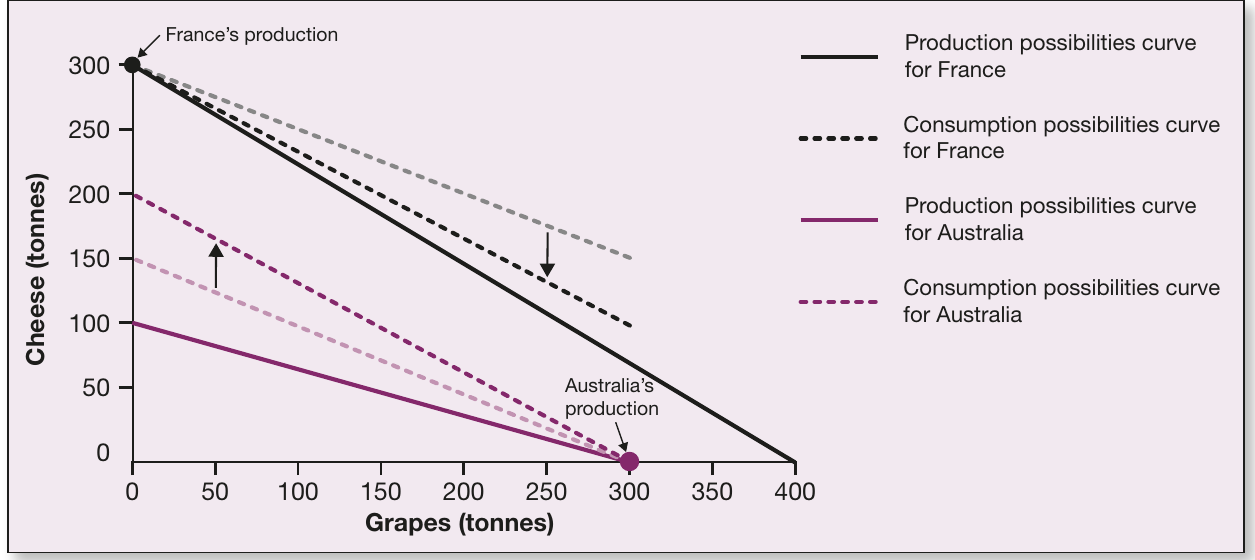
Changes in the terms of trade directly affect the consumption possibilities curve. Suppose Australia's terms of trade improve such that selling 150 tonnes of grapes now allows Australia to purchase 100 tonnes of cheese instead of 75 tonnes. Australia's consumption possibilities curve shifts upward. The improvement means that for every tonne of grapes Australia exports, it can now import a greater quantity of cheese than before.
However, since France exports cheese (which has fallen in relative price), France's terms of trade deteriorate. France's consumption possibilities curve shifts downward because each tonne of grapes France wishes to import must now be paid for with a larger quantity of cheese.
Important
Mutual Gains from Trade Persist
Importantly, even after this adverse movement in France's terms of trade, its consumption possibilities curve still lies above its production possibilities curve. France continues to gain from trade, albeit by a smaller amount than before. As long as gains from trade exist, both countries benefit from continuing to trade with each other.
Real-world limitations
While comparative advantage provides a powerful theoretical argument for free trade, the simplified model makes several assumptions that do not hold in the real world. These limitations help explain why protectionist policies persist despite the clear theoretical benefits of free trade.
The model assumes perfect mobility of labour and capital between industries within an economy. It assumes that workers and resources can seamlessly shift from one industry to another in response to changing consumer demands and price levels. Reality is far more complex.
Note
The Challenge of Labour Mobility
Consider what would happen if Australia decided to stop cheese production entirely and specialize fully in grapes. Dairy industry workers in Victoria could not simply relocate to South Australian vineyards overnight. Geographic distance creates barriers. Workers may lack the necessary skills for vineyard work. Many might face prolonged unemployment while searching for new opportunities. The human cost of such transitions is substantial and not captured in the simple model.
The model also ignores broader economic and social impacts. It does not account for how a shrinking grape industry might affect French culture and rural communities. It does not consider how a surge in grape imports might influence France's trade balance or exchange rate. These real-world complexities mean that while comparative advantage demonstrates significant theoretical benefits from free trade, policy makers must balance these gains against legitimate social, cultural, and economic adjustment costs.
Understanding both the power and limitations of comparative advantage theory helps explain why debates about trade policy remain so contentious in the global economy despite centuries of economic analysis supporting free trade.
Remember!
Summary
Key Points to Remember:
-
Absolute advantage means producing more output with the same resources, but has limited applicability to trade theory
-
Comparative advantage is based on opportunity cost—countries should specialize where they sacrifice less to produce a good, even without absolute advantage
-
Calculate opportunity cost using: opportunity cost of good X = quantity of good Y / quantity of good X
-
No country can have comparative advantage in everything—if relatively better at one good, must be relatively worse at another
-
Trade enables consumption beyond the production possibilities curve through specialization according to comparative advantage
-
The consumption possibilities curve shows what a country can consume with trade and lies outside the production possibilities curve
-
Terms of trade (ratio of export to import prices) determine how much a country gains from trade
-
Real-world factors like labour immobility, cultural impacts, and adjustment costs complicate the simple comparative advantage model, explaining persistence of protectionist policies