The Business Cycle (HSC SSCE Economics): Revision Notes
📚Revision Notes
The Business Cycle
What is the business cycle?
Economic growth does not follow a smooth, predictable path. Instead, market economies experience regular fluctuations in their level of economic activity. Economic activity refers to the total amount of goods and services produced within an economy during a specific time period.
The business cycle (sometimes called the economic cycle) describes these recurring patterns of expansion and contraction that characterise market economies like Australia. Rather than growing at a constant rate, economies move through alternating phases of strong growth and economic slowdown.
Note
Definition of the Business Cycle
The business cycle refers to fluctuations in the level of economic growth due to either domestic or international factors. These fluctuations create a pattern of expansion (growth) and contraction (slowdown) that repeats over time.
Understanding economic fluctuations
While economies generally experience an upward trend in output over the long term, they are subject to continuous fluctuations. A typical pattern involves a period of robust economic growth, followed by a slowdown where economic activity often declines. The economy may remain weak for some time before beginning to recover. It then gradually accelerates, reaching a peak before slowing down again and repeating the cycle.
Although no economy follows this theoretical model precisely, the cyclical pattern of growth and contraction repeatedly occurs in market economies. This creates significant challenges for individuals, businesses, and governments.
Note
The Cyclical Pattern
Think of the business cycle as waves in the ocean - there are periods of high activity (peaks) and low activity (troughs), with the economy constantly moving between these extremes. Understanding this pattern helps policymakers, businesses, and individuals prepare for and respond to economic changes.
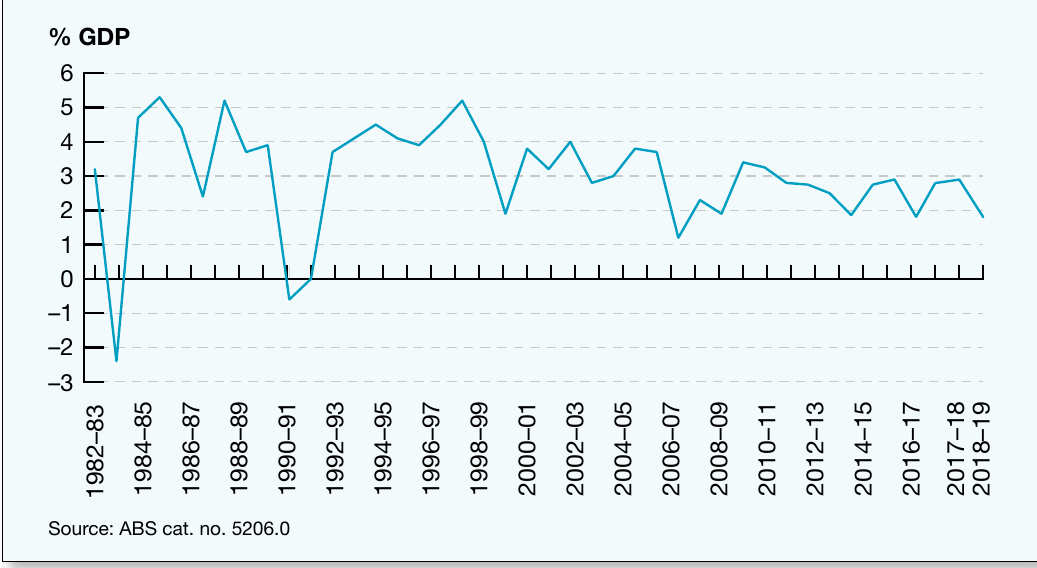
The graph demonstrates Australia's economic growth performance measured as percentage change in GDP (Gross Domestic Product) from 1982-83 to 2018-19. The data clearly shows the cyclical nature of economic activity, with periods of strong growth (reaching peaks of around 5-6% GDP growth in the 1980s) alternating with periods of slower growth or contraction. Notable features include the sharp negative growth around 1990-91 (Australia's last recession) and the relatively stable growth period from the mid-1990s onwards, though with continued fluctuations typically ranging between 2-4% GDP growth.
Stages of the business cycle
Recession
A recession represents the contractionary phase of the business cycle. It is formally defined as two consecutive quarters (six months) of negative economic growth, meaning GDP actually falls rather than grows.
Important
Formal Definition of Recession
Recession is the stage of the business cycle where there is decreasing economic activity, defined as two consecutive quarters (six months) of negative economic growth, that is, a fall in GDP.
Remember: "Two Quarters Down" = 2 consecutive quarters of negative growth
During recessions, several interconnected problems emerge. Businesses typically respond to declining demand by postponing investment plans, reducing production levels, and cutting their workforce requirements. This reduction in labour demand causes employment to fall and unemployment to rise.
The impact on consumers and households is severe. Families lose their regular income sources and must depend on savings and government social security payments to cover basic expenses. As unemployed individuals reduce their spending, this creates a ripple effect throughout the economy. Reduced consumption leads to further economic contraction, potentially causing more job losses in a downward spiral.
Example
The Recession Spiral: How One Problem Leads to Another
Step 1: Businesses face declining demand → They reduce production and lay off workers
Step 2: Unemployment rises → Families lose regular income sources
Step 3: Unemployed people reduce spending → This causes further decline in demand for goods and services
Step 4: Lower demand causes more business problems → Leading to more job losses and repeating the cycle
This demonstrates why recessions can be self-reinforcing and difficult to escape without intervention.
Memory aid: "FUEL Problems" - Firms cut back, Unemployment rises, Expenses exceed income, Living standards fall
Rising unemployment pushes more people below the poverty line. The consequences extend beyond mere financial hardship. Living standards decline, which can trigger increased health problems, disrupted educational opportunities, and rising social problems including crime and suicide rates. Collectively, these effects significantly reduce quality of life across society.
Boom
The boom phase (also called an upturn) represents the opposite scenario. During economic upturns, the economy experiences accelerated growth. This expansion is characterised by increased business investment and rising production of goods and services.
As businesses expand their operations, they require more workers, causing labour demand to increase and unemployment to fall. More people in employment means higher disposable income for consumers. This increased purchasing power often fuels further economic expansion as consumption levels rise, creating a positive reinforcing cycle.
Quality of life improves during boom periods as poverty levels decline. With more people earning regular incomes, there is less dependence on social security and savings. The broader improvements in employment and income create better conditions for health, education, and social wellbeing.
Note
The Boom Multiplier Effect
During boom periods, positive effects multiply throughout the economy:
- More jobs → Higher incomes → Increased spending → More business revenue → More jobs created
- This creates a self-reinforcing cycle of growth and prosperity
Memory aid: "RICE UP" - Rising Investment, Consumption, Employment, Upward income and Production
Impacts of the business cycle
The business cycle's different phases create dramatically different conditions for individuals, businesses, and society as a whole. Understanding these contrasting effects helps explain why governments prioritize economic stability.
Note
Comparing Recession and Boom Effects
The following table illustrates how the same economic indicators move in opposite directions during different phases of the business cycle:
| Recession | Boom |
|---|---|
| Falling production of goods and services | Increasing production of goods and services |
| Falling levels of consumption and investment | Rising levels of consumption and investment |
| Rising unemployment | Falling unemployment |
| Falling income levels | Rising income levels |
| Falling quality of life | Rising quality of life |
This comparison highlights why managing the business cycle is crucial for economic policy. The negative impacts of recession affect not just economic statistics but real people's lives and wellbeing.
Government intervention in the business cycle
Given the severe negative consequences of prolonged economic downturns, one of the primary aims of government economic policy is to moderate the business cycle. Governments attempt to "smooth out" the cycle by reducing the severity of both contractions and expansions.
During recessions, governments intervene to stimulate economic growth. They implement policies designed to restore the economy to positive growth and improve employment opportunities. In the longer term, governments also work to sustain economic growth for extended periods, thereby avoiding major economic downturns.
Note
The 2008 Global Financial Crisis Response
The 2008 Global Financial Crisis (GFC) sparked significant debate about appropriate government responses to severe economic downturns. Faced with the threat of an extremely deep recession, governments worldwide made substantial interventions in their economies.
These interventions, which involved unprecedented levels of government spending and support, were generally regarded as successful in preventing a much more severe recession than what actually occurred. This demonstrated the important role governments can play in managing severe economic downturns.
Australia's economic resilience
Australia's experience during and after the GFC demonstrates effective business cycle management. While many developed economies fell into recession, Australia avoided this outcome entirely. The graph shows that by 2019, Australia had achieved 28 consecutive years of economic growth, having last experienced a recession in 1991.
Important
Australia's Remarkable Achievement
By 2019, Australia had recorded 28 consecutive years of economic growth without a recession - one of the longest periods of sustained growth among developed economies. This achievement reflects:
- Sound government policy and intervention
- Favourable economic conditions
- Effective management of the business cycle
This demonstrates that while the business cycle cannot be eliminated entirely, effective policy interventions can significantly reduce the severity and frequency of recessions, maintaining economic stability over extended periods.
This remarkable achievement reflects both sound government policy and favourable economic conditions. The sustained growth period demonstrates that while the business cycle cannot be eliminated entirely, effective policy interventions can significantly reduce the severity and frequency of recessions, maintaining economic stability over extended periods.
Summary
Key Points to Remember:
- The business cycle describes recurring fluctuations in economic activity, with periods of strong growth alternating with slowdowns and contractions
- A recession is formally defined as two consecutive quarters of negative economic growth (falling GDP)
- Recessions cause falling production, rising unemployment, declining incomes, and reduced quality of life
- Boom periods bring increasing production, falling unemployment, rising incomes, and improved living standards
- Governments intervene to smooth the business cycle, stimulating growth during recessions and maintaining sustainable expansion
- Australia has achieved 28 consecutive years of economic growth since 1991, demonstrating successful business cycle management