The Economic Problem and the Role of Choices (HSC SSCE Economics): Revision Notes
📚Revision Notes
The Economic Problem and the Role of Choices
What is the economic problem?
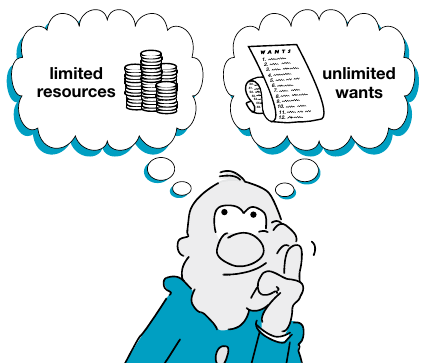
The economic problem is the fundamental challenge that every society must address. It arises because human wants are unlimited, but the resources available to satisfy those wants are limited (scarce). This creates a situation where choices must be made.
Important
The Core Economic Problem
The economic problem can be summarised in four key points:
- Wants are unlimited – people always desire more goods and services
- Resources are scarce – there are not enough resources to satisfy all wants
- Choices must be made – since all wants cannot be met, society must choose which ones to satisfy
- Preferences must be ranked – we satisfy our highest-priority wants first, leaving others unsatisfied
Note
Economics is fundamentally the study of how societies allocate scarce resources to satisfy unlimited and competing wants. Every economic decision involves choosing one option while rejecting an alternative.
Understanding wants
What are wants?
Wants are the material desires of individuals or the community. They are items that provide satisfaction or pleasure when consumed. Economists use the term utility to describe the satisfaction or pleasure gained from consuming goods and services.
Wants can be categorised as:
- Needs – basic necessities essential for survival (e.g. food, shelter)
- Non-essential wants – items that improve quality of life or provide pleasure (e.g. entertainment, luxury goods)
Individual wants
Individual wants are the personal desires of each person. These wants:
- Depend on personal preferences (though influenced by social trends)
- Vary based on ability to purchase goods and services (income level)
- Are more difficult to satisfy for those on lower incomes
Note
The Income-Wants Relationship
People with low incomes face the economic problem more severely. They can satisfy fewer wants and may struggle to afford even basic needs such as food, housing and clothing. The lower a person's income, the fewer wants they can satisfy.
Collective wants
Collective wants are desires of the entire community rather than individual people. These are typically provided by government:
- Local government – provides wants for neighbourhoods (parks, libraries, sporting facilities)
- State government – provides wants for the wider community (hospitals, schools, police force)
- Commonwealth (Federal) Government – satisfies wants of the entire nation (defence force)
Governments fund collective wants through taxation revenue collected from the community.
Characteristics of wants
Wants are unlimited
As soon as one want is satisfied, another emerges. Because resources (represented by income) are limited, we cannot satisfy all wants simultaneously. This forces us to make choices about which wants to satisfy first. Generally, the most pressing wants take priority.
Example
Real-World Application: Prioritising Wants
Satisfying the want for food comes before purchasing a new laptop. This demonstrates how we naturally rank our wants based on urgency and importance.
Wants are recurrent
Some wants must be satisfied repeatedly over time. When you satisfy your want for food today, you will need to satisfy this want again tomorrow. Other examples of recurrent wants include newspapers, clothing and petrol.
Wants are complementary
A complementary want naturally follows from satisfying another want. For instance, satisfying the want for a car creates additional wants for petrol and car accessories.
Wants change over time
As people age and circumstances change, their wants evolve. Key factors influencing these changes include:
- Age – a one-year-old wants a pram; an eleven-year-old wants a video game console; a twenty-one-year-old wants a car; a ninety-one-year-old may want a wheelchair
- Income – higher income allows people to afford more luxury goods and satisfy a wider range of wants
- Technology – new technology creates new wants (e.g. mobile phones were uncommon a generation ago but are now almost universal)
- Fashion – changing trends influence what people want to consume
The key economic issues
All economies, regardless of type, must answer four fundamental questions when allocating scarce resources.
1. What to produce?
Because resources are limited, no economy can satisfy all wants. Decisions must be made about which wants will be satisfied first and which will remain unsatisfied. This determines what goods and services the economy will produce.
Note
Priority Decisions
Every economy must rank wants by importance and urgency, choosing to produce goods and services that satisfy the most pressing needs of society while leaving other wants unmet.
2. How much to produce?
To allocate resources efficiently and maximise satisfaction of wants, economies must decide the quantity of each good or service to produce. Producing too much wastes resources, while producing too little leaves some wants unsatisfied.
3. How to produce?
After deciding what and how much to produce, economies must determine how to allocate resources in the production process. The goal is to find the most efficient production method that uses the least resources, allowing the greatest number of wants to be satisfied at any point in time.
4. How to distribute production?
Once goods and services are produced, economies must decide how to distribute them among the population. In modern economies, each person's share of total production depends on their income level. Those with higher incomes can afford more goods and services than those on lower incomes, receiving a larger share of total production.
Important
The Equity vs Efficiency Trade-off
Economies must decide whether they want a more equitable (even) or inequitable (uneven) distribution of production. This is challenging because there is often a conflict between equity and efficiency – more efficient systems may produce less equitable outcomes.
Opportunity cost
What is opportunity cost?
Whenever we satisfy one want, we give up the opportunity to satisfy an alternative want. The real cost of satisfying a want is not the money paid for it, but the next-best alternative that must be foregone.
Important
Definition: Opportunity Cost
Opportunity cost (also called economic cost or real cost) represents the alternative use of resources. It is the cost of satisfying one want over an alternative want.
Applications of opportunity cost
Opportunity cost applies to individuals, businesses and governments:
Individual consumers
An individual with limited income may choose between satisfying a desire for a car or an overseas holiday.
Example
Worked Example: Personal Opportunity Cost
If a consumer chooses to purchase a car, the opportunity cost is the overseas travel she must forgo. The real cost isn't just the dollar price of the car – it's the holiday experience she gives up.
Business firms
A business must make choices when allocating scarce resources. An entrepreneur who decides to produce computers gives up the opportunity to produce something else (such as electrical appliances) with those same resources.
Example
Worked Example: Business Opportunity Cost
An entrepreneur has resources to produce either:
- 1,000 computers, OR
- 2,000 electrical appliances
If she chooses to produce computers, the opportunity cost is the 2,000 electrical appliances she cannot produce with those same resources.
Government
Government has limited resources for satisfying community wants.
Example
Worked Example: Government Opportunity Cost
If the government allocates resources to constructing a new fleet of submarines worth $50 billion, the opportunity cost may be a new motorway or airport that cannot now be built. The true cost isn't measured in dollars alone – it's the alternative infrastructure projects that must be foregone.
Summary
Exam Guidance: Answering Questions About the Economic Problem
When answering questions about the economic problem and opportunity cost:
- Define key terms clearly – examiners look for precise definitions of concepts like scarcity, opportunity cost and wants
- Use relevant examples – illustrate concepts with appropriate examples for individuals, firms or government
- Explain the trade-offs – when discussing opportunity cost, clearly identify what is gained and what is sacrificed
- Link to resource allocation – connect your answer back to the fundamental issue of allocating scarce resources among unlimited wants
Summary
Key Points to Remember
- The economic problem arises because unlimited wants cannot be satisfied with limited (scarce) resources, forcing societies to make choices
- Wants are material desires that provide utility (satisfaction); they can be individual or collective, and are unlimited, recurrent, complementary and change over time
- The four key economic issues are: what to produce, how much to produce, how to produce, and how to distribute production
- Opportunity cost is the real cost of any choice – it represents the next-best alternative that must be foregone, not just the money price
- Income determines satisfaction – people on lower incomes can satisfy fewer wants and experience the economic problem more severely than those on higher incomes