The Demand for Labour (HSC SSCE Economics): Revision Notes
📚Revision Notes
The Demand for Labour
Introduction to labour demand
A labour market is where jobseekers interact with employers who need workers with specific skills for their production processes. Understanding how labour demand works is fundamental to analysing labour market outcomes.
Firms demand labour by offering wages, similar to how consumers demand products by offering prices. However, labour demand has a distinctive characteristic: it is a derived demand. This means firms don't demand labour for its own sake - they demand it because they need workers to produce goods and services that consumers want to buy. When consumer demand for products rises, firms must increase output to meet this demand, which requires hiring more workers. Labour is therefore demanded only because it enables firms to produce goods and services profitably.
Important
Labour demand is fundamentally different from consumer demand for products. It is a derived demand - meaning firms demand labour only because consumers demand the goods and services that labour produces. This relationship means changes in consumer preferences and spending patterns directly drive changes in labour demand across the economy.
Like other demand curves, the demand for labour is downward-sloping. As wages (the price of labour) fall, firms will employ more workers. Conversely, as wages rise, firms will employ fewer workers. The key question is: what factors determine how much labour a firm demands at any given wage level, and how does demand respond to changing economic conditions?
The output of the firm
Since labour demand is derived from consumer demand for products, the single most important influence on labour demand is the firm's level of output. When a firm experiences higher sales, it increases production and therefore demands more labour. Several factors influence output levels and consequently affect labour demand.
General economic conditions
Overall economic conditions strongly influence labour demand across the economy. During periods of strong economic growth, firms typically enjoy higher sales and need more employees. Conversely, economic downturns reduce sales and employment. The relationship between economic growth and unemployment is generally inverse - higher economic growth rates are associated with falling unemployment, while economic contractions lead to rising unemployment.
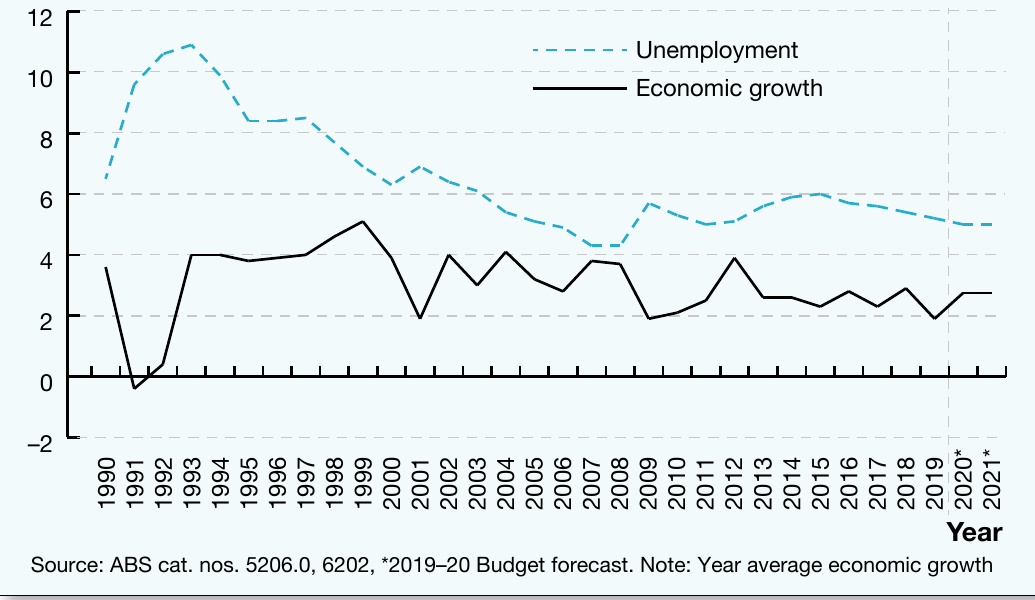
However, changes in economic activity don't immediately translate into employment changes. Time lags exist between firms observing demand changes and adjusting their workforce. Several reasons explain these delays:
Note
Understanding Time Lags in Employment
Employment levels don't respond instantly to economic changes. Two key factors create delays between economic shifts and workforce adjustments:
Labour hoarding: Firms don't always fully utilise their existing workers and tend to retain staff even during downturns. Training new employees is expensive and time-consuming, so firms prefer to avoid redundancies if they expect conditions to improve. When aggregate demand increases, firms can initially meet higher demand by using existing labour and capital more intensively - for example, by offering overtime at premium rates - rather than hiring new staff immediately.
Employment contracts: Employment agreements sometimes restrict firms' ability to make redundancies. Contracts may require employers to maintain employment for specified periods or pay penalties (such as three months' wages) for early termination. These provisions delay workforce adjustments until contracts expire.
Aggregate demand refers to total demand for goods and services within the economy. Its components are:
- Consumption (C)
- Investment (I)
- Government spending (G)
- Net eXports (X - M)
The 2008 example illustrates these time lags clearly. The Australian economic slowdown began in early 2008, but unemployment only started rising towards the end of that year as firms gradually responded to sustained deteriorating conditions.
Conditions in the firm's industry
Consumer preferences constantly evolve, creating shifts in demand patterns across different industries. These shifts directly affect labour demand distribution throughout the economy. Industries experiencing increased product demand will raise their labour demand, while those facing declining demand will reduce employment. Industry-specific factors such as barriers to entry, regulation levels, and competitive intensity also influence labour demand.
Example
Worked Example: The Mining Industry Boom (2003-2012)
The mining industry provides a striking demonstration of how industry-specific demand changes affect employment:
Starting point (2003): 87,500 workers employed in Australian mining
Peak (2012): 278,000 workers employed
Change: Employment increased more than threefold (217% increase)
Recent levels (2019): 245,500 workers (still significantly above 2003 levels)
This dramatic shift occurred due to enormous increases in global mineral demand, particularly from developing economies. The example shows how industry-specific factors can create substantial employment changes in particular sectors, even when economy-wide conditions remain relatively stable.
The demand for an individual firm's products
Within any industry, individual firms' labour demand depends on their market success. Factors determining this include:
- Product quality
- Company reputation and size
- Customer service standards
- Marketing effectiveness
Even when overall industry demand declines, successful firms can increase output and labour demand by capturing greater market share through superior performance in these areas.
The productivity of labour
Beyond determining overall output levels, firms must decide how to organize production. This involves choices about using labour more intensively versus relying more heavily on technology and automated processes. Labour productivity and overall labour costs, compared to other input costs like capital, determine how extensively firms use labour in production.
Labour productivity measures output per unit of labour per unit of time:
Generally, labour productivity depends on workforce quality factors including education levels, skills, health, and motivation. It also depends on how efficiently labour combines with other production factors. Workers can become more productive simply through capital investment (technology), even without improvements in their skills or work patterns. For instance, new machinery might enable each worker to produce more output per hour.
Important
Critical Distinction: Short-run vs Long-run Effects
Labour productivity increases have complex and different effects on labour demand depending on the time horizon. Understanding this distinction is essential for predicting how technological improvements and efficiency gains affect employment levels.
Short-run effects of productivity increases
The short-run impact depends critically on aggregate demand conditions:
When aggregate demand is rising: If aggregate demand increases faster than productivity, the higher consumer demand exceeds the additional production from existing workers. Firms must hire more workers to meet demand. Labour demand increases.
When aggregate demand is unchanged: Existing workers produce more goods and services, but consumer demand hasn't increased. Firms face excess capacity and don't need additional workers. Labour demand may decline as businesses can reduce their workforce while maintaining previous output levels.
When aggregate demand is falling: Labour demand falls even more sharply. Although workers produce more output, consumer demand for that output is declining. To maintain profits, firms must significantly reduce labour demand.
Long-run effects of productivity increases
Over longer periods, higher labour productivity makes labour more attractive relative to other production inputs. Firms may shift toward labour-intensive production methods because labour has become more productive than capital (or capital has become too expensive). Higher labour productivity should increase labour demand in the long term as firms substitute labour for other factors like capital.
Conversely, if labour productivity improvements lag behind technology and capital improvements, labour demand might decline. New technologies that improve capital efficiency create cheaper alternative production methods, potentially allowing firms to reduce labour demand while maintaining or increasing output levels.
The cost of other inputs
When firms decide how to combine different production inputs, they usually have various options for mixing labour and capital. If new technologies can reduce overall costs, firms will increase capital (technology) inputs and reduce labour use. Similarly, if labour costs fall, firms may shift back toward greater labour use relative to capital. Essentially, capital substitutes for labour in production.
Elasticity of labour demand
A firm's labour demand is more elastic (responds more sharply to wage changes) when:
- Substitution between labour and capital is easy
- Labour costs represent a high proportion of total costs
- The firm cannot easily pass increased labour costs to consumers through higher prices
Labour costs
When comparing labour costs to other input costs, remember that labour costs for employers extend beyond wages. Labour on-costs include additional employment expenses:
- Long service leave entitlements
- Sick leave
- Holiday pay
- Workers' compensation
- Payroll tax
- Fringe benefits tax
- Superannuation contributions
The labour demand curve reflects that businesses employ more workers when labour costs decline and fewer workers when costs increase.
Capital costs
Capital comprises manufactured products used to produce goods and services - "the produced means of production."
Note
Components of Capital Costs
The interest rate is the most important capital cost factor, representing the cost of borrowing funds to purchase capital equipment. If firms borrow internationally, exchange rate changes also affect these costs.
Interest rates also represent opportunity costs when firms use their own funds for capital purchases - those funds could earn returns elsewhere rather than being reinvested in business operations.
Other capital cost considerations include tax system structure and special tax allowances that might encourage business investment.
When capital becomes cheaper to use than labour, employers may substitute capital for labour, reducing labour demand, and vice versa.
International labour cost comparisons
Choosing between labour and capital isn't firms' only consideration. Firms might also shift operations overseas, especially where labour costs are lower. Establishing foreign operations or engaging overseas contractors for manufacturing or services has become increasingly easy. Therefore, Australian labour demand in certain industries is influenced by foreign labour costs and productivity.
Firms facing domestic cost pressures might close local operations and shift production overseas where labour is cheaper. Recent decades saw most Australian clothing manufacturers relocate manufacturing to lower-cost economies like China and Indonesia, where labour costs are substantially lower. More recently, some service industry firms in banking, insurance, and telecommunications have moved customer services such as call centres and back-office processing to countries like India and the Philippines.
Factors influencing labour demand
The table below summarizes the key factors affecting labour demand:
| Output factors | Input factors |
|---|---|
| General economic conditions | Productivity of labour versus other inputs |
| Conditions in the firm's industry | Cost of labour versus other inputs |
| Demand for an individual firm's product | Cost of labour versus cost of foreign labour |
Summary
Key Points to Remember:
-
Labour demand is derived demand - firms demand labour because they need to produce goods and services that consumers want, not for labour itself.
-
Economic growth and unemployment move inversely - stronger economic conditions increase labour demand and reduce unemployment, while economic downturns have the opposite effect. Time lags exist due to labour hoarding and employment contracts.
-
Labour productivity has complex effects - in the short run, productivity impacts depend on aggregate demand conditions; in the long run, higher productivity generally makes labour more attractive relative to capital.
-
Firms substitute between labour and capital based on relative costs. Labour demand elasticity increases when substitution is easy, labour costs form a large proportion of total costs, and cost increases cannot be passed to consumers.
-
Labour costs exceed wages alone - employers must consider on-costs including leave entitlements, compensation, taxes, and superannuation when making employment decisions.
-
Remember the components of aggregate demand: Consumption, Investment, Government spending, and net eXports (CIGX)