Price Elasticity of Supply (HSC SSCE Economics): Revision Notes
📚Revision Notes
Price Elasticity of Supply
What is price elasticity of supply?
Price elasticity of supply (PES) indicates how much the quantity supplied of a product changes in response to a change in its price. It measures the sensitivity or responsiveness of producers to price movements.
The price elasticity of supply is calculated as the percentage change in quantity supplied divided by the percentage change in price.
For most goods, when price rises, quantity supplied expands. This means PES is typically positive. However, the size of that response varies considerably between products.
Note
The value of PES tells us about producer responsiveness: higher PES values indicate that producers can easily adjust output in response to price changes, while lower values suggest output is more difficult to change.
Types of price elasticity of supply
Relatively elastic supply
When quantity supplied changes by a larger percentage than the price change, supply is described as relatively elastic. Producers can respond strongly to price signals by significantly increasing or decreasing output.
Example
Example: Elastic Supply Response
If price increases by 10% and quantity supplied rises by 20%, supply is relatively elastic.
In this case: PES = 20% ÷ 10% = 2
This PES value greater than 1 indicates elastic supply.
Relatively inelastic supply
When quantity supplied changes by a smaller percentage than the price change, supply is described as relatively inelastic. Producers find it difficult to adjust output in response to price changes.
Example
Example: Inelastic Supply Response
If price increases by 10% but quantity supplied only rises by 5%, supply is relatively inelastic.
In this case: PES = 5% ÷ 10% = 0.5
This PES value less than 1 indicates inelastic supply.
Unit elastic supply
When quantity supplied changes by exactly the same percentage as the price change, supply is unit elastic. The proportional response is equal (PES = 1).
Note
Understanding PES Values:
- PES > 1: Relatively elastic supply
- PES < 1: Relatively inelastic supply
- PES = 1: Unit elastic supply
- PES = 0: Perfectly inelastic supply
- PES = ∞: Perfectly elastic supply
Price elasticity and the slope of the supply curve
While the slope of a supply curve can give some indication of elasticity, it doesn't always provide a complete picture. However, we can identify two theoretical extremes that show the relationship between curve shape and elasticity.
Perfectly elastic supply
Perfectly elastic supply occurs when producers are willing to supply any quantity at one particular price, but nothing at all below that price. This is represented by a horizontal supply curve.
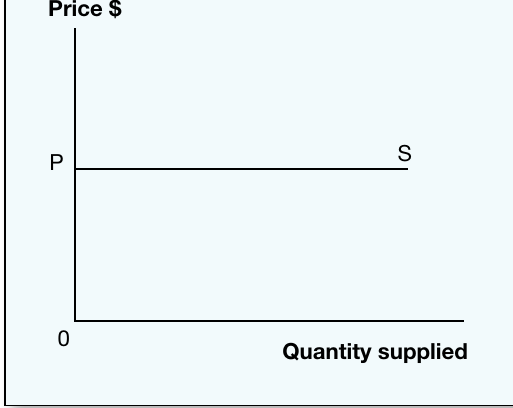
At price P, suppliers would theoretically supply an unlimited quantity. Below that price, quantity supplied falls to zero. In reality, this situation is highly unlikely to occur, as no firm can produce infinite output. However, it represents the theoretical extreme of maximum responsiveness.
Important
Remember the relationship: Horizontal curves represent perfectly elastic supply. Think "Horizontal = Highly responsive = Perfectly Elastic" to help remember this connection.
Perfectly inelastic supply
Perfectly inelastic supply occurs when producers supply a fixed quantity regardless of the price level. This is represented by a vertical supply curve.
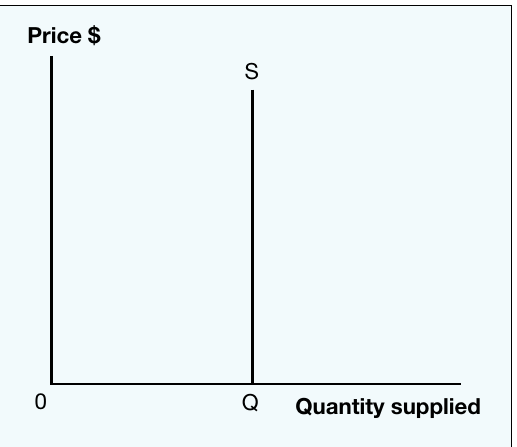
The quantity supplied remains fixed at Q, no matter how much price changes. A real-world example might be a unique piece of art. If only one original painting exists, the supply is fixed at one unit regardless of how high the price rises. Similarly, land in a specific location has perfectly inelastic supply in the short run.
Note
Real-world examples of near-perfectly inelastic supply:
- Original artworks by deceased artists
- Land in a specific location
- Concert seats in a particular venue (once built)
- Fresh produce immediately after harvest
Between the extremes
Most real-world supply curves fall somewhere between these two theoretical extremes. The actual elasticity depends on several factors, which we explore in the next section.
Factors affecting elasticity of supply
Several key factors determine how elastic or inelastic supply will be for a particular product.
Time lags after a price change
The amount of time producers have to respond to a price change is perhaps the most important determinant of elasticity. Generally, the longer the time period, the more elastic supply becomes.
Immediate period: In the very short run, immediately after a price change, supply is virtually perfectly inelastic. Producers cannot adjust any inputs quickly. They can only try to work existing staff and equipment harder, which has limited impact on output.
Short run: Over several weeks or months, producers can vary some inputs to the production process. They can hire additional workers, order more raw materials, or increase overtime. Supply becomes somewhat more responsive, though it remains relatively inelastic because major constraints (like factory size) remain fixed.
Long run: Given sufficient time (months or years), producers can adjust all inputs. They can build new factories, install additional machinery, and fully expand their productive capacity. This makes supply relatively elastic, as firms can substantially increase output in response to higher prices.
Example
Worked Example: Time and Supply Elasticity in Agriculture
Consider what happens when wheat prices rise:
Immediate period (within days):
- Farmers cannot change this year's harvest
- The wheat is already growing or harvested
- Supply is perfectly inelastic
- PES ≈ 0
Short run (several months):
- Farmers might work harder to minimize crop losses
- They could harvest more efficiently
- Supply becomes slightly more responsive
- PES might increase to 0.3-0.5
Long run (next growing season and beyond):
- Farmers can plant more wheat in the next season
- They can potentially purchase or lease additional land
- They might invest in better equipment
- Supply becomes much more elastic
- PES might increase to 1.5-2.0 or higher
Important
Key principle: Supply elasticity increases with time. As the time horizon extends from immediate to short run to long run, producers gain more flexibility to adjust their output, making supply progressively more elastic.
The ability to hold and store stock
The ease with which producers can hold inventory affects how readily they can respond to price changes.
Inventory refers to the total stock of finished goods and services held by a firm, which is intended for sale to consumers.
Products that are easy to store can be withheld from the market when prices fall and released when prices rise. This makes supply more elastic. For example:
- Durable goods like furniture, appliances, or tinned food can be stored easily, making their supply relatively elastic
- Non-perishable manufactured goods can be warehoused for extended periods
Conversely, goods that are difficult or impossible to store have more inelastic supply:
- Fresh fruit, vegetables, and dairy products perish quickly
- Services like haircuts or restaurant meals cannot be stored at all
- Live entertainment cannot be inventoried
Note
Producers of perishable or non-storable products must sell at whatever price the market offers, reducing their ability to respond to price changes. This is why agricultural markets for fresh produce often experience significant price volatility.
Excess capacity
Excess capacity exists when a firm is not using its existing resources to full capacity. This concept directly impacts supply elasticity.
When firms have excess capacity (spare resources), supply tends to be elastic. They can quickly increase output by utilizing unused machinery, hiring idle workers, or increasing shifts. For example, a factory running at 50% capacity could potentially double output rapidly in response to a price increase.
When firms are operating at or near full capacity, supply becomes inelastic. There is no spare productive capacity to tap into, so output cannot increase substantially even if prices rise. The firm would need to invest in new capacity (which takes time) to increase production further.
Note
Practical application: This factor helps explain why supply elasticity varies across different firms and industries. Capital-intensive industries with high fixed costs often maintain some excess capacity and may have relatively elastic supply over certain output ranges.
Exam guidance
Important
Exam Success Tips for Price Elasticity of Supply
When analyzing PES in exam questions:
- Explain the numerical value and what it means for producer behavior
- Apply the concept to real-world scenarios by identifying which factors (time, storage, capacity) are most relevant
- Evaluate by considering both short-run and long-run perspectives, as elasticity changes over time
- Diagram skills: Be prepared to sketch supply curves showing different elasticities and explain their slopes
- Use terminology precisely: Distinguish clearly between elastic, inelastic, perfectly elastic, and perfectly inelastic supply
Command words to watch:
- Outline: Give main features or describe key factors
- Explain: Show cause and effect relationships
- Analyse: Break down the concept and show interconnections
- Evaluate: Make judgments supported by evidence, considering different viewpoints
Summary
Summary
Key Points to Remember:
-
Price elasticity of supply (PES) measures how responsive quantity supplied is to price changes, calculated as percentage change in quantity supplied divided by percentage change in price
-
Elastic supply means quantity supplied changes by a larger percentage than price; inelastic supply means quantity supplied changes by a smaller percentage than price
-
Perfectly elastic supply (horizontal curve) is where infinite quantity is supplied at one price; perfectly inelastic supply (vertical curve) is where quantity stays fixed regardless of price
-
Three key factors affect elasticity:
- Time available to respond (longer time = more elastic)
- Ability to store stock (easier storage = more elastic)
- Excess capacity (more spare capacity = more elastic)
-
Supply typically becomes more elastic over time as producers can adjust all inputs in the long run versus being constrained in the short run