Categories of Development in the Global Economy (HSC SSCE Economics): Revision Notes
📚Revision Notes
Categories of Development in the Global Economy
Introduction to economic classifications
Economists group nations together based on their development stage, as countries at similar levels face comparable economic challenges. When examining global living standards and development patterns, we use categories such as high-income, middle-income, and lower-income economies. More specifically, economists classify countries as advanced, developing, or emerging economies.
These classifications help identify common issues and policy challenges that nations face depending on where they stand in their economic development journey.
Advanced economies
Advanced economies are nations with strong levels of economic development, extensive trade and financial relationships with each other, and liberal-democratic political and economic institutions. The International Monetary Fund (IMF) identifies 41 countries as advanced economies, which make up the majority of high-income nations globally.
Note
Defining Advanced Economies
Advanced economies are characterized by:
- GNI per capita (PPP) exceeding $13,205
- Well-developed service industries and manufacturing sectors
- Slower economic growth in recent decades compared to emerging economies
- Strong institutional frameworks and rule of law
- Most members of the Organisation for Economic Co-operation and Development (OECD)
Geographic distribution: Most advanced economies are located in North America and Western Europe, with a smaller number in the Asia-Pacific region (including Australia, New Zealand, and Singapore) and some in Latin America and the Caribbean.
Examples: Singapore, Portugal, Czech Republic, Australia, United States, Germany
Developing economies
Developing economies typically show low average incomes, with populations experiencing inadequate access to education and healthcare. These nations have experienced only limited industrialisation, resulting in significant economic and social challenges.
Important
A defining feature of developing countries is the large proportion of people living in absolute poverty, defined as surviving on less than $2.15 per day (in 2017 US dollars PPP). This extreme poverty affects hundreds of millions globally, though rates vary significantly by region.
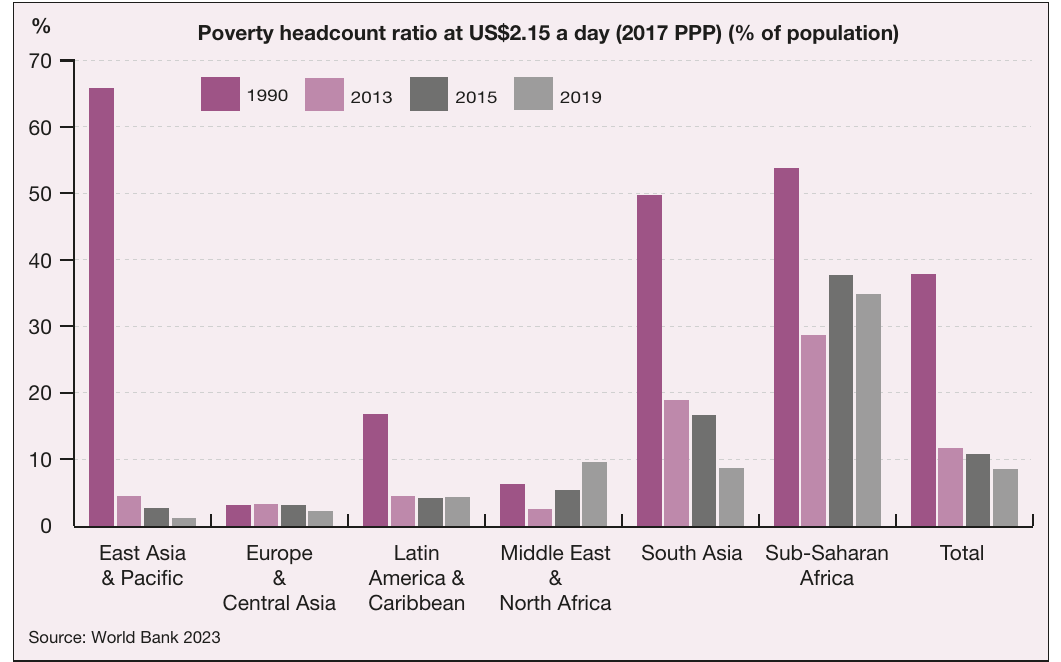
The chart above demonstrates substantial progress in poverty reduction across most regions between 1990 and 2019. East Asia and South Asia have achieved dramatic improvements, while Sub-Saharan Africa continues to face persistent poverty challenges.
Common features of developing economies
While developing nations vary considerably, many share several characteristics:
Income and inequality:
- Low per capita income levels
- High levels of income inequality within their societies
- Around half the population often living in absolute poverty
Economic structure:
- Heavy reliance on agricultural production for income, employment and export earnings
- Low levels of labour productivity
- Limited industrialisation and manufacturing capacity
- Minimal technological innovation
- Underdeveloped infrastructure (transport, energy, communications)
External dependencies:
- Significant reliance on foreign aid and development assistance
- Dependence on external funding for major projects
Institutional weaknesses:
- Weak political and economic institutions
- High prevalence of corruption
- Poor governance and regulatory frameworks
Note
Developing countries are often subdivided into low-income and middle-income categories based on their GNI per capita levels.
Least developed countries
The United Nations Conference on Trade and Development (UNCTAD) has identified a subgroup of 46 least developed countries (LDCs), which face the most severe development challenges globally.
Important
Criteria for Least Developed Countries (LDCs)
LDCs are defined by three key criteria:
- GNI per capita below $1,081 per year (the lowest in the world)
- Weak human assets based on health and education indicators
- High economic vulnerability based on economic structure, size and exposure to economic shocks
Regional concentration: Thirty-three of the 46 LDCs are located in Sub-Saharan Africa. This concentration has led economists to describe the "Africanisation of poverty", highlighting how extreme poverty is increasingly concentrated in the African continent. As the data shows, while rapid poverty reduction has occurred in East Asia, South Asia, Latin America, and other regions, Africa's progress has been slower.
Examples: Madagascar, Yemen, Myanmar, Chad, Niger, Burkina Faso
Emerging economies
Emerging economies are nations in the process of industrialisation or modernisation that are experiencing sustained high levels of economic growth. This category includes a diverse range of countries that don't fit neatly into either the advanced or traditional developing economy classifications.
Note
Key Characteristics of Emerging Economies
- Rapid economic growth rates, typically 5-10% annually
- Favourable long-term economic prospects
- Undergoing significant industrialisation
- Developing substantial manufacturing sectors
- Income levels vary widely but are generally rising quickly
Historical classifications: The emerging economy category encompasses several previously distinct groups:
- Newly industrialised economies: Countries like Malaysia and the Philippines that successfully transitioned from agriculture-based to manufacturing-based economies
- Transition economies: Former socialist countries making the shift to market-based economies, such as China, Hungary, and Vietnam
- Developing economies with improved prospects: Nations like India and Indonesia that have achieved sustained growth and structural transformation
Examples: China, Brazil, Indonesia, India, Mexico, Turkey
Comparing the three main categories
The table below summarizes the key differences between advanced, developing, and emerging economies:
| Type of economy | Income levels | Economic growth | Structure of economy | Examples |
|---|---|---|---|---|
| Advanced | High income with GNI per capita above $13,205 | Slower growth in recent decades | Large service industries and advanced manufacturing | Singapore, Portugal, Czech Republic |
| Developing | Low income with around half of population in absolute poverty | Moderate growth rates but population growth also high | Heavily reliant on agriculture and (in extreme cases) foreign aid | Madagascar, Yemen, Myanmar |
| Emerging | Income levels vary, but what these economies share is fast growth in income levels | Strongest growth rates globally (5-10%) with favourable prospects | Industrialising, usually with substantial manufacturing sectors | China, Brazil, Indonesia |
Limitations of classification systems
While classification systems provide a useful framework for understanding global economic patterns, economists recognize several important limitations:
Important
Oversimplification: Classifications are necessarily broad and can group quite different economies together. For example, Brazil and Indonesia are both classified as emerging economies, yet they have significantly different living standards, economic structures, and development challenges.
Borderline cases: Some economies don't fit neatly into any single category. Bulgaria, for instance, has progressed beyond typical developing economy status but hasn't yet achieved the characteristics of an advanced economy, nor does it show the rapid growth typical of emerging economies.
Dynamic nature: Economic classifications can change over time as countries develop. What was once an emerging economy may become advanced (as South Korea did), or a developing country may transition to emerging status.
Internal variation: These classifications apply to entire countries but may mask significant internal regional variations. Large countries like China or India have regions at vastly different development levels.
Despite these limitations, classifying economies remains valuable for understanding the fundamental reasons behind economic inequalities between nations and for developing appropriate policy responses.
Summary
Key Points to Remember:
- Three main categories: Advanced, developing, and emerging economies represent different stages of economic development
- Income thresholds matter: Advanced economies have GNI per capita above $13,205; absolute poverty is defined as less than $2.15 per day; LDCs have GNI below $1,081 per year
- Structural differences: Advanced economies focus on services and manufacturing; developing economies rely on agriculture; emerging economies are rapidly industrialising
- Regional patterns: Poverty has decreased dramatically in Asia but remains concentrated in Sub-Saharan Africa (33 of 46 LDCs)
- Growth rates vary: Emerging economies show the fastest growth (5-10%), while advanced economies have slower recent growth
- Classifications have limits: They are broad generalizations that may group dissimilar economies together and don't capture all nuances of development