Differences in Economic Development (HSC SSCE Economics): Revision Notes
📚Revision Notes
Differences in Economic Development
Economic development is a much broader concept than simply measuring economic growth through GDP or GNI figures. While nearly all nations have experienced some level of economic growth in recent decades, this does not tell us the full story about living standards or quality of life. Understanding the differences in economic development helps us see beyond income levels to assess true wellbeing across the global economy.
What is economic development?
Economic development is a broad measure of welfare in a nation. It includes indicators such as health standards, education levels, environmental quality and income distribution, as well as material living standards measured by income.
The key difference between economic growth and economic development is this:
- Economic growth measures the increase in GDP or GNI - essentially how much extra money an economy produces
- Economic development measures improvements in wellbeing and welfare - how people's lives are actually improving
Higher incomes certainly play a crucial role in improving wellbeing, particularly for those living in poverty. However, money alone does not capture the full picture. A nation could have rising GDP while most citizens lack access to healthcare, education or clean water. This is why economists look at development indicators alongside growth figures.
Note
The relationship between income and wellbeing is complex. While higher incomes are essential for development, particularly in lifting people out of poverty, they must be accompanied by effective policies and equitable distribution to translate into genuine improvements in quality of life.
Important
Exam tip: When asked to evaluate economic progress, always consider both growth (GDP/GNI) and development (HDI, health, education). The best answers will explain the relationship between them - growth is necessary but not sufficient for development.
Global inequality in wealth and income
While income gaps between richer and poorer countries appear to be lessening, this reduction is occurring very slowly. More concerning is the highly unequal distribution of global wealth.
Wealth is an important safety net when people lose income. It can be used to fund education or create new income opportunities. However, wealth is distributed even more unevenly than income throughout the global economy.
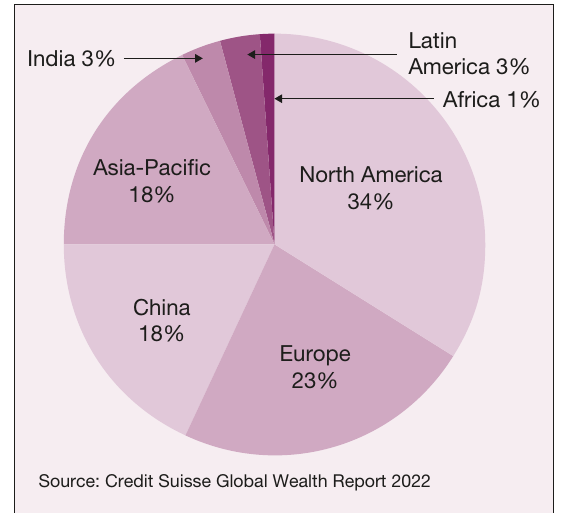
According to Credit Suisse's 2022 Global Wealth Report, the concentration of wealth is extreme:
- The top 1% of people owned 46% of all global wealth
- The bottom 50% owned less than 1% of global wealth
- Most wealth is concentrated in households across Europe, North America and Asia-Pacific countries (Japan, China, Australia)
- People in Latin America, India and Africa hold only a small percentage of global wealth
Note
During the COVID-19 pandemic, this inequality worsened. While aggregate household wealth grew, the richest 1% gained double what the other 99% combined gained. The number of billionaires worldwide has doubled in the past decade, with half residing in countries without inheritance taxes. This allows wealth concentration to persist across generations.
Important
Key point for analysis: When discussing global inequality, distinguish between income inequality and wealth inequality. Wealth is distributed more unevenly and is harder to redistribute.
The Human Development Index
The Human Development Index (HDI) was devised by the United Nations Development Programme (UNDP) to provide a more comprehensive measure of economic development than GNI alone.
Components of the HDI
The HDI takes into account three key dimensions of human development:
1. Life expectancy at birth
This indicates health and nutrition standards in a country. High levels of longevity are critical for both economic and social wellbeing. Countries with better healthcare systems, sanitation and nutrition will have higher life expectancy.
Note
Life expectancy serves as a powerful proxy for overall health system quality and public health conditions. It reflects access to healthcare, prevalence of disease, nutrition levels, and environmental factors like clean water and sanitation.
2. Educational attainment
Education is vital for developing workforce skills and future development potential. The HDI measures:
- Average years of schooling for adults aged 25 and over
- Expected years of total school attendance for school-age children
This captures both current education levels and investment in future human capital.
3. Gross National Income per capita (PPP basis)
This measures the sum of gross value added by all resident producers, plus income from foreign sources, adjusted for purchasing power parity. It indicates material living standards and access to goods and services.
Note
Using PPP (Purchasing Power Parity) adjustment is crucial because it accounts for differences in price levels between countries. This allows for more meaningful comparisons of living standards - $10,000 might buy much more in one country than another.
How the HDI works
The HDI is calculated as a score between 0 and 1:
- 0 represents no human development
- 1 represents maximum human development
Countries are then categorised into four groups:
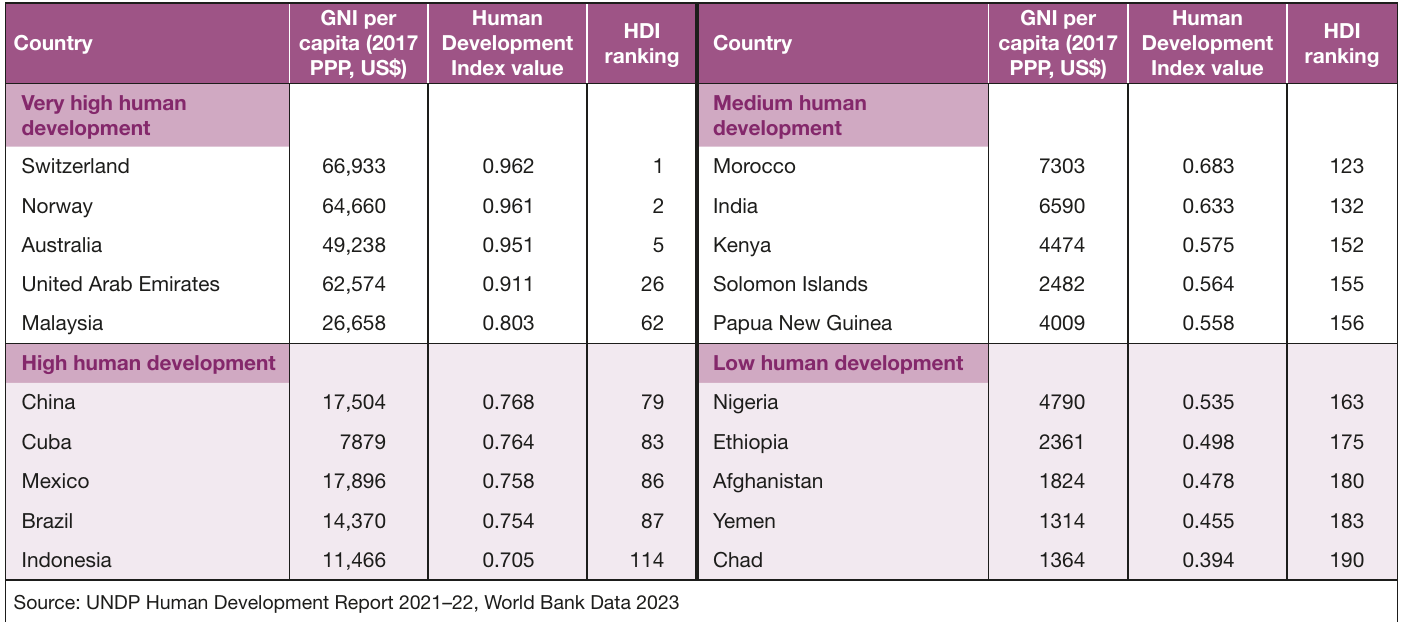
- Very high human development (e.g. Switzerland 0.962, Australia 0.951)
- High human development (e.g. China 0.768, Brazil 0.754)
- Medium human development (e.g. India 0.633, Morocco 0.683)
- Low human development (e.g. Chad 0.394, Yemen 0.455)
The 2021-22 Human Development Report showed Switzerland ranked first globally with an HDI of 0.962, while South Sudan ranked lowest at 0.385. Australia ranked fifth with an HDI of 0.951.
Important
Notably, in both 2020 and 2021, the global HDI declined for the first time since records began. These declines reflected reduced life expectancy due to COVID-19, erasing five years of development gains.
Comparing HDI and GNI: what the data reveals
Comparing HDI and GNI statistics reveals important differences between economic growth and development. The data highlights why we need broader welfare measures than GDP figures alone.
Key insights from the comparison
Economic growth remains crucial for development
Countries like Norway demonstrate very high rates of both per capita income and human development. This confirms that economic growth is essential for achieving high development levels - you cannot fund quality healthcare and education without resources.
Income does not automatically translate to development
Some countries show similar HDI levels despite very different income levels. This suggests income benefits are not well distributed due to high inequality.
Example
Country Comparison: Income vs Development
The United Arab Emirates and Australia demonstrate how income alone doesn't guarantee development:
- United Arab Emirates has GNI per capita of US$62,574 but ranks 26th in HDI
- Australia has lower GNI per capita of US$49,238 but ranks 5th in HDI
The UAE's higher income has not translated into proportionally better health and education outcomes, likely due to inequality in how that income is distributed.
Government policy matters
Example
Government Policy Impact: Cuba vs Morocco
Cuba and Morocco both have income levels around US$8,000 per capita, yet:
- Cuba has HDI rank of 83
- Morocco has HDI rank of 123
This 40-place difference shows that how governments spend resources and prioritise health and education significantly affects development outcomes, regardless of income levels.
Important
Exam technique: When evaluating development, always analyse both HDI and GNI data. Look for discrepancies - they reveal important information about inequality and government priorities. In exam questions asking you to "assess" or "evaluate" development, discussing these gaps demonstrates higher-order thinking.
Sustainable Development Goals
In September 2015, world leaders agreed to 17 Sustainable Development Goals (SDGs) - ambitious targets to be achieved by 2030. These goals promote a renewed focus on sustainability alongside traditional development concerns.
The SDGs address interconnected challenges including:
- Ending poverty and hunger (Goals 1-2)
- Ensuring health, education and gender equality (Goals 3-5)
- Providing clean water, energy and infrastructure (Goals 6-7, 9)
- Promoting sustainable economic growth and decent work (Goal 8)
- Reducing inequality (Goal 10)
- Ensuring sustainable cities, consumption and production (Goals 11-12)
- Combating climate change and protecting ecosystems (Goals 13-15)
- Building peaceful, inclusive societies (Goal 16)
- Strengthening global partnerships (Goal 17)
The SDGs build on the earlier Millennium Development Goals (MDGs) which ran from 1990 to 2015. While the MDGs achieved some successes - particularly reducing extreme poverty in Asia, especially China - many targets were not met. Progress was uneven, with stronger results in some regions and weaker results in Sub-Saharan Africa.
Progress towards the SDGs
At the halfway point to 2030, the UN Independent Group of Scientists reported that the world is not on track to meet the SDGs. Several factors have worked against progress:
COVID-19 impacts:
- An additional 80 million people pushed into extreme poverty
- 100 million children fell below minimum reading proficiency levels
- Life expectancy declined globally
Violent conflicts:
- The greatest number of conflicts since 1945
- Food crises and refugee crises in affected regions
Economic challenges:
- Rising interest rates reduced fiscal capacity of developing nations
- Highly indebted countries have less to spend on programmes addressing the SDGs
Important
Case study application: When answering questions about global development challenges, the SDGs provide an excellent framework. You can analyse specific goals (like reducing inequality or ensuring quality education) and evaluate progress using real-world evidence.
Summary
Key Points to Remember:
-
Economic development is broader than growth - it includes health, education and environmental quality, not just income levels
-
HDI measures three dimensions - life expectancy, educational attainment and GNI per capita (remember: Health, Education, Living standards)
-
Wealth is distributed more unevenly than income - the top 1% owns 46% of global wealth while the bottom 50% owns less than 1%
-
HDI and GNI comparisons reveal inequality - countries with similar income can have very different development levels depending on how income is distributed and government priorities
-
Economic growth is necessary but not sufficient - high development requires both adequate income AND effective policies to improve health and education